





How to park right
The easy way to avoid parking tickets

Parking tickets are hideously expensive. They can take months to reverse, so to avoid them, PARK RIGHT. It's that simple.
The five facts everyone should know
Before we get to the nitty-gritty, if you only take in five things about parking, remember these:
There's no standard 'single yellow' parking restriction
You can sometimes park on a single red or yellow line, but many assume there are standardised times – that's a mistake. Restrictions for parking on single lines will usually be shown on accompanying road signs - make sure you scope the area and check before you park. Generally speaking, you'll be barred during peak daytime hours but are usually OK at some point during evenings and weekends.
When it comes to double yellows you simply can't park, though you can sometimes stop to load or unload. There are also some exceptions for Blue Badge (disabled) holders. With double reds, you can't even stop, unless you are a Blue Badge holder and there are designated parking bays for you. See the full red lines and yellow lines guides below
Watch your wheels
Make sure your motor is completely within any defined spot, such as a residents' or pay-and-display bay. If just one wheel is outside, you could get a ticket.
Especially in London, unless signs specifically indicate it, don't park on the pavement and keep your car as close to the kerb as possible. If you park more than 50 centimetres from the kerb (unless within a bay), you could get a ticket. This also means double parking is prohibited unless you're loading or unloading for no more than 20 minutes.
Proudly display your permit or ticket
If you have a special permit (such as a residents' or disabled permit), a warden must be able to see and clearly read it, otherwise you'll probably get a ticket. The same goes for any voucher or pay-and-display ticket you've bought. While this sounds obvious, permits can fall off after a few months' wear so make sure they are securely fastened. Plus, if you simply load one parking ticket on top of the next on the dashboard so there's a whole pile, making the current one difficult to distinguish, that can get you a fine.
Also, if you have a residents' or other permit, note the renewal date. If you miss it, and you park outside your home, it's likely you'll get a ticket.
Different councils have different bank holiday rules
Many people wrongly assume you can park where you want on a bank holiday. Some councils will allow you to park in a residents' bay or on a yellow line, but others won't. Sadly, there's no hard and fast rule so if you're unsure, check the council website for the area you wish to park in or the message on the parking meter or ticket machine. If unsure, don't do it. See the bank holiday restrictions section.
Beware EVERYTHING in private car parks
Most of this guide is about parking on public roads, but the rules change on private land or in private-run car parks – in supermarkets, hospitals, housing estates or elsewhere. Here, you can sometimes enter the land of the cowboys, where you can be asked to pay huge amounts without reason, or for just minor 'offences'. Always check signage - it may be hidden - and be ultra-cautious.
If you get an unfair ticket, as is common, DON'T automatically pay it. The firm has no right to fine you. All they're actually doing is invoicing you – though it'll be dressed up like a fine. See the Fight Private Parking Tickets guide for full info.
Related parking guides:
Parking Ticket Appeals | Fight Unfair Private Parking Tickets | Cheap Airport Parking | Rent Your Parking Space
Where can I park?
The first rule is to use your loaf. Don't do anything stupid such as parking on a zig-zag, bus stop or taxi rank, or blocking traffic or entrances, otherwise you can hardly quibble if you get slapped with a ticket.
But even the law-abiding majority can find that parking rules are full of jargon and difficult to understand, so we've answered your key questions below:
Important note before you begin
Parking rules across the country are confusing. On official sites like Gov.uk or Transport for London, the relevant info can be hard to find. We’ve worked through as much original source material as we can, but rules vary around the country, so it's important you always double-check your local rules before acting if you’re not sure, and see this only as a starting point.
Can I park on a single or double yellow line?
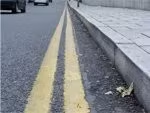
Sadly, it's impossible to give a universal definition of when yellow line restrictions apply as they change from street to street.
Parking chiefs say the variations are because some streets are more busy than others and some have more demand for parking than others.
Double yellow lines
What they mean: You cannot park on one at any time.
Any exceptions? Only if there are signs stating explicitly that you're permitted to park during certain times, or stop temporarily when loading or unloading goods (see below).
Single yellow lines
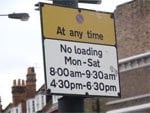
What they mean: You cannot park on one during certain controlled times. Those times will be signposted (as in pic, below) but they will change from street to street.
If the signs do not indicate a day of the week, the restrictions apply at the same time every day, including bank holidays. Even when they indicate a day, they also apply on bank holidays, unless otherwise stated.
Any exceptions? Sometimes, there will be signs saying you are permitted to stop temporarily when loading or unloading goods (see below).
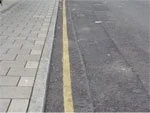
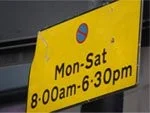
What if I can't see a sign? In some cases, the signs won’t be anywhere near the yellow lines they apply to, which makes life particularly difficult for motorists.
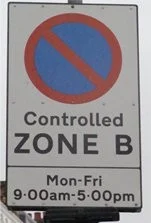
In such cases, you'll need to read the restrictions which are put up at the entrance to the parking zone (see pic, above) you are in.
But you could have passed that five minutes previously, and even then, you probably weren’t looking for it. So you may not know where the zone begins.
One fallback is to use the local residents' permit restricted times or paid-for parking restricted times (which should be signposted close by) as an indication to know when you can and can't park on a single yellow line – though this isn't fool-proof.
When can you load or unload on yellows?
The exceptions to yellow line restrictions come when you're loading and unloading heavy or bulky goods (that cannot reasonably be carried from a legal parking spot), or dropping off or picking up passengers.
Unless explicitly stated, or if there are no markings on the kerb or pavement, you can usually load and unload for as long as necessary, as long as its continuous, and pick up and drop off passengers as long as you're not blocking any roads, junctions or traffic.
What if a warden's around? However, if a traffic warden spots your car, and you are not clearly loading or unloading for five minutes (or even less in some cases), you could get a ticket - so it's worth constantly checking. If you get a ticket when loading, then see the Parking ticket appeals guide.
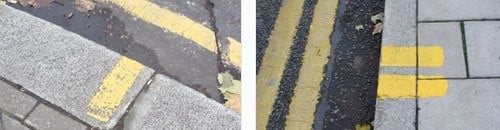
Watch for the blips: If there are any small yellow lines at a right-angle to the kerb, known as 'blips', the rules vary. If there are two sets of blips it means you can't load at any time.
If there are single blips, there should be signs indicating when loading is allowed.
Can I park on a red line?
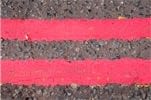
On some urban main roads in London, Birmingham and Edinburgh you will also see red lines, often referred to as 'red routes'.
Here, the restrictions are greater than on yellow lines.
Double red lines
You cannot park, stop to load or unload or drop off/pick up passengers on a double red line.
What about on bank holidays? Red route restrictions are usually enforced on public holidays.
Any exceptions? If you have a Blue Badge and are dropping off or picking up a disabled passenger, you can usually stop briefly.
Single red lines
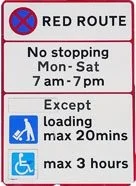
You cannot park, stop to load or unload or drop off/pick up passengers on a single red line during designated periods as determined by nearby signs (usually 7am-7pm). At other times, you can park on a single red line.
Any exceptions? If you have a Blue Badge and are dropping off or picking up a passenger, you can stop briefly.
Red route bays
There will also be boxes marked out with a broken red line within single or double red routes that you can use to stop in to load or unload at designated times. Again, check exactly what the restrictions are on nearby signs as they will vary.
If the box is white it means you can park, but only during the specified times.
Some will only allow stopping for short periods (anything from 10 minutes to two hours) and you won’t be able to simply drive off and come back straight away as there may be a specific period in which you are not allowed to return after leaving.
Red route clearways
These are usually on dual carriageways, where stopping is only allowed in marked lay-bys.
On these roads there are signs but no red lines except at some roundabouts and junctions.
Residents' parking bay rules
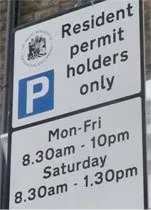
These are designed, as the name would suggest, to ensure local residents have a spot to park near their home.
However, they are free to use outside restricted hours (usually during evenings and/or at weekends).
If you don't have a permit
You can only park in a bay outside restricted hours, which will be signposted (see example pic, above right). Make sure your car is completely within any bay to avoid a ticket.
What about on bank holidays? In some areas, bank holidays are treated as a normal working day in which case restrictions apply as usual. In others, they are treated as a Sunday, and in others you are completely free to park.
You'll need to check the relevant council’s rules via its website. See Gov.uk to find local authority pages.
If you have a permit
You can park in a bay at any time unless the bay is suspended (see below). Also watch out for metered or pay-and-display parking mixed among residents' bays as you may not be able to park for free in them. Read the notices on the overhead signs, meters or pay machines.
Keep your permit visible. Even if you have a permit, it is also your responsibility to display it clearly. So make sure it's upright and the holder is sticky enough to keep it up. Even if you have legitimately bought a permit but fail to clearly display it, you may lose an appeal against a ticket if you get one.
Residents' bay parking suspensions
It's not all plain sailing for residents. They also need to beware the curse of the dreaded suspended bay. A council can shut off any parking spot for an indefinite period to allow roadworks, tree-cutting, domestic moves, etc (see suspended bay example pic, below).
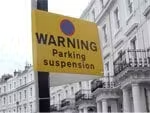
While the bay is suspended, no-one can park there or you risk a ticket or being towed away. The suspension warning sign should be placed on the nearest parking sign plate, tree or telegraph pole.
You’ll normally get a few days' notice but in emergencies, a bay could be suspended with less than 24 hours' notice.
What if the bay gets suspended while you're on holiday? The regulations state it is your responsibility to check for any suspensions and to move your car if necessary otherwise you’ll get a ticket, or worse.
If you've gone on holiday and you miss the notices going up, it can be a real pain. The warden will understandably issue a ticket, and proof of travel will not necessarily get you off the ticket.
Councils can play hard-ball on ticket appeals. You’ll have to rely on the council's discretion when appealing as, technically speaking, you have committed an offence (see Parking Ticket Appeals for how to do this).
If your appeal is rejected by your council, the independent arbitrator can only recommend the council cancels your ticket - it cannot force it.
Some councils are particularly unsympathetic to this problem and insist it is motorists' responsibility to check their car is parked correctly. They say you need to make specific arrangements to get someone to check the car if you plan to leave it parked in a residents' bay. If you're away with the family, ensure a neighbour is insured before asking them to move the vehicle.
Some councils have specific car parks reserved for those going on holiday, or if you're flying, you could drive to the airport and leave your car nearby (see the Cheap Airport Parking guide).
Parking in paid bays and council car parks
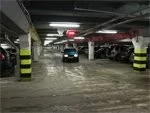
Paid-for bays include pay-and-display, council-run car parks, voucher parking and metered bays. During controlled hours (usually during working hours on Mondays-Fridays, plus weekends in busy areas), you'll need to pay.
Outside these times, you'll be free to park. So check the signs on the roadside or at a ticket machine/meter to be sure. Also make sure your vehicle is completely within any bay.
But there's more you need to know:
Nipping off for change isn't fine
Make sure you have enough coins with you as many parking ticket machines do not accept notes or cards.
Sadly, if you get a parking ticket you cannot technically appeal on the grounds you were getting change.
Beware the 'no return' sign rules
With all paid-for parking, watch out for maximum time limits or no return limits in some bays to ensure you don't spend too long there.
If you can park somewhere for an hour but it says 'no return' within two hours, it means you must leave at least two hours between parking spells.
Sometimes you can pay by phone
In some built-up areas, you can pay for your parking by phone. It works by setting up an account by phone or text and then letting the council know when you're parking and how long you want to stay there for. Your chosen credit or debit card will then be charged.
The advantage of this method is you can top up your payment if you want to stay longer without returning to your motor. The disadvantage is, in some cases, you'll have to pay a fee for each payment.
Many of these schemes also require you to call 0870 or 0871 numbers, which cost more than a normal phone call so factor that in. See the Say No To 0870 guide to cut call costs.
What if the meter or machine's broken?
If the meter or pay and display machine is broken or has a cover placed over it, it usually means you cannot park there during controlled hours.
For pay-and-display though, if you can find a nearby machine that works and operates under the same time restrictions and cost, you can get a ticket from there.
However, to be safe, check the rules written on the machine as it will state if it's legal to park there if out of action.
What happens on bank holidays?
Other than in busy shopping areas, you can usually park in a paid-for bay for free. But again, check the machine or sign to be safe.
Permit holders
Residents and disabled permit (Blue Badge) holders sometimes get some free time in a local paid-for parking space during restricted periods, so check the rules if you have one.
Keep your ticket visible
As with residents' permits, if you buy a pay-and-display ticket it is also your responsibility to display it clearly. Make sure the ticket is upright and stuck to the window rather than left on the dashboard, to ensure any passing warden can clearly see it.
Also make sure it's sticky enough to remain on your window.
What if there are no road markings?
In rural or suburban areas you’ll usually be able to park for free if there are no road markings. But there are still some basic rules you must follow - you can't simply park anywhere where there are no markings:
-
Avoid parking near the top of a hill otherwise you may not be seen by approaching vehicles.
-
For the same reasons, never park on a bend.
-
Ensure you're not on a red route clearway. If you can't see a red route clearway sign, or simply weren't looking for one, this generally means you cannot park on busy roads, so stick with residential streets or roads where many other cars are parked.
-
Don't park within ten metres of a junction.
-
Don't park where the kerb has been lowered to allow vehicles to access a driveway.
For a list of where else you shouldn't park, see section 243 of the Highway Code.
Parking right FAQs
What does 'waiting', 'loading', and stopping actually mean?
You'll see these phrases on many parking signs. It's important to understand exactly what they mean, so you're not caught cold.
-
Waiting.
This basically means stopping your car by the roadside and either parking (when you leave your car) or waiting while still in your car.
-
Loading.
This is defined as someone stopping to load or unload bulky or heavy goods (not shopping). The goods must be of a type that cannot easily be carried by one person in one trip.
If they can be, the vehicle should be parked legally and the goods carried to the premises. Picking up items that could be carried easily, however great the value, does not constitute loading.
The activity should be continuous, adjacent, reasonable and timely. Loading times differ from area to area - ensure you check and move your car as soon as you've finished.
-
Stopping.
This covers every type of stopping your vehicle, other than if you're stuck in traffic, it's an emergency or you're stopping to pick up an obstruction from the road.
Can I park on the pavement?
You must not park partially or wholly on the pavement in London, and should not do so elsewhere unless signs permit it.
What if I'm disabled?
If you're disabled, you can get what is known as a Blue Badge. This allows you to park for free in parking meter and pay-and-display bays, though do check signs. Badge holders are also exempt from getting clamped and are exempt from some other parking restrictions, as long as they are not causing an obstruction, but check the relevant sign to be sure.
For instance, they can park on single or double yellow lines for up to three hours in England and Wales, except where there is a ban on loading or unloading. Visit Gov.uk for more information on who qualifies for one.
Be warned, the Blue Badge scheme doesn't apply to some areas in London - including Westminster, Chelsea and Camden - as they have their own rules. If you're a Blue Badge holder and you're taking your car to London, make sure you check the systems that operate in each borough. For more info see the City of London website.
When can I park in a doctors', hospital or disabled bay?
Unless you have a valid permit, the answer is never. So don't park in one as you'll be blocking someone else's space and you'll risk a fine.
What happens if there's a major event nearby?
Watch out for extra restrictions when there's big sporting event, concert or festival taking place. It may mean parking is suspended for non-residents for those few hours over a weekend, for example, when it is normally permitted. In some cases, parking may be completely suspended for everyone.
Where can motorcycles/scooters park?
Restrictions apply to motorcycles and scooters in the same way they apply to cars, vans and lorries. So it is just as important not to break the rules if you get about on two, rather than four, wheels.
However, where car drivers have to pay or purchase a permit in some spots, motorcycles and scooters can sometimes park for free or get a discount. As these dispensations change from council to council check your local authority's website for its rules. You can find your council's homepage on Gov.uk.
Some councils have set up motorcycle-only parking bays where you can park for free, though there are a growing number of specialist motorcycle paid-for parking bays.
The Parking for Bikes website helps motorbike owners find free parking spaces, and lists the location of nearby car parks. However, only use it as a guide, rather than gospel; and check the restrictions by the roadside when you park.
What if I have an electric car?
Many urban councils allow free or discounted parking for electric cars in parking bays where you'd normally need a permit or have to pay. You can find your council's homepage on Gov.uk to check if discounts apply.
Where can I find a car park?
There is no one website we know of that lists all car parks, but good starting points are Parkopedia, Parkmark and, in selected cities only, AppyParking and Park-up.
Also read the Airport Parking guide to help cut your costs of your holiday parking.
How do I find free parking spots?
If you know an area well, you may know some of the backstreets where you can park for free. If you're visiting friends, ask them if they know of any free parking spaces nearby if they live in a restricted zone.
When can I park in a car park/private land?
If you're parking at a supermarket, superstore, airport car park, or on any piece of land that is privately-owned, you could be in the land of the cowboys. There are few firm rules and some landowners and their agents have been known to issue tickets at their whim.
The key is to read any restrictions and stick to them or risk major hassle if you're ticketed - or worse. If you are given an unfair penalty, see the Private Parking Ticket Appeals guide for help escaping any fine.
Share this guide?