



Council Tax discounts
Many are entitled to discounts that can help save £1,000s

Many people are eligible for a Council Tax discount or reduction of between 25% and 100%, saving £100s or even £1,000s each year. Those living alone or only with children, students, those with a carer or a specific medical diagnosis – as well as people on low incomes and even those with empty properties could cut their bill. Read on to see who's eligible, how much you might save, and how to apply.
Who can get money off their Council Tax bill?
There are different reasons you might qualify for a lower Council Tax bill, and these can be broadly separated into four categories:
-
Discounts based on who you live with.
-
Discounts for those on a low income or receiving certain benefits.
-
Discounts if someone in your household is terminally ill.
-
Discounts and reductions based on the type of property you live in.
Watch Martin's three-minute Council Tax discounts briefing
Before reading on, first watch MoneySavingExpert.com founder Martin Lewis's video on why households may be missing out on Council Tax discounts worth £100s or £1,000s.

This clip has been taken from The Martin Lewis Money Show Live on Tuesday 16 January 2024, with the permission of ITV Studios. All rights reserved. Full episode on the ITVX Hub.
Council Tax discounts based on who you live with
First, we're focusing on discounts based on who lives in your household.
Here, Council Tax discounts depend on whether enough 'qualifying adults' live in your household (anyone who isn't a qualifying adult is 'disregarded' for Council Tax). In brief :
-
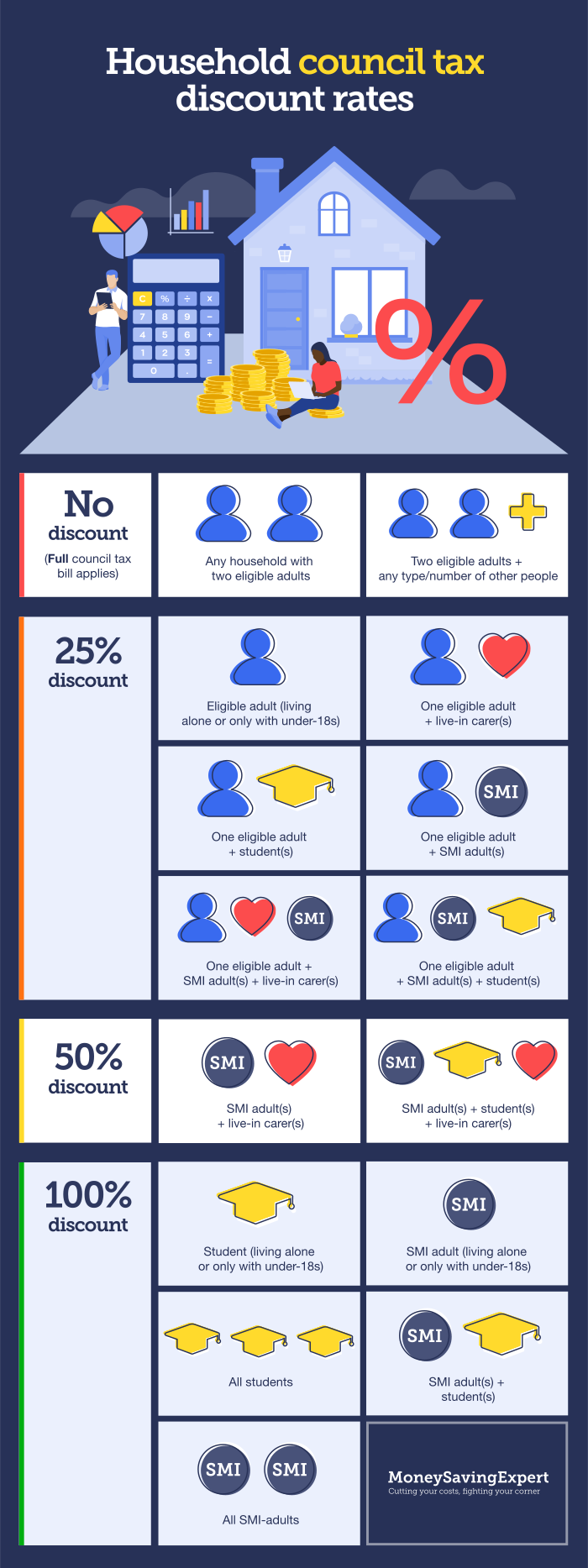
TWO or more qualifying adults. Where there are at least two qualifying adults in your household then no discount will apply and the full Council Tax rate will be due.
-
ONE qualifying adult. Where only one qualifying adult lives in your household then the single person discount applies, equivalent to 25% off the Council Tax bill.
-
NO qualifying adults. Where there are no qualifying adults in your household then either a discount of 50% or a 100% exemption will apply (this depends on exactly who lives there). Be aware 'no qualifying adults' isn't the same as a property being empty.
Below we explain who does and doesn't qualify, but first here is a graphic summarising which households may be due a discount ('SMI' stands for 'severe mental impairment').
Who is 'disregarded' for Council Tax?
As mentioned above, certain people don't count as qualifying adults and as a result are 'disregarded' for the purpose of Council Tax. These people include:
-
Children. If you're under 18 you'll be disregarded for the purpose of Council Tax.
-
Full-time students. To count as a full-time student, your course must last at least a year and involve at least 21 study hours a week. Full-time student nurses normally qualify too and some councils also let part-time student nurses apply. Apprenticeship schemes sometimes count, as can getting funding from the Education and Skills Funding Agency (if you're under 25) and British Council foreign language assistants.
-
Adults who are 'severely mentally impaired' (SMI). Such as those with Alzheimer's, Parkinson's, profound learning difficulties, multiple sclerosis and stroke sufferers. To qualify, you’ll need to be both medically certified as having an SMI and be receiving at least one of a number of benefits. See our SMI Council Tax discount guide for more.
-
Live-in carers. This is someone who looks after a person with a disability who isn't their partner, spouse or child under 18, for an average of at least 35 hours a week – looking after a mother, father, brother, sister, niece, nephew, friend, uncle or aunt DOES count. The person cared for must be getting one of the following benefits:
- Attendance allowance.
- Middle or higher rate of the care component of disability living allowance.
- Standard or enhanced rate of the daily living component of PIP.
- An increase in constant attendance allowance.
- An increase in disablement pension.
- Armed forces independence payment.
You do NOT need to be receiving carer's allowance to qualify for this Council Tax discount and more than one person in a household can qualify if each fits the criteria. -
Care leavers (young adults). If you grew up in care and are now leaving (or did in the past) to live independently. In Scotland and Wales, you'll be disregarded until the age of 24 or 25. In England, you won't actually be disregarded, but local authorities often offer discretionary discounts to care leavers – it varies by council, so check.
-
Ukrainian refugees. If you're hosting a Ukrainian refugee as part of the Homes for Ukraine scheme, it won't affect any discounts or reductions you're entitled to.
Where you don't fit any of the categories above, you'll be considered a qualifying adult.
Remember, if there is only one qualifying adult in your household then you're due a 25% single person Council Tax discount. And if there are no qualifying adults then the discount is either 50% or 100%. Where you are eligible for a discount, you'll need to apply.
Quick questions:
Can I get a single person discount if I let my spare room?
It depends on where the person in your spare room has their 'sole' or 'main' residence – specifically, whether this is at your home or not.
If you only let out your spare room for a few days or weeks at a time, then it's unlikely that person is going to have their sole or main residence at your home. In which case, you should still qualify for the single person discount.
But if you're letting the room on a longer-term basis – for example, you've signed a contract with a tenant or the person has redirected mail to your address – then it's more likely their main residence is your home. In this scenario, you shouldn't really claim the single person Council Tax discount.
I'm a student – how long can I claim a Council Tax discount for?
A full-time student is disregarded from paying Council Tax for the duration of their course – for an example, an undergraduate at university would be disregarded from the day their course begins until the day it formally ends.
In other words, a student is liable to pay Council Tax outside of their course.
So if you're living in an all-student house, this means you should get a Council Tax bill if you continue to live there after your course ends. Many undergraduate courses end in early June, so if the tenancy on your house runs until August, that means there are two months where you'll pay Council Tax.
Similarly, if you move into your student house before your course actually starts, there will likely be some Council Tax to pay.
Council Tax discounts if you're on a low income

You may qualify for a reduced Council Tax bill – by up to 100% – if you have a low household income.
Unlike discounts based on who lives in your home (where the rules are fixed by law), each council operates its own reduced bill scheme – meaning the size of any reduction and the qualifying criteria vary by local authority. This can result in households with similar incomes receiving significantly different levels of support.
Nevertheless, more than two million people are thought to be missing out on this type of Council Tax support. This may partly be because some eligible people think they'll get the reduction automatically – but that's not the case. You'll need to apply for any reduction.
You're on a low income and/or benefits
If you're on a low income or claim benefits, such as Universal Credit, your household may qualify for a Council Tax reduction – which can be as much as 100%. It doesn't matter if you own your home or rent, or whether you're employed or not.
Rather, what you get depends on:
- Where you live.
- Your circumstances (such as income, number of children, benefits, residency status).
- Your income, including savings, pensions and your partner's income.
- If any children or other adults live with you.
When working out your income, councils in England can partly or fully disregard things like child maintenance, fostering payments and charity contributions – see your council's website for its full list. Disregarded income should also include any payments in relation to the Windrush Compensation Scheme and historic child sexual abuse.
Remember, if you're eligible you'll need to apply – it's not automatic.
Some MoneySavers have told us they've been able to get the 25% single person discount AND a low income Council Tax reduction simultaneously.
You're receiving Pension Credit
If you or your partner are getting the 'guaranteed' part of Pension Credit, your household could be eligible for a full reduction on your Council Tax bill of up to 100%.
If you get the 'savings' part of Pension Credit, you may also be eligible for a reduced bill, though not by 100% – how much will depend on what savings you've got. And if you live with someone who isn't dependent on you, then the reduction might also be less.
According to Independent Age, of those in England in receipt of Pension Credit who are eligible for a Council Tax Reduction, only half are currently getting one, while those who aren't getting one end up overpaying Council Tax by £1.7 billion.
Remember, if you're eligible for a reduction you'll need to apply for it (it's not automatic).
I'm on Pension Credit. I applied to my council and now I get a 100% Council Tax discount. It's such a relief and I'll be using the extra cash towards more carers and food. It's made the world of difference.
Martin: Two MILLION missing out on Council Tax reductions
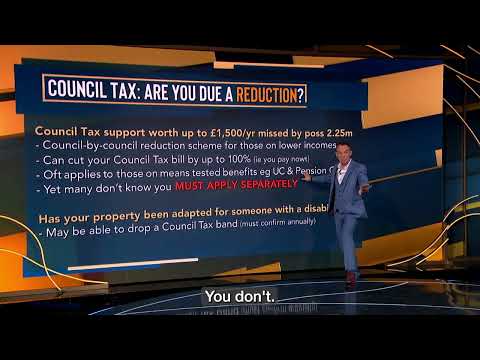
This clip is from The Martin Lewis Money Show Live on Tuesday 12 November 2024, permission of ITV Studios. All rights reserved. Full episode on the ITVX Hub.
Council Tax discounts if you're terminally ill
If you or someone else in your household is terminally ill, then you may be able to apply for an exemption from paying Council Tax. In brief:
- Only some councils allow this (under 30 currently, see the full list below).
- You won't pay Council Tax again until the person who is terminally ill has passed away.
- Some councils limit the illness to a partner or family member.
- Some councils only offer the exemption to low household income homes, while other councils offer it to all households regardless of income.
In almost every case, a doctor or medical professional will be required to fill out what's called an 'SR1 form', which confirms you're terminally ill.
You'll need to get in touch with your council in order to apply.
Important. To explore what other support is available for those impacted by terminal illness, a good place to start is the end-of-life charity Marie Curie.
Full list – councils offering a terminal illness Council Tax discount
The terminal illness discount is a relatively new form of Council Tax support, so it's possible that more councils will start offering it beyond those listed below.
These are the councils we're currently aware that offer the discount:
-
Barnet
-
Barnsley
-
Blackburn with Darwen
-
Bristol City
-
Broxtowe
-
Burnley Borough
-
Camden
-
Cheshire West and Chester
-
Durham County
-
Elmbridge
-
Gateshead
-
Gedling
-
Hull City
-
Isle of Anglesey
-
Knowsley
-
Liverpool City
-
Manchester City
-
Milton Keynes
-
Newark & Sherwood
-
Newcastle City
-
North Lincolnshire
-
Pendle
-
Preston City
-
Salford City
-
Sefton
-
Wakefield
-
Wealden
-
Wirral
Council Tax discounts based on your property

You may be able to get a discount or reduction off your Council Tax bill based on a property's status or condition. If you are eligible for this type of discount, you will need to apply to get it – it's not something you get automatically.
Here are a few examples:
Properties adapted for a disabled person
If you can prove your home has been adapted for a disabled person then you're eligible to drop a Council Tax band. Where your property is already in band A (the lowest Council Tax band), your Council Tax bill will be reduced by 17% instead.
The types of adaptations could include:
- An extra bathroom or kitchen for a disabled person to use.
- Creation of sufficient floor space to make the home wheelchair-friendly.
- A room that's 'predominantly' used by a disabled person (for example, a downstairs room in a two-storey house that's been turned into an accessible bedroom, or a room adapted specifically for a disabled person to use).
After you mentioned disability rates relief I emailed my local council, and they sent me a form to complete. Three weeks later I was informed that my band had been reduced from E to a D, saving me over £400/yr going forward. Not only that, the discount was backdated to the time I came out of rehab following an above-the-knee leg amputation, meaning an extra pay-out of £1,500. Thank you so very much, I wouldn't have known about this reduction otherwise.
John
Properties being renovated to make them liveable
For unoccupied properties which are undergoing major repair work or structural alterations to make them habitable, you may be able to claim a 100% Council Tax exemption.
If your property qualifies, it will be exempt from Council Tax for up to 12 months.
Properties that are empty
There are some cases where you don't pay Council Tax on an empty home, such as if:
-
You're a long-term resident of a care home or hospital. Though if you're only in hospital or a home for a short time then you'll need to pay Council Tax as normal.
-
You're in prison. Unless you're in prison for not paying Council Tax.
-
The owner of the property has died. Here the home will be exempt until someone moves in, or probate is granted. If probate has been granted but the home is still empty and not sold, it will be exempt for a further six months. If it's still empty and unsold after six months, the executor will become responsible for paying Council Tax from the estate.
If you inherit a home you'll be responsible for Council Tax once the transfer is finished.
Properties with an annexe
If your home has an annexe (also known as a 'granny annexe') or similar extension, you might get a discount it's in use as a residence or used by the main homeowner.
An annexe is typically a self-contained and separate living area from your main home, though your council will have to decide whether or not it qualifies as an annexe.
If you qualify as having an annexe, you will receive two Council Tax bills – one for the annexe and one for the rest of your home. You're entitled to a discount of 50% on the annexe's Council Tax bill, but you'll still pay Council Tax as normal on the main home.
Properties that are second homes but not usually lived in
If you own a second home then there are scenarios where your council will give you a discount. This is most likely if you have to live in it for your job – for example, you live in a second home during the week but have your main residence elsewhere. It's up to the council to decide both if it'll offer the discount and how much that will be.
However, councils also have the power to charge a premium on second homes (on top of what's normally charged), sometimes worth an extra 100%. This means some second home-owners may pay double Council Tax on the property that isn't their main residence.
Quick questions:
How much Council Tax do I pay on an empty property that isn't exempt?
If your empty home isn't exempt for any of the reasons described above, you will likely have to pay Council Tax.
Where your home's been empty for 12 months or more, councils are able to charge a premium. This can be worth an extra 100% on top of what you'd normally pay, meaning double Council Tax on empty properties is possible.
What if I'm in the armed forces and stationed away from home?
If you're in the armed forces and stationed away you won't be charged extra Council Tax on your empty home, but you will need to pay the normal amount.
You must APPLY for a Council Tax discount
Discounts and reductions can be worth £100s off your Council Tax bill each month. You may be able to backdate too, though councils set their own rules about this – if they allow backdating, you'll normally need to explain why you hadn't claimed before.
Remember you need to apply for a discount or reduction. They're not given automatically.
-
England and Wales. Visit Gov.uk to find your council's details and then apply.
-
Scotland. Visit Mygov.scot to find your council's details and then apply.
You may be asked to provide evidence. For example, if you've got a low household income, you might need to prove your identity, rent or mortgage payments, income and savings.
Important. If you're receiving a Council Tax discount and your circumstances change, you should notify your council.
Council tax budgeting
By default, Council Tax is paid over 10 months rather than 12 (February and March are usually the months off). This can make monthly budgeting difficult.
While some councils don't advertise it loudly, all councils in England must allow you to pay Council Tax over 12 months if you request it. So if you want to change to a 12-month payment schedule then you should contact your council.
Importantly, from April 2027 charging over 12 months will start becoming the default for English councils, though you can stick with the 10-month payment plan if you request it.
In Wales and Scotland, while paying over 10 months is also normally the default, councils sometimes let you pay over 12 months. Again, contact your council to change schedule.
Warning – missing a Council Tax payment can be disastrous
Missing a Council Tax payment can have disastrous effects – so try to avoid this.
Within three weeks of missing one Council Tax payment, councils can ask for the full annual bill within just seven days. Fail to pay this and councils can go to court and ask for a 'liability order' – which lets them take more aggressive forms of debt collection, such as bailiffs.
In stark contrast, a credit card firm must go through more steps to engage people about a missed payment before demanding full repayment (this typically takes three to six months). Credit card firms must also offer a much wider range of support and repayment options.
But following campaigning from Martin, the Government has announced that from April 2027 households will be given two months to settle a bill if they miss a payment, while councils will be required to work on a "sustainable" repayment plan for those struggling.
Watch Martin explain how devastating the existing rules can be:
This clip is from The Martin Lewis Money Show Live on Tuesday 12 November 2024, permission of ITV Studios. All rights reserved. Full episode on the ITVX Hub.
If you're struggling with debt or find making repayments difficult, see our Debt help guide.
Council Tax discounts FAQs
Who is responsible for paying Council Tax?
This section on liability is only for those living in England.
Working out who specifically is responsible for paying a household's Council Tax bill is more complicated than you might think.
For many homes this likely won't be an issue if you simply split the bill between everyone who lives there (or something like this). The intention of this chapter isn't to mess with such an arrangement. But where you disagree about who should pay, there is a method to work it out.
It's all to do with the Council Tax 'hierarchy of liability'
In the Local Government Finance Act 1992 is a section on Council Tax liability. This sets out who is legally responsible for covering the bill.
Known as the 'hierarchy of liability', it specifies six types of people, each with a rung on the hierarchy. Where someone fits the criteria of the first rung, they will normally be the person liable for paying a Council Tax bill.
If nobody fits the first rung, then liability passes to anybody on the second rung, then to anybody on the third rung, and so on.
The hierarchy of liability is as follows:
-
Resident with a freehold interest.
-
Resident with a leasehold interest.
-
Resident with a statutory or secured tenancy.
-
Resident with a contractual licence to live in the property.
-
Resident.
-
Owner of the property.
(A 'resident' is defined as somebody who is at least 18 years of age and has his or her 'sole or main residence' in the property.)
Where two or more people occupy the same rung, liability for the Council Tax bill is divided equally (you'll be 'jointly and severally liable)'.
Joint and several liability also applies to married and unmarried couples living together, even if one person is on a higher rung of the hierarchy.
There are some exceptions to the hierarchy
There are some exceptions to the hierarchy of liability. In brief:
-
Some households are exempt from paying Council Tax (meaning the hierarchy of liability is irrelevant). Such as households that only contain students or people with a severe mental impairment (SMI).
There's also an exception to the joint and several liability rule:
-
Joint liability doesn't apply to full-time students and people with SMIs. So if a household contains a student or somebody with an SMI plus other adults on the same rung of liability, joint liability won't apply. Instead the bill's liability is split between the non-student/SMI adults.
Can a discount apply to two homes simultaneously?
A Council Tax discount can only apply to one home – not multiple homes simultaneously. So if, say, you get the 25% single person discount, this will only apply to your main residence (not any other homes you own).
There are circumstances where your council may offer a discount on a second home or on an empty property. However, councils also have the power to charge Council Tax premiums on second homes.
Other MSE Council Tax guides...
Check your Council Tax band. Are you paying too much?
Council Tax overpayments. How to reclaim.
'Severe mental impairment' discount. How it works.
Share this guide?