
Cheap & free prescriptions and medications
20+ ways to slash the cost of prescriptions, medicine & flu jabs

Pricey pills and health treatments can leave your wallet feeling woozy, so it's time for a MoneySaving medical. For starters, are you one of the hundreds of thousands of people overpaying for a subscription by not getting a 'season ticket'? Other top tips include how to get a free or cheap flu jab, where to get the lowest prices on high-street meds, and the best drink to help the (generic) medicine go down.
-
Prescriptions in England cost £9.90 (they're free in Scotland, Wales & Northern Ireland)
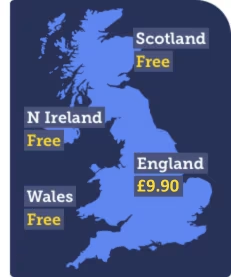
While prescriptions are free in the rest of the UK, they cost £9.90 per item in England.
The aim of the prescription system is simple. It's a flat fee, so that people can afford any necessary medicine regardless of cost. Yet for those on regular prescriptions, it can add up. In this case, check if you can save with a prepayment certificate.
All medicines administered by a GP or in hospitals or NHS walk-in centres are free. Also free are prescribed contraceptives, and treatments for most sexually transmitted diseases, tuberculosis and some mental health conditions (if the medicine has been prescribed under a community treatment order).
-
... but a few in England DO qualify for free prescriptions
Sadly, if you're in England, nipping across the border to Scotland or Northern Ireland, where prescriptions are free, won't help – but you may still qualify for free prescriptions. Use this quick, free NHS calculator to check if you qualify.
You're entitled to free medicines if:
-
You're under 16 or over 59.
-
You're in full-time education and 16-18 years old.
-
You're pregnant or gave birth in the last 12 months, and have a valid maternity exemption certificate (known as a 'MatEx'). It's valid for 12 months after your due date, though can be extended if your baby is born later than expected.
-
You have a valid medical exemption certificate (known as a 'MedEx') – given for a range of illnesses, such as epilepsy, cancer, or severe disability.
-
You or your partner receive income support, income-based jobseeker's allowance, income-related employment & support allowance, or pension credit guarantee credit.
-
You're receiving universal credit and your earnings for the most recent assessment period were £435 or less (it's £935 or less if your universal credit includes an element for a child, or if you have a 'limited capability for work' or 'limited capability for work and work-related activity').
-
You're under 20 and are the dependant of someone who receives any of the following (in some cases you may also qualify if you claim universal credit):
-
Income support.
-
Income-based jobseeker's allowance.
-
Income-related employment & support allowance.
-
Pension credit guarantee credit.
-
-
You have a war pension exemption certificate.
-
You're an NHS inpatient.
-
You have a valid NHS certificate for full help with health costs (known as an 'HC2').
People named on an NHS certificate for partial help with health costs (HC3) may also get some assistance towards prescription costs. Find out more about the NHS Low Income Scheme (LIS).
If you qualify for free prescriptions, just fill in the back of the form at the pharmacist. Don't be tempted to lie – a false declaration can lead to a fine and prosecution.
-
-
If you get free prescriptions, you can often get other free meds for minor ailments too

If you or your child has a minor health complaint and you're already entitled to a free prescription, you may also be able to get free medicines and treatments from your local pharmacist without making a GP appointment – though it varies depending on whether you're in England, Scotland, Wales or NI.
In England, the scheme Pharmacy First gets you access to advice/treatment at your local pharmacy, and, for certain conditions, medicines. The usual NHS prescription charges apply to medicines supplied this way, so if you're already entitled to free NHS prescriptions – for example, because you're under 16 – you won't have to pay a prescription charge. In some areas there are also locally commissioned pharmacy services, but what's available and who's eligible can vary.
The equivalent in Wales is the Common Ailments Service (CAS) – it provides free pharmacist advice/treatment for a range of minor illnesses.
In Scotland, the NHS Pharmacy First Scotland service can be accessed from all Scotland pharmacies that dispense NHS prescriptions.
Similarly, in Northern Ireland, there's Pharmacy First.
Remember... the meds you get for free through this scheme are paid for by the (increasingly cash-strapped) NHS – and ultimately taxpayers.
So only get what you really need, but can't afford. Many generic medicines cost pennies and are quicker to get hold of.
-
If you use prescriptions regularly, check if you can save with a prepay certificate in England
Pay for a prescription in England and it costs £9.90 a time. If you need them regularly it can really add up. Alternatively, you can get a prescription prepayment certificate (PPC) – it's a bit like a prescription season ticket and can mean big savings. Yet many don't take advantage and end up overpaying unnecessarily.
As a rule of thumb...
Prepayment certificates win for people using at least one prescription a month over a long period.
According to the NHS, an estimated 872,000 patients could potentially have saved around £35 million (£41 each on average) in 2023/24 by purchasing a 12-month PPC. There are two prepayment options – once you've got one, it covers all your prescriptions (with the exception of support tights) in that time. Prices were frozen in 2025 and are listed below.
-
Three-month prepayment certificate - £32.05
-
12-month prepayment certificate - £114.50
There's also a PPC specifically for hormone replacement therapy:
-
12-month HRT prepayment certificate - £19.80 (more on this below)
(The NHS estimates 286,000 people could have saved around £8 million (£27 each on average) by purchasing a 12-month HRT PPC.)
Someone who gets two prescriptions each month for 12 months would save more than £100, compared with paying for individual prescriptions. See our table below for more help comparing costs.
How to get a certificate
Apply via the NHS Prescriptions site. You can pay by card, or by direct debit if you'd prefer to spread the cost. Forms are also available at certain pharmacies, or alternatively call 0300 330 1341.
To use it straight away, you can get your certificate by email, or you can print it after you've applied, then show your certificate details when collecting your prescription.
If you become eligible for free prescriptions after buying a certificate, you can reclaim the proportional cost for that time.
It's slightly different for a HRT PPC.
NHS season tickets cost comparison
In the table below, we've shown how much you'll pay for regular single prescriptions over a three or 12 month period. Compare this with the cost of a prepayment certificate to see if it's worth it for you.
Total cost for single prescriptionsSINGLE PRESCRIPTION
FOR 3 MONTHS
FOR 12 MONTHS
1 ITEM A MONTH
£29.70
£118.80
2 ITEMS A MONTH
£59.40
£237.60
3 ITEMS A MONTH
£89.10
£356.40
Compare costs above with a 3-month certificate (£32.05) and 12-month certificate (£114.50)
You can backdate a prepayment certificate for up to a month
Certificates usually start on the day applications are received. However, if you've shelled out for prescriptions in the month before you got your PPC, you can request it's backdated – and reclaim the cost of those prescriptions.
If you have to pay for a prescription while waiting for your certificate, you can claim back the cost up to three months after paying.
You must ask for an NHS receipt (FP57) from the pharmacist when you pay for the prescription(s) – you can't get one later.Get regular HRT? Save with an HRT prepayment certificate
Hormone replacement therapy (HRT) is free on the NHS in Wales, Scotland and Northern Ireland, but not on the NHS in England. So, if you're going through perimenopause or menopause and you're prescribed HRT by your doctor, you can buy an HRT prepayment certificate (HRT PPC) for a one-off fee of £19.80. This will cover you for a year of prescriptions, including eligible HRT patches, gels and tablets.
How to save with an HRT prepayment certificate
The certificate was introduced in April 2023 (see our MSE news story). It does exclude some HRT – there is a full list on the NHS website.
It covers you for all eligible HRT prescriptions, with no limit on the number, while it's valid. This is useful as you may want to keep consulting with your GP as you adapt to HRT, and they may change dose or HRT type (for example, changing from patches to a gel).
It’s worth noting that this certificate is specific to HRT, and will not cover other medicines. For example, if you are prescribed HRT but also medication for arthritis, the HRT PPC will only be valid against the HRT medicines, so a standard 3 or 12-month prepayment certificate might be better for you to avoid paying twice.
You can buy an HRT PPC online as well as in-store from some pharmacies. For help with buying one, call 0300 330 2089.Be aware your PPC may auto-renew, and you're liable for the full cost
If you paid for your PPC by Direct Debit, note that it will auto-renew in the final month, with some exceptions. It won't auto-renew if:
-
you're turning 60 within nine months of the expiry date
-
the Direct Debit was set up via telephone and paid for by a third party
-
you have an outstanding balance
To cancel your PPC, you must cancel your Direct Debit with your bank and also contact the NHS on 0300 330 1341 or by filling out its online form.
Once a PPC has begun, you're expected to pay for the full term (three or 12 months). If you try to cancel at this point, you'll be billed for the remaining months, as Suzanne's husband experienced with his 12-month certificate:
Be aware that this auto-renews and you are liable for a year at a time. My husband has used this for several years to save money. For some reason he hasn't received emails about his yearly renewal – we just thought he paid monthly by Direct Debit and it was ongoing. We are about to move to Ireland so cancelled the Direct Debit, only to get a bill through the post for £92!
~ Suzanne via Facebook, May 2025
-
-
Prescriptions aren't always cheapest
If you're prescribed common medication such as painkillers or dermatology creams that are also available over the counter, often it's cheaper to buy them that way rather than pay for a prescription.
There's no hard and fast rule, though. On the flip side, if you use a lot of medication, getting a doctor to do a bulk prescription may be cheaper. Plus if you've already bought a prepayment certificate, you'll pay nothing extra.
Prescription vs over the counterDRUG
DOSE
PRESCRIPTION COST
OVER-THE-COUNTER COST
Aqueous cream
500ml
£9.90
£1 at Savers
Hydrocortisone (1%)
15g tube
£9.90
£1.99 (normally £2.49) at Holland & Barrett (10g)
Prices correct as of August 2026.
-
Find the cheapest private prescriptions
While NHS prescription prices are fixed, pharmacies can set their own for private prescriptions, meaning costs vary hugely. These are given when you want a drug not covered by the NHS in your region, such as Malarone to prevent malaria if you're travelling, and some cancer drugs.
It could be a drug for a lifestyle-enhancing purpose, such as sexual aid Viagra (although this can be on the NHS if your erectile dysfunction's caused by a medical problem, such as diabetes, prostate cancer or a kidney transplant) or anti-baldness drug Propecia.
Non-NHS doctors can't give NHS prescriptions. So go to one for emergency weekend diagnosis, or because you're a member of a scheme, and you'll get a private prescription.
-
Now booking. Grab a free or cheap flu jab
The NHS England flu jab booking service is now open. It's happened earlier this year: Monday 17 August compared to last year's 1 September. It will run until 31 March 2027. Appointments begin from Tuesday 1 September for children and pregnant women, and from Thursday 1 October for over-65s and other eligible people.
Plenty of people qualify for a free flu jab through the NHS, and if you're among those it lists as being at risk, it's recommended you have the vaccine every year to protect yourself. The NHS says the best time to have your flu vaccine is in the autumn or early winter, before flu starts spreading. Check the free flu jab criteria below to see if you're eligible.
If you don't qualify for a free NHS flu jab, you may be able to get one free through your employer. You may also be able to get a cheap vaccine from your local pharmacy.
Who qualifies for a free NHS flu jab? Available at GP surgeries or some pharmacies
Here's who qualifies for a free flu jab:
-
Those aged 65 or over
-
Those who are pregnant
-
Those with certain medical conditions (the NHS has a full list)
-
Those living in a long-stay residential care home or other long-stay care facilities
-
Those who receive a carer's allowance or are the main carer for an elderly/disabled person
-
Those living with someone who's more likely to get infections
-
Front-line health and social care workers (jab given through their employer)
-
Children between the ages of six months and 17 years with a long-term health condition
-
Children who are aged two or three
-
All school-aged children, spanning reception to year 11 (jab is administered at school)
To get an NHS flu jab, contact your GP surgery or a pharmacy offering the service. All the pharmacies in the table below offer the free flu jab for those who qualify, and it may be available at your local independent pharmacy, but you'll need to check.
Some midwifery services provide flu jabs for pregnant women.
Check if your employer offers it free
Some employers also offer free flu vaccinations, so it's worth checking if you can get the jab at work (or get a voucher to use at a local pharmacy). These schemes are typically open to everybody, but may be run on a first come, first served basis, so make sure you sign up promptly.
Find a flu jab cheap elsewhere – from £10
If you don't qualify for a free flu jab on the NHS or at work, you'll have to pay. You can often get it privately at your GP, but prices vary. We've seen it cost as much as £40 for adult vaccinations. It can be significantly cheaper from major supermarkets and pharmacies – this year, Superdrug Health & Beautycard members can get it for a discounted £9.98.
Flu vaccination price comparisonPHARMACY
PRICE PER DOSE
£9.98 for Health and Beautycard members, otherwise £19.99
£14.97
£17, or £16 if you had the jab at Tesco in 2025. Clubcard holders can earn 16-17 points.
£19.49
£21.95, or £26.95 in Jersey. Advantage Card holders can earn 65p-80p worth of points.
Prices correct as of 12 August 2026. Adult vaccinations only
Quick question
How is the flu vaccine administered?
Normally you'd get the vaccine as an injection, although the NHS says for most children it's administered via a nasal spray instead.
-
-
Check out supermarkets or discount stores for medicine
The biggest saving is in switching to generic from branded medicines, regardless of where you shop. However, to grab even bigger price cuts, try your supermarket or discount stores, such as Savers.
Asda, Sainsbury's and Tesco especially have steamrollered the pharmaceutical world in the past few years, with cheap prices that often undercut the high street pharmacies.
Remember though, if the price difference isn't too great, buying generic at your local independent pharmacy may help it remain open in the face of stiff competition.
-
Revealed: IDENTICAL meds, half the price
The pharmaceutical industry's full of wizards – both those who make the drugs that help, and the marketeers who use a raft of tricks to persuade us there's hidden magic in their brands. Drug companies spend millions promoting 'only-use-the-name-you-know' messages... but it's often marketing baloney.
It's important to realise you can often save big by buying an IDENTICAL pill, just in different packaging. Some tablets are half the price of their doppelgangers.
How to spot which tablets are identical. Check the 'PL number' on the packet. It's a unique licence number given to a particular drug made by a particular manufacturer (such as PL 12063/0104, which is a cold and flu remedy). The medicine can be generic or branded, and it can even be marketed at different ailments, but if the PL numbers match, it's the SAME drug.
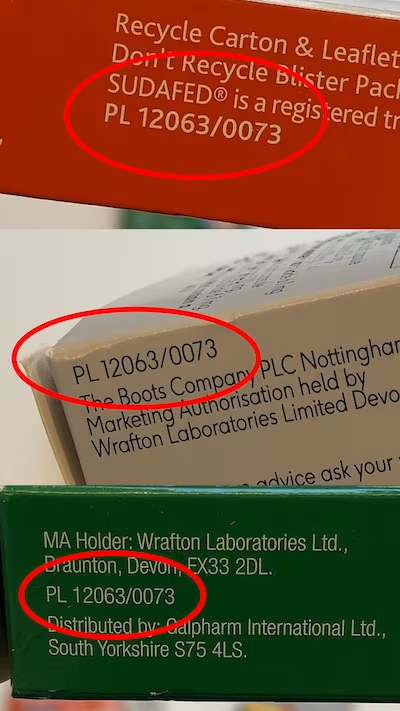
We recently found a number of savings:
Sudafed Congestion & Headache Relief Day & Night Capsules are £5.99 at Boots.
Boots' own-brand Max Strength Cold & Flu Relief Day & Night Capsules are £2.40.
Poundland sells Galpharm Max Cold & Flu Day & Night Capsules for just (you guessed it) £1. All three have an identical PL number (PL 12063/0073), as pictured.
Sudafed Sinus Max Strength Capsules (PL 12063/0067) are £5.50 at Boots.
Boots Max Strength Sinus Pressure & Pain Relief Capsules have the same PL number, and are £2.40.
Feminax Express (PL 12063/0071), 16 tablets) is £4.90 at Boots.
Tesco Health Rapid Pain Relief (12 tablets) have the same PL number, and are £3.30. While you get fewer of them in a pack, it's still cheaper per tablet.
What if the ingredients are identical, but the PL number is different?
Confusingly, medicines with the same formulation, from the same brand, can have different PL numbers. This is because companies sometimes license the same formulation under multiple product names.
For example, Boots Max Strength Sinus Pressure & Pain Relief Capsules (PL 12063/0067) and Boots Max Strength Cold & Flu Relief Capsules (PL 12063/0066) have exactly the same active ingredients, in the same quantities (caffeine 25mg, paracetamol 500mg, phenylephrine hydrochloride 6.1mg).
The only difference is the colours used in the capsule, and the fact they are marketed at (slightly) different conditions.
-
Same active ingredient – pay up to 90% less
Even if there's not an identical medicine that's cheaper, don't sniffle at generic equivalents. It's a medicine's 'active' ingredient that matters – the rest is largely irrelevant (unless you've certain allergies or avoid gelatine), though liquid capsules work quicker and some taste different.
For example, Asda sells Nurofen 200mg ibuprofen tablets for £1.88. Its own-brand 200mg ibuprofen caplets are just 35p.
Don't take our word for it. The Royal Pharmaceutical Society told us:
If an over-the-counter medicine contains the same active ingredient, strength and formulation, it should work just as effectively whether it is a well-known brand or an unbranded generic alternative. If you’re unsure which product is most suitable for you or if you have any questions about ingredients or interactions, speak to a pharmacist who can provide safe, expert advice.”
- Professor Amira Guirguis, RPS Chief Scientist
In 2016, we published a report on the prices of branded vs generic medications, and now in 2026 we've updated and expanded our research to include 14 online and high street stores.
Below you can see the price differences between big-brand medications and generic medications (such as store own-brand or those from manufacturers like Galpharm and Bell's Pharmacy).
Branded vs generic medicationBRANDED PRODUCT
CHEAPEST BRANDED
GENERIC EQUIVALENT
CHEAPEST GENERIC
PERCENTAGE SAVING
Nurofen (16)
£1 Poundland
Ibuprofen (16)
35p Asda, Sainsbury's, Tesco, Aldi, Lidl
65%
Anadin Paracetamol (12)
£1 Savers (in-store, online)
Paracetamol (16)
35p Asda, Home Bargains, Sainsbury’s, Savers (online), Tesco, Aldi, Lidl
73%
Benylin Mucus Cough Menthol Flavour 300ml
£7.79 Savers (in-store, online)
Mucus Cough Syrup 300ml
£2.49 Lidl
68%
Nurofen Joint and Back Pain Gel 40g
£7.49 Superdrug
Ibuprofen gel (10%) 40g
£5.70 Savers (in-store)
24%
Sudafed Congestion & Headache Relief (16)
£3.49 Savers (in-store, online)
Max Strength Congestion Relief (16)
£1.09 Home Bargains, Aldi, Lidl
69%
Lemsip Max sachets (10)
£4.98 Poundstretcher
Max Strength Cold and Flu sachets (10)
£2.19 Home Bargains, Aldi, Lidl
56%
Nurofen Migraine (12)
£2.99 Home Bargains, Savers (online)
Migraine Relief (12)
£1.32 Savers (online)
56%
Nurofen Kids 100ml
£3 Asda
Ibuprofen suspension 3+mths
49p Savers (in-store, online)
84%
Calpol Infant 2+ mths 100ml
£3 Poundland
Infant Paracetamol Suspension 100ml
99p Poundstretcher
67%
Vicks Sinex Micromist 15ml
£3.79 Savers (in-store, online)
Nasal Decongestant Spray 15ml
£1.29 Home Bargains, Savers (in-store, online), Lidl
66%
Imodium Original (6)
£2.49 Home Bargains (in-store)
Loperamide (6)
49p Savers (in-store)
80%
Corsodyl 300ml
£3 Poundland
Chlorhexidine 500ml
£2 Savers (in-store)
60%
Piriton (30)
£6.49 Superdrug
Chlorphenamine Maleate (30)
£2.99 Boots
54%
Clarityn (30)
£4.80 Savers
Loratadine (30)
69p Savers (in-store)
86%
Piriteze (30)
£7.79 Savers
Cetirizine Hydrochloride (30)
69p Savers
91%
Prices checked Jan 2026 for medicine containing the same active ingredient, ingested the same way. Where pack size differed, we used the nearest available size and compared price per tablet or ml.
We found that the cheapest stores to buy medicine were Lidl, Poundstretchers, Savers, and Home Bargains; of those, Savers had the widest selection of medications. The most expensive were Boots and Superdrug.
Important – watch out if you have allergies. For example, if you're lactose intolerant, it's important to check non-active ingredients too, as these can differ between branded and generic drugs. If in any doubt, ask a pharmacist, particularly if taking other medication.
Don't sneeze at hay fever savings
According to our research, allergy and hay fever sufferers stand to save the most, with the cheapest generic equivalents for Clarityn and Piriteze being 86% and 91% cheaper, respectively. Clarityn can cost over £11 for one month's supply at Boots, while at Savers you can get six months' worth of the same active ingredient (loratadine) for just over £4.
See our full Cheap hay fever tablets guide for the latest top deals.
-
Different names doesn't mean it's a different medicine
Medicines are allowed to have "informative" names on the packet, such as Bloggs Pain Relief, to help you choose the product you need.
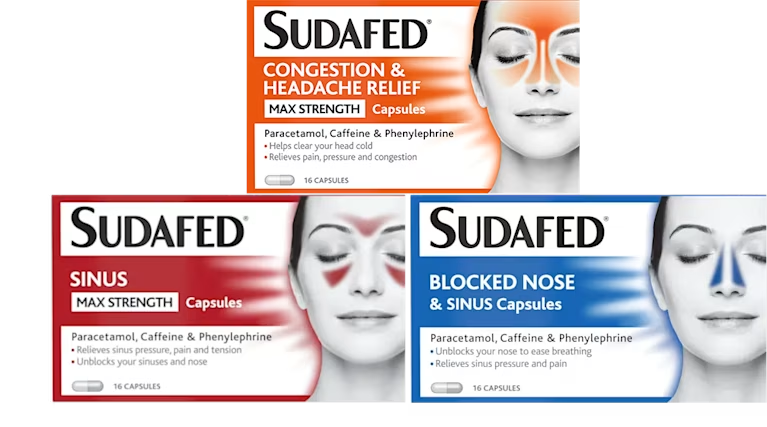
But this can be confusing, because even the same medication from the same company can be branded differently. For example, Sudafed's Sinus Max Strength Capsules, Congestion & Headache Relief Max Strength Capsules, and Blocked Nose & Sinus Capsules sound different, and on the packaging you can see different parts of the person's face highlighted to indicate they target those areas. But they're exactly the same medication, right down to the PL number (12063/0067).
If you spot two medications with the same PL number, even if the packaging is worlds apart, the Royal Pharmaceutical Society says it means it's the same product – that's the same active ingredient AND the same formulation.
Also, be wary of claims that a medicine can 'target' specific areas. Nurofen was rapped by the Advertising Standards Authority for a "misleading" TV advert which it said claimed a Nurofen product could specifically target joint and back pain. See the Nurofen TV advert banned MSE News story for more.
-
The 'morning after pill' is now free at many pharmacies in England
An NHS expansion means the oral emergency contraceptive pill (or 'morning after pill') is now free at almost 10,000 pharmacies across England. There's no need for an appointment or a GP referral; women can just drop into their nearest participating pharmacy.
-
Ask your GP for a bigger prescription
Doctors often automatically write out prescriptions for small amounts. If you know you'll be coming back for more and the medicine's not dangerous if overused, ask for a bigger prescription, for example a longer-lasting pack or three of the same item instead of one. But be aware that some doctors are only allowed to prescribe enough to last a certain amount of time.
I used to take a daily medication. Because my condition was stable and I'd been on the medication for a while, my doctor agreed to authorise repeat prescriptions that last three months. That meant I didn't have to go to the pharmacist as often, but more importantly, over the year, I only spent £38.60 (£9.65 x 4) instead of £115.80 (£9.65 x 12). A saving of £77.20 a year!
~ MSE Clare
-
Buying from an online pharmacy's cheap, but make sure it's safe too
When buying online, ensure it's an above-board UK pharmacy, not an illegal site based in some far-flung corner of the world. Follow this checklist before buying:
Is it registered?
All pharmacies in Great Britain (including online pharmacies) need to be registered with the General Pharmaceutical Council. You can check to see if a pharmacy's registered on the GPhC site.
Does it ask for a prescription?
The GPhC also suggests using a pharmacy that asks you for a prescription before they give you your meds. Lots of online pharmacies don't (even registered ones). Instead, they run an online prescription service (sometimes called an 'online doctor'), where you can enter details about your symptoms before getting a diagnosis and prescription medication. The GPhC says to avoid these if you can.
Check the use-by date
Online pharmacies sometimes flog medication cheap because it has a short lifespan. Be sure to check the use-by date on the packet.
Tablets usually have a lifespan of a few years, so this is rarely a problem. But if you're buying in bulk it's worth considering whether you'll use them in time.
-
Cheap tablets taste bad? Try a glass of squash

While there's no medical difference between branded and generic medicines, the packaging and design can differ, with nicer-coloured tablets and better-tasting coatings on premium brands (though generic medications with the same PL number as branded will look and taste exactly the same). But swallow a pill with a glass of squash and you shouldn't notice the difference.
Don't use citrus juice such as grapefruit or orange though, as doctors warn it can counteract some medications.
-
Over 60? Join Boots' club
The Over 60s Rewards club gives members eight Advantage Card points for every £1 spent on Boots' own brand and selected other products. It's free and open to anyone aged 60 or over and a UK resident.
-
Get free eye tests

High street opticians often offer free tests for a limited time. Keep an eye on our Free eye tests Deals page – we'll add freebies there as they arise. You'd pay around £20 normally, unless you're in Scotland where it's free.
It's also worth knowing you've a legal right to take your prescription elsewhere after an eye test, so check the masses of online discount suppliers for glasses at a fraction of the cost.
-
Knock £100s off contact lenses costs

Don't feel obliged to get your glasses or contacts from the optician who does your eye test. Always compare prices online.
The likes of Boots and Specsavers also sell own-brand lenses, which are often reboxed versions of big manufacturers' lenses.
-
Grab a free NHS quit smoking kit
Smoking's as bad for your wealth as it is for your health. There are a raft of subsidised or free ways to help you quit, such as personal quitting plans from the free NHS Quit Smoking website or its free Quit Smoking app (Android or iOS).
-
Check if you have a valid EHIC or apply for a free GHIC
A Global Health Insurance Card (GHIC) and European Health Insurance Card (EHIC) give you treatment at state-run EU hospitals and GPs at the same cost as a local.
If you already have an EHIC, it will continue to cover you in EU countries for the entire time it's valid, so you MUST check it's still in-date as they expire after five years (with the last date to renew EHICs being at the start of 2021, it's likely your EHIC is expired by now).
If you need to renew, or apply for the first time, you'll receive a GHIC instead – but it does pretty much the same thing. For full help, including how to get one for FREE (never pay), see our Free GHIC or EHIC guide.
-
Download our free Mental Health & Debt booklet
Mental health issues can cause severe debt, and severe debt's a catalyst for mental health problems. So we launched our Mental Health & Debt Help PDF booklet (thanks to charities Mind, Rethink, CAPUK & others for help).
The booklet's crammed with info on handling debts when unwell, working with banks, where to get help, whether to declare a condition to your bank and more.
It's written for individuals, caseworkers and carers as well as families of those with anxiety, depression, bipolar and more.

Share this guide?