


Cheap petrol & diesel
Cut your fuel costs by up to 30%

Fuel prices are up by 23% over the past year. The average price of petrol reached its highest in almost four years in August, according to the Office for National Statistics, and diesel prices have also risen sharply. You can put the brakes on these accelerating costs by filling up in the right place and using the right card. Then use our fuel efficiency tips to make further savings – follow our five-step guide...
Step 1: Make your car more fuel-efficient
Some simple checks and adjustments to your vehicle can help reduce fuel consumption (thanks to the RAC for its input in compiling this list). Combined with the tips below on driving more efficiently, these could help save up to 30% on fuel costs – and of course, they're a quick and painless way to benefit the environment too.
If you'd rather watch than read, Martin rounded up these tips and the ones on driving efficiency below on The Martin Lewis Money Show Live on 17 March 2026:


Transcript of what Martin said on his show about petrol and diesel costs
From The Martin Lewis Money Show Live on Tuesday 17 March 2026, courtesy of ITV. All rights reserved. Watch the full episode on ITVX.
"Now, these seem small, but have a bigger impact than you think. You should try and look to make your car as efficient as possible. Here is our car that has a few problems. First of all, it's got a roof rack on. If that's empty, get rid of it. Really inefficient. You're having to push that through the wind on the motorway as you drive, and you'll see problems in all walks of like this – junk in your trunk.
"You want to get rid of junk in your trunk. Extra weight, for every about 45kg it makes your car 1% less fuel efficient. So we get anything out of the boot that we're not using and heavy weight. And look at those tyres not pumped up. Again, that can add 3% or 4% to your fuel bills when it's not more efficient. So get your tyres checked and pumped up properly.
"Finally, air-con. When you're going at low speeds, your air-con can be really quite expensive proportionately, make the car much less fuel efficient. At high speeds if it's warm, keep it on because opening your windows, again the motorway will really add drag and make the car have to work much harder to go further.
"So that's the next step. Make your car more efficient, and you add that to this one. How you drive matters too. Your accelerator is a money pump. When you are pressing it, you are spending the fuel that you have put into the car. Your brake isn't much better, it's a money burner because when you're braking, you are converting the energy stored into the car into heat and throwing it away.
"Now, I'm not saying don't accelerate or brake, because that's what driving is all about. But... yeah, obviously. Your road positioning – [staying a] safe distance from the car in front, thinking ahead, all enables you to speed up more slowly and slow down more gradually, which is massively more fuel efficient. To put it another way, if you’re a [mimicking car screeching noises] that's bad, if you're a [mimicking relaxed car driving sounds] that's good.
"So it all sounds a bit silly on the back of that, but when they do studies, making your car more efficient, driving a better way can cut... [talking to studio screen] Here we go. Hurry up. Shoo!... 10% to 30% off your petrol and diesel cost, depending on where you start. So it really is worth having a look at, especially at the moment when prices are high.
"Not rocket science, but worth knowing."
-
Keep your tyres inflated

Lower tyre pressures increase drag on a car, meaning you need more fuel. Regularly check the pressures are correct (overinflating will also use more fuel) and your car will need less oomph to keep it moving.
-
Declutter your car
The lighter your car is, the less effort it needs to accelerate. By clearing out junk from the boot and not carrying any unnecessary weight, you can save a little more money. Any extra weight you ride around with ups your fuel consumption – while lightening the load won't make the biggest difference, every little helps towards keeping it down.
-
Take your roof rack off
A roof rack, even unused, adds wind resistance to a car, increasing drag and making the engine work harder. If you don't need it, take it off, along with anything else inefficient. Even closing the windows and removing any flags will make the car run slightly more efficiently.
-
Turn off air-conditioning at lower speeds

Air-conditioning uses engine power and therefore fuel – so make sure it's turned off unless you really need it. The general consensus is it's more efficient to drive with the windows down and the air-con off at lower speeds, but at higher speeds it's better to use the air-con and keep windows up due to the extra drag caused by having windows down.
If you're not using your air-con, it's worth turning it on once in a while as not using it can mean it stops working. -
Not filling up is more fuel efficient – but only just
A lighter car uses less fuel and a full tank adds weight, so technically, the less fuel your car is carrying, the more efficiently it drives. But even a full tank typically makes up only a small proportion of a car's overall weight, so don't expect miracles if you switch to putting less in and filling up more often.
You'll likely save more by removing unnecessary weight from elsewhere (as Martin says above, every 45kg or so makes your car 1% less fuel efficient) and by finding a cheap forecourt to fill up at, than you would by putting less fuel in – especially if you run low and end up having to buy more expensive fuel elsewhere later on.
Step 2: Eight tips to drive more efficiently
You can drive the same distance, in the same car, without slowing down, but using less fuel – better for your wallet, better for the environment. The key is to drive smoothly. Here are the eight tips you need to know.
-
Think about road position
Most of the tips in this list require you to be alert and aware of your road position. This helps you plan ahead and move gradually. It also means that more efficient driving is also safer driving.
-
Accelerators are money pumps – accelerate gradually
Speed up smoothly. The harder you press on the accelerator, the more fuel will flow – but you can reach the same speed using much less power. As a rough rule, stay under 3,000 revs. Plus, if you accelerate too quickly, chances are you'll then have to brake hard, which isn't exactly efficient.
-
Change up a gear sooner
Always drive in the highest gear possible without labouring the engine. So change up much earlier than feels natural – it'll take some pace out of your acceleration, but as that's another key tip, it isn't a bad thing. If you have a fuel efficiency display, you'll be surprised how immediate an impact this has.
-
The brake is a money burner
Where safe, allow yourself to slow naturally rather than hitting the brakes. When you press the brake you are essentially converting the energy you've paid to put into the car into heat. Instead, where you can, make the most of the car's momentum – good road positioning is crucial for this. Over the course of a journey if you brake frequently, you'll end up having to accelerate more too, which ultimately means using more fuel.
-
Listen to the noise of your engine
If you hear sharp acceleration and screeching brakes you know you're doing it wrong. Imagine driving from traffic light to traffic light doing that. The person behind who accelerates and decelerates more slowly will still be behind you at the next light – they'll just have spent far less getting there.
-
Keep moving if you can
The most expensive metre you drive is always the first one. It takes huge energy to get a car going. So if you can safely roll gradually up to a traffic light as it changes from red to green, without stopping, it is more efficient than stopping and restarting.
-
Save cruise control for motorways
On long, flat roads, cruise control helps you save on fuel by maintaining a constant speed, thus removing unnecessary acceleration. But used regularly on roads that aren't flat, it will increase how much fuel you use because it's slower to react to changes in gradient, meaning it will accelerate for longer than a driver would when going up a hill. Motorways are usually flat, so reserve it for when you can cruise along.
-
Coasting in neutral can be cheaper – but it's dangerous
While putting the car into neutral and coasting may feel like you're using less fuel, it's dangerous – don't do it. You always need access to the accelerator to avoid unexpected hazards. Plus cars can handle far worse on sharp corners when in neutral.
In many ways, this all comes down to one little rule of thumb...
When you put your foot on the accelerator, the harder you press, the more fuel you use.
Just being conscious of this, and your road position, should massively increase how far you can drive on a tank of petrol or diesel.
While it's tricky to accurately gauge exactly how much you could save on fuel by making your car more fuel-efficient and driving more efficiently, the AA says when 50 of its staff undertook an eco-driving trial they saved an average of 10% in a week – the biggest saving was a whopping 33%.
 Martin LewisMSE founder & chair
The real world impact: Martin's story
On an overseas holiday I got to test this, thanks to a sexy little digital display in my hire car which gave me a km/litre readout. For every trip, I drove normally on the way there and used the 'think when pressing the pedal' method above on the way back.
If you're thinking 'Did he really bother while on holiday?' – yes I did, and I loved it. Luckily my girlfriend (now my wife) is very understanding!
The improvement was enormous. Overall, I drove about 500 miles, and the different 'efficiency' averages per litre of petrol were incredible: for normal driving, it was 11.2 km per litre, but for efficiency-conscious driving, a remarkable 13.4 km per litre.
Most intriguingly, the efficient driving didn't cost me any time at all, and on motorways my top speed didn't change. Others drove harder, only to brake harder at the next traffic light...
- Martin Lewis, MSE founder & chair
If you try this and want to share your experiences, visit the Petrol efficiency experiment forum discussion.
Step 3: Find the cheapest petrol or diesel prices in your area
The easiest way to find the cheapest forecourt in your area for petrol or diesel, whether standard or premium, is by comparing prices using a nifty free tool like the one below...
You may have seen stories about the Government 'Fuel Finder' service, which launched in February. But it is NOT by itself a service for motorists.
It aims to force retailers to report their prices and make the data available to third-party websites and apps like the one below. This then allows drivers to compare prices in real time, helping them find the cheapest and so – hopefully – increasing competition.
For more on the scheme, see the Gov.uk website.
Find the cheapest fuel near you
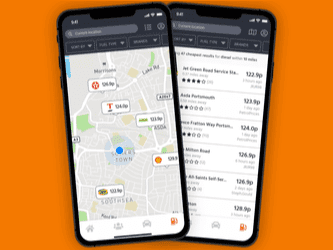
Go to PetrolPrices.com
See the cheapest filling stations in your area by entering a postcode, town or city, the type of fuel you want and how far you're willing to travel (up to 20 miles).
It covers over 8,000 forecourts across the UK, and there's a PetrolPrices app to make it easier to use on your phone or tablet.
Using it can save as much as £10-£20 on filling up a typical family car. For example, within five miles of a postcode in Gloucester the price of unleaded on Tuesday 22 September ranged from 161.9p to 195.9p per litre. While the difference per litre may be pennies, in percentage terms you could pay up to 19% more by going to the 'wrong' forecourt.
Got a Costco near you? Fuel savings can pay for membership
Many unknowingly qualify for Costco membership, which costs £42 a year, and what you save on fuel alone may pay for it. As an example, for a postcode in Sheffield on Tuesday 22 September we found petrol prices ranging from the cheapest – Costco, at 147.9p per litre – to a pricey 175.9p per litre within five miles. That's a £15 difference when filling up a typical family car. For a full rundown, see our Costco tips.
Use loyalty schemes
Buying petrol or diesel is a regular outlay, and you spend more on it in a year than you think – £30 a week is over £1,500 a year. As many fuel stations (including supermarket ones) run some form of loyalty scheme, it's worth signing up to schemes for the forecourts you'll use most regularly, to get a little extra back.
However, never choose a filling station just for its loyalty scheme, as the difference is small compared with how fuel prices can vary from forecourt to forecourt (also see our guides on Boosting Nectar points and Tesco Clubcard vouchers).
Also, keep an eye out for short-lived fuel discount promos that pop up from time to time. There aren't currently any on that we know of, but we'll publish details here when there are.
Other filling-up tips
There are several other ways to cut the cost of petrol and diesel:
Always fill up at least 50 miles before your tank's dry
Then there's no panic and you've enough time to get to a cheaper filling station. Leave it longer and you'll fill up at the next one you see, so you won't be focused on price.
This is slightly offset by the fact that a lighter car uses less fuel. But with 50 miles of fuel left, the difference is tiny.
Filling up at night won't be a big MoneySaver
Talk of filling up at night getting you more is a slight urban myth, as the difference is minuscule – pennies at best. Fuel pumps are calibrated by volume, so fill up at night when it's colder and you get a tiny, tiny bit extra.
Don't try to put more in after the clunk
Filling your tank to the top isn't great, as it adds weight to the car (see how to make your car more fuel-efficient). But if you must, don't keep going after the petrol nozzle 'clunks'. If you do, you're overfilling.
Step 4: Pay using a cashback card
Cashback cards pay you back each time you spend on them. They are a great way to shave the cost of your fuel, but if you get a cashback credit card ALWAYS abide by the golden rule...
Set up a direct debit to repay the card in full each month, so you never pay interest, which would outstrip any gain.
The reason credit card companies offer cashback or reward schemes is simple. They want to encourage you to spend on the card and pay them interest. The interest cost of all cashback cards dwarfs the cashback you'll earn. For full details on what to consider before applying, see Credit card rewards.
Each time you apply for one of these cards, you'll be credit-checked by the lenders. Multiple applications in a short period can affect your future ability to get credit. Read full details in our Credit scores guide.
The easy way to pay off in full
It's easy to do this via direct debit, which allows the credit card company to take a variable monthly amount that corresponds with what you owe. Unfortunately, some firms deliberately omit 'repay in full' as an option when you set up a direct debit, as it makes them less money. If that's the case, contact them and ask them to make sure your direct debit is set up to pay off what you owe in full.
The top Amex cashback credit card
You can get 5% bonus cashback on everything you buy for the first five months, up to a maximum £125, with our top-pick American Express reward card, the Cashback Everyday. After the introductory bonus, cashback is then tiered up to 1%, though you need to spend £3,000+ a year to get any cashback.
Full details and more options in Top-paying rewards credit cards.
The top cashback (and easy to apply for) debit card
You can get 2% cashback, up to a max of £20 a month, on supermarket, transport and fuel spending with Chase's app-only current account. After the first full month, you need to make at least 15 card or direct debit payments a month and have £1,000 or more in Chase savings account to qualify for cashback.
You don't need to switch from your current bank to open a Chase current account, there's no hard credit check when you apply and there's no minimum pay-in requirement.
Full info and how to apply in Top alternative reward debit cards.
Step 5: Share the driving to cut your fuel costs
An easy way to cut fuel costs is to drive less. One option is to share lifts to work with friends. There are a few sites that connect people doing the same journey.
Liftshare

Register your details on Liftshare and enter the journey you'd like to share. Then check the results for matching commuters – it also lets you search for potential matches before registering.
The site's been going since 1998, and it reckons its members save over £1,000 a year on average. It has a nifty savings calculator to help work out how much your journey costs, plus how much you could save by sharing.
BlaBlaCar

Founded in France in 2006, BlaBlaCar came to the UK in 2011 and says it now has 27 million active members across 21 countries. You can search for potential matches without registering, but you'll need to register for free using Facebook or email if you want to get or give a lift.
Anything to watch for?
-
Be safe. The sites store details securely, but when it comes to travelling it's important to be vigilant. Arrange to meet for the first time in a public place, let friends or relatives know what you're doing and check the other person's ID to ensure they are who they say they are.
-
Taking passengers shouldn't affect insurance. If you're giving a lift to someone and asking for a contribution towards fuel costs, the Association of British Insurers says that provided there's no element of profit, your car insurance is unlikely to be affected.However, to be completely sure, check with your provider first.
How much can you save using the five-step cheap petrol system?
MoneySavers who have tried this have made big savings off the bat (and see below for our estimates of how much you could save taking this to the max)...
'Do it – you'll be surprised'
Thanks to driving tips from @MoneySavingExp, I have saved myself £20 in fuel in 1 month, driving more carefully. Do it – you'll be surprised.
- MoneySaver @mathewhasker on Twitter
'I doubled my fuel economy!'
Over the last 2 years I have almost doubled my fuel economy, without changing vehicles.
1. I drive much more smoothly and don't overtake other car users just to get one or two places further along in a big queue.
2. I leave for work a little later and return home a little later – as a result I no longer spend 30 mins plus on a 4-mile crawl through stop/start traffic on a 26-mile (each way) commute into and out of Aberdeen.
My blood pressure is also lower.
- MoneySaver Caleypine
'75+ extra miles per tank!'
Results I've got from trying to drive more fuel-efficiently. Most of this has been city driving:
Previously, 33 to 35 litres gave me around 215 miles.
Driving more carefully increased this to around 235 miles.
Turning engine off at lights increased this to 293 miles ... Lots of lights in London.
- MoneySaver Krishna
MSE challenge: The petrol/diesel diet
Once you've read the steps above, why not try the petrol/diesel diet? No, we don't advocate swigging the stuff – it's a challenge on the MSE Forum, where MoneySavers share tips to help cut their annual fuel spend, track savings and inspire others.
The forum's proved hugely powerful in the past, seeing people work together to get debt-free, pay off mortgages and more. It's free to join, and open to all – see the Petrol/diesel diet challenge discussion.
How much can you save?
The savings from following our system can be huge. For someone driving 15,000 miles a year, averaging 35 miles per gallon (12.4 km per litre), just buying petrol at the average UK price would cost £3,356 annually as of September 2026. Cutting this by 25% could save a whopping £839 a year.
To work out roughly how much it costs you to run your car, use the fuel consumption search tool on the Gov.uk website (it's best for newer vehicles). Motoring website Honest John also has a handy 'real miles-per-gallon' section where drivers report the miles per gallon they actually get from their cars.
ANNUAL MILEAGE | AVERAGE ANNUAL COST (1) | COST IF CUT BY 5% | COST IF CUT BY 20% | COST IF CUT BY 25% | POTENTIAL MAX SAVING |
|---|---|---|---|---|---|
5,000 | £1,119 | £1,063 | £895 | £839 | £280 |
15,000 | £3,356 | £3,188 | £2,685 | £2,517 | £839 |
30,000 | £6,713 | £6,377 | £5,370 | £5,035 | £1,678 |
(1) Cost of unleaded at 35 miles per gallon (12.4 km per litre) at 172.4p per litre. Updated September 2026.
How does the cost of fuel break down?
Tax makes up a hefty portion of the cost of a litre of fuel. The current fuel-duty rate for petrol and diesel is set at 52.95p per litre. This was set to rise at the end of August but is now frozen until 31 December. On top of that you pay VAT at 20%, which is applied to both the fuel price and the duty.
Share this guide?