

Energy bills explained
How to use them to save

Energy bills can be confusing – sometimes it's hard to decipher exactly how much you're paying. This guide explains the key items you'll find on your bill to give you more control over what you're paying and make switching easier.
Sample bills explained, by company
Select your supplier to see our explanations of the items you'll find on your bill. Ovo Energy and Scottish Power were unable to provide us with a sample bill.
British Gas
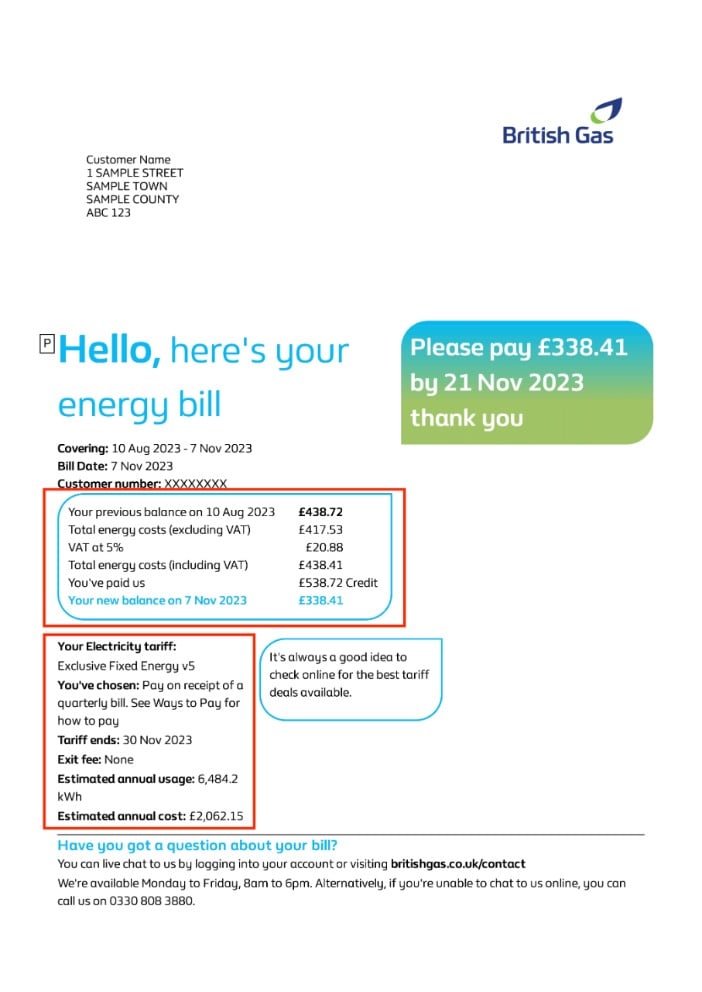
Your new balance
Here you'll see your balance as of the latest billing date, alongside a breakdown of how your supplier got to that figure.
In the example above for British Gas, you can see the new balance is calculated by taking the balance from the previous billing period (in this case on 10 August 2023), PLUS the cost of energy you've used in the current billing period (10 August to 7 November 2023), including 5% VAT (the tax everyone pays on energy).
Anything you've paid to British Gas during the billing period is then taken off to get your new balance. This is the amount you owe British Gas. If British Gas owes you money, it'll say 'Credit' next to the amount.
Your tariff and energy usage
Here, you'll see the name of the tariff you're currently on (you'll need this exact name when comparing prices), the date your tariff ends (if on a fixed tariff) and any exit fees you'll be charged if you leave the tariff before the end date.
You'll also see how you pay for your energy bills (for example, 'Pay on receipt of a quarterly bill' or 'Direct Debit'). Remember, it's always cheaper to pay by Direct Debit than on receipt of bills.
Your bill will also include an estimate of how much energy you're predicted to use, and how much it'll cost you on your current deal, over 12 months. Always submit a meter reading to make sure you're being charged for the exact amount of energy you're using.
Could you pay less?
Most bills also include a section on whether you could pay less by moving to your provider's cheapest tariff. It's fairly basic on British Gas's bill, simply reminding you to check online if you can switch and save.
Providers often include their cheapest tariff in this section (if you're not already on it), but bear in mind that your provider might not have the cheapest deal on the market, so it's always worth doing a full market comparison.

Your account in detail
This breaks down how your charges for the current billing period have been calculated, using the amount of energy you've used in kilowatt hours (kWh) and the daily standing charge cost for this period.
You can also see your total electricity usage in the current billing period in kWh and how much you used in the same period last year.
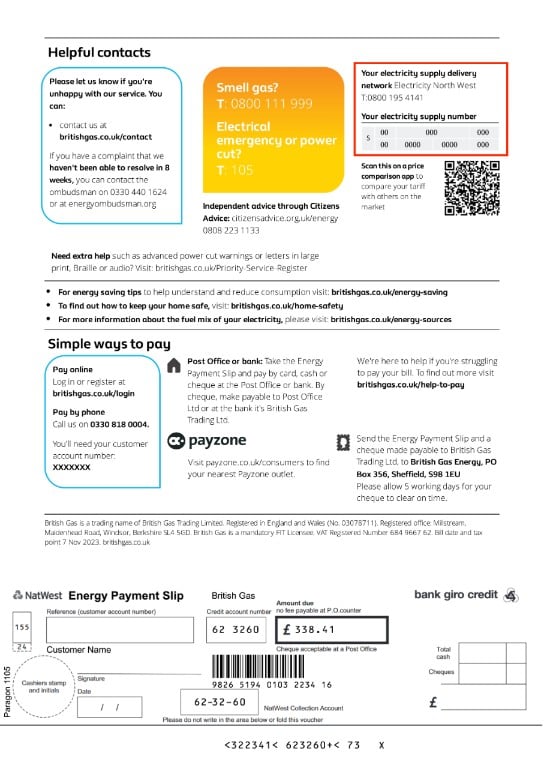
Your electricity supply delivery network
This shows what region you're in for your electricity supply. Different regions pay different rates and standing charges for their energy.
Your electricity supply number
Your supply number, also called Meter Point Administration Number (MPAN), is shown here. It's unique to your home and you'll need it if you're switching. It's 21 digits in length and you'll see it printed on all electricity bills.
E.on Next

Your new balance
Here you'll see your balance as of the latest billing date, alongside a breakdown of how your supplier got to that figure.
This is the balance from your last bill, PLUS the charges for the energy you've used in the current billing period (in this example, 5 December 2023 to 4 January 2024), LESS anything you've paid to E.on Next during the billing period.
For E.on Next, if it has a 'DR' next to the balance amount, it means you owe it money. If you're in credit, your new balance will have a 'CR', which means you're in credit (in fact, you may be able to request some money back).
Could you save money and pay less?
In this section your supplier will give you details of its cheapest tariff. Yet bear in mind that your supplier's cheapest deal might not be the best on the market. Always do a full market comparison to compare all deals.
Your estimated cost for the year
Your bill will also include an estimate of how much energy you're predicted to use, and how much it'll cost you on your current deal, over 12 months. Always submit a meter reading to make sure you're being charged for the exact amount of energy you're using.

Your charges in detail
On this page, you'll see a breakdown of how your charges for the billing period have been calculated, detailing how much energy you've used, plus the daily standing charge cost.
You'll also see here whether your bill is based on an actual meter reading or an estimated one. In the example bill above, an estimated reading is used.
E.on Next shows your supply number here, also called Meter Point Administration Number (MPAN). It's unique to your home and you'll need it if you're switching.
About your tariff
This includes: the name of the tariff you're currently on (you'll need this exact name when comparing prices); whether it's a fixed or variable tariff; your payment method (for example, Direct Debit or 'pay on receipt of bill'); plus the unit rate and standing charge that you're paying while on this tariff.
If you're on a fixed tariff, your bill will show any early exit fees you'll be charged if you leave the tariff before the end date.


How much energy did you use?
This section of your bill shows your daily average gas and electricity use for the billing period. This is the total used during the period, divided by the number of days.
EDF Energy

Your new balance
Here you'll see your balance as of the latest billing date, alongside a breakdown of how your supplier got to that figure.
This is the balance from your last bill, PLUS the charges for the energy you've used in the current billing period (in this example, 30 November 2023 to 1 January 2024), LESS anything you've paid to EDF during the billing period.
This is usually the amount you owe EDF. However, in this example, EDF owes you money, as it says 'Credit' next to the amount. This means you've been paying more than you've been charged (though depending on the time of year, this isn't a bad thing – see Martin's blog on the Direct Debit cycle).
Your estimated annual cost
Your bill will also include an estimate of how much energy you're predicted to use, and how much it'll cost you on your current deal, over 12 months. Always submit a meter reading to make sure you're being charged for the exact amount of energy you're using.
Could you pay less?
Most bills also include a section on whether you could pay less by moving to your provider's cheapest tariff. In the example above, the bill-payer is on EDF's cheapest.
If that wasn't the case, it would mention its current cheapest tariff in this section. Yet bear in mind that your supplier's cheapest deal might not be the best on the market. Always do a full market comparison to compare all deals.

Your charges in detail
On this page, you'll see a breakdown of how your charges for the billing period have been calculated, detailing how much energy you've used, plus the daily standing charge cost.
You'll also see here whether your bill is based on an actual meter reading or an estimated one. In the example bill above, an actual reading is used.
About your tariff
This includes: the name of the tariff you're currently on (you'll need this exact name when comparing prices); whether it's a fixed or variable tariff; your payment method (for example, Direct Debit or 'pay on receipt of bill'); plus the unit rate and standing charge that you're paying while on this tariff.
If you're on a fixed tariff, your bill will show any early exit fees you'll be charged if you leave the tariff before the end date.
Octopus Energy

Your new balance
Here you'll see your balance as of the latest billing date, alongside a breakdown of how your supplier got to that figure.
This is the balance from your last bill, PLUS the charges for the energy you've used in the current billing period (in this example, 4 December 2023 to 3 January 2024), LESS anything you've paid to Octopus during the billing period.
If you're in credit, this amount will be positive. If you owe Octopus, it'll be negative.
Could you pay less?
Most bills also include a section on whether you could pay less by moving to your provider's cheapest tariff. In the example above, the bill-payer is on Octopus's cheapest tariff.
If that wasn't the case, it would mention its current cheapest tariff in this section. Yet bear in mind that your supplier's cheapest deal might not be the best on the market. Always do a full market comparison to compare all deals.
Your estimated annual cost
This is your estimated usage for the next 12 months, not your actual usage, assuming your unit rates and standing charges stay the same. Always submit a meter reading to make sure you're being charged for the exact amount of energy you're using.

Your charges in detail
Here, you'll see a breakdown of how your charges for the billing period have been calculated, detailing how much energy you've used, plus the daily standing charge cost.
You'll also see here whether your bill is based on an actual meter reading or an estimated one. In the example bill above, an actual reading is used.
For Octopus, it'll show your supply number here as well, also known as a Meter Point Administration Number (MPAN). It's unique to your home and you'll need it if you're switching.
About your tariff
This includes: the name of the tariff you're currently on (you'll need this exact name when comparing prices); whether it's a fixed or variable tariff; your payment method (for example, Direct Debit or 'pay on receipt of bill'); plus the unit rate and standing charge that you're paying while on this tariff.
If you're on a fixed tariff, your bill will show any early exit fees you'll be charged if you leave the tariff before the end date.


How much did you use?
This section of your bill shows your daily average gas and electricity use for the billing period. This is the total used during the period, divided by the number of days.
Crucial tips to save on your energy bills
Here are our top tips to save:
Should you switch supplier?

If you're one of the 65% of households in Great Britain on the Price Cap, you are likely overpaying for your energy. Consider moving to one of the current deals available.
For a full comparison, see our Cheap Energy Club, or you can read more in our Should I fix? guide.
Pay by monthly Direct Debit

Opt to pay your energy bills by monthly Direct Debit and you'll usually save around £100 a year compared to paying on receipt of a bill.
Yet it's crucial to make sure your supplier doesn't set it too low or too high. Either the supplier keeps hold of your cash unnecessarily, or you end up with a big catch-up bill. Full details in Energy Direct Debits help.
Most suppliers will credit-check customers wanting to pay by Direct Debit. You can sign up to our Credit Club to get your free credit score and check your chances of being able to switch to Direct Debit payments.
Do a meter reading regularly

Every time you receive a bill, do a meter reading. Don't rely on your energy provider's estimate – these are often way out. If they're under-billing, you'll have a big whack to pay at the end of the year. If they're over-billing, then they've unfairly got your cash.
If your Direct Debit is way off-kilter, call up and request it's changed. You have a range of rights to ensure it's correct. See the full Energy Direct Debits guide for full details.
Smart meters can help stop this as they send meter readings automatically to your supplier, so you only pay for what you use. See our Smart meters guide for more.
Using less energy is a simple way to save on bills
Using less energy can really pay off and is simple to do. Turn down the thermostat and wear jumpers, turn lights off when you leave a room, take shorter showers, use energy-saving light bulbs and don't leave electrical goods on standby. For more info, see our top Energy saving tips or our Energy mythbusting guide.
Grab £1,000s of grants

There is a vast range of grants available for improving home heating and insulation.
If you're on benefits or live in a home in council tax bands A to D, you might be eligible for free insulation through The Great British Insulation Scheme.
For more help, see our What to do if you're struggling to pay for your energy guide.
Energy bill FAQs
What does 'kWh' mean?
A kilowatt hour (kWh) is the measure used to explain how much energy you use. One kilowatt hour is equal to 1,000 watt hours. Use an appliance rated at 1,000 watts for one hour and you'll be billed for 1kWh.
This is unlike phone bills, where you can clearly see the price per minute and relate it to how much you're using.
What's the difference between debit and credit?
The terms 'debit' and 'credit' can be confusing. While you'd usually associate 'credit' with something you owe, in this case credit means when you've paid extra on your energy bill. 'Debit' means when you owe the supplier.
Can I get my energy bill in an alternative format?
Like every company, energy suppliers are not allowed to discriminate against customers who have different needs when it comes to reading their bills. You can request for your bill to be in large print, Braille or even another language.
If you're on the Priority Services Register, you shouldn't have to pay to have your bill provided in an alternative format.
What is the QR code on my bill?
All suppliers must now provide a QR code on your energy bills, so you can easily compare available tariffs. If you have a smartphone or tablet, you can scan the QR code on your bill and it will give you information, such as:
-
How much gas and/or electricity your supplier estimates you'll use in a year (based on the latest information it has about your energy use).
-
Your electricity MPAN and gas MPRN (also known as your supply numbers).
-
Whether you have electricity, gas or both.
-
Who supplies your energy.
-
The name of your current tariff.
-
How you pay for your energy (for example, by Direct Debt, or on receipt of bill).
Your bill must also provide details on how you can contact Citizens Advice and Citizens Advice Scotland. It can offer you information and energy advice, as well as helping with supplier disputes.
Share this guide?