




Cheap travel insurance
Get annual cover from under £10/year, or less for single-trip cover

If you've booked a holiday but not got travel insurance cover yet, DO IT NOW, DON'T DELAY. Half travel insurance's value is protecting you BEFORE travelling if something happens and stops you from going, as well as covering you on holiday if you need medical treatment. Find out what to watch out for, then use our Cheap Travel Insurance Finder tool to find your cheapest policy.

First, a quick overview of cheap travel insurance
Travel insurance protects you before and during your trip – covering cancellations, medical costs abroad, and lost or stolen belongings. Here's what you need to now:
Buy cover As Soon As You Book. So you're protected if something happens before you go and you need to cancel.
Always declare all medical conditions. Or any claims may be rejected.
Find the best policy for you. Use our Cheap Travel Insurance Finder tool to compare prices.
Choose the right type of cover. Single-trip covers one holiday, or look at annual/multi-trip if you’ll travel twice or more a year.
Going skiing or on a cruise? You'll likely need to add winter sports or cruise cover as extras.
Take your free EHIC or GHIC card for medical care in the EU. It entitles you to the same medical treatment as a local, but it’s not a substitute for insurance.
Are you in the right place?
- Over 65? See our Over-65s' travel insurance guide.
- Medical conditions? See Pre-existing conditions.
- Staycation planned? See UK travel insurance.
What does travel insurance cover?
The aim of travel insurance is to cover the cost of the unforeseen, such as illness, injury or theft of your stuff while you're away. It's also designed to cover you if you have to cancel your trip before you go, or if you need to return early due to an emergency. However, it's not designed to cover every eventuality or every loss or inconvenience that you experience while on holiday.
You should expect an insurer to pay out for most of the below, though not all policies are the same, so cover will vary by policy – so always check the terms carefully before you buy.
Reason | Typical examples |
|---|---|
Cancellation as you can't travel | If you're made redundant, have to do jury service, fall seriously ill, test positive for Covid, suffer a bereavement or have a home emergency such as a fire, flood or break-in. |
Medical expenses while abroad | If you fall ill overseas, including Covid, and require treatment – plus any travel costs if you need to be brought back to the UK for it. Though ALWAYS tell your insurer about any pre-existing health conditions, or you won't be covered (see our Pre-existing conditions travel insurance guide for full help). |
Cutting your trip short (curtailment) | If an emergency happens that requires you to travel home early, such as death of a close relative. |
Baggage and personal belongings | If any of your stuff is lost, stolen or damaged while you're away. Though there are often limits on the amounts they'll pay out. You may also have cover for this under personal belongings on your home contents policy or for certain items if you've gadget insurance. |
Sports, excursions and other activities | If you can't make use of your booked activities, though some policies only cover this if the provider went bust. |
Personal liability | If you accidentally hurt someone or damaged their property, such as spilling a drink and staining an expensive upholstered chair. |
You catch Covid | You're generally covered if you test positive for coronavirus before your trip or while on it. |
Does travel insurance cover war?
Due to the conflict in the Middle East, many are asking if they can claim on their travel insurance, and what it will pay out for. Generally, war and conflict aren’t covered, so cancellations and delays are usually not covered.
Yet there is some help as many insurers say you’ll still be covered for medical emergencies unrelated to the conflict. In addition, some insurers say they’ll support those stranded abroad or whose future trips have been affected. What you’re entitled to, or the support you will get, will vary from one insurer to another, so it is always a good idea to contact your insurer for clarification.
In brief:
-
War-related claims: usually not covered.
-
Medical issues unrelated to conflict: often covered.
-
Cancellations: sometimes covered, especially if the FCDO advises against travel.
-
Stranded abroad: some insurers may extend cover or help case by case.
For more on this and the help available, including the latest info from major airlines, see our Stranded abroad or travel disrupted due to conflict in the Middle East? Your rights explained guide.
What types of travel insurance can I buy?
There are several different types of holiday insurance – they mostly differ in terms of the length of the policy, who's covered by it, and where you're covered. For example, you can choose between:
-
Single-trip travel insurance. This covers you from the point you buy insurance to the day you come home from the specific trip you're insured for.
-
Annual multi-trip travel insurance. This covers all trips taken during the period the policy covers.
But, once you've chosen between the two, you then need to decide who to cover:
-
Family travel insurance. Generally covers parents, and children who live with them.
-
Couples' travel insurance. Covers the two named policyholders.
-
Individual travel insurance. Just covers the person named on the policy.
And your final decision is where you want the travel insurance to cover (see how to check this):
-
European travel insurance. Does as it says, but insurers' definitions of 'Europe' vary, so do check.
-
Worldwide travel insurance. You'll often have to choose to include or exclude North America from the policy (medical expenses are often high in the USA, so you may pay extra for cover if you're travelling there).
Travel insurance need-to-knows
As we highlighted above, holiday insurance covers a wide range of unforeseen events – and here are a few things you need to know before choosing a policy. Know what you want? Go straight to our Cheap Travel Insurance Finder tool which shows the cheapest no-frills policies.
Always declare medical conditions or your claim may be rejected
The thought of declaring health conditions can be daunting, but if you don’t tell your insurer, any claim you make could be rejected.
Always declare all existing medical conditions, even ones you don’t think are important, as each insurer treats them differently. Be full and frank about your health history (usually the past five years), including any Covid-related issues, and let them know if you’re pregnant.
For more help – including what counts as a pre-existing condition, how to declare it, and tips to find the cheapest cover – see our Pre-existing medical conditions travel insurance guide.
Using weight-loss jabs? You must declare them
More than a million people in the UK now use drugs such as Ozempic, Wegovy or Mounjaro. If you do, you’ll need to tell your insurer when buying travel insurance as they usually treat them as prescribed medication. If you don’t declare them, your cover could be invalidated – even if your claim has nothing to do with the jab.
Don't forget your free EHIC/GHIC as it can help with medical costs in Europe
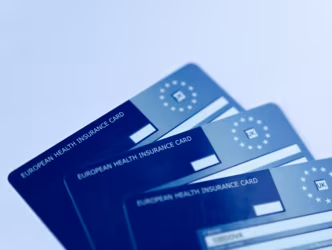
The free European Health Insurance Card (EHIC) and its replacement, the Global Health Insurance Card (GHIC), which has been sent to new applicants since 1 January 2021, entitles you to treatment in state-run hospitals in the EU at the same cost as a local would pay. So if they pay nowt, you pay nowt.
Also worth knowing that even though Norway, Iceland and Liechtenstein are not part of the EU, you'll still be entitled to treatment in state-run hospitals when you use your health insurance cards in these countries.
The card is free so if a copycat site pretending to be the real thing advertises a fee (often about £35), run a mile. For full info and how to get it for free from the legitimate NHS site, read our Free EHIC/GHIC guide.
IMPORTANT. A EHIC/GHIC should be seen only as a supplement to travel insurance, not a replacement. Holiday cover protects against a much wider range of scenarios, including cancellation, possessions, delays, repatriation, personal liability and more. Even when using the card you may still face charges, which travel insurance can cover – and in many cases, presenting it means you won’t have to pay the excess.
Check you're covered for the countries you're travelling to (you'll need a specialist policy if not)
Insurers will classify your trip as 'European' or 'worldwide'. This is often further broken down to include or exclude the US, Canada, the Caribbean or Mexico. Selecting the option to include these countries increases the premium due to the high cost of medical treatment – particularly in the US – and possible repatriation.
Annual European travel cover isn't just for Europe
If you're travelling just outside Europe, you don't always have to select worldwide cover. Many insurers actually allow you to use their European cover in a handful of non-European countries too.
If you're visiting Egypt, Morocco, Turkey or Tunisia, it's worth getting a quote for European cover first and then checking the policy's geographical area definition to see if the country you're going to is included. The following insurers – Allianz*, Insure and Go and Coverwise* – all class Egypt, Morocco, Turkey and Tunisia as Europe.
It's also worth noting that not all insurers automatically include Spain (and the Balearic/Canary Islands) in their European cover – you may have to pay extra, so do check.
Check if the Foreign Office is advising against travel to your destination
The FCDO has a list of countries which it feels are unsafe for travel. Usually, this covers areas where there's war, terrorism or other reasons not to travel, such as natural disasters or a pandemic.
Check its website for the latest as things can change quickly. You should also see if the country you're planning to travel to has restricted entry – you can usually do this via its UK embassy website. If one or the other means you can no longer take your trip, see if you can rearrange it, or if the provider will give you a refund.
If you still want to travel (though note we're not encouraging you to do so), you'll need a specialist policy as standard insurers won't cover you, even if travel was allowed when you booked your trip.
Try Battleface*, or, for European trips, Insurefor.com* and Staysure* (with its 'European Foreign Office travel advice extension' optional add-on).
How to get travel insurance for a holiday over a year ahead
If you’ve booked a trip more than 12 months in advance, your options depend on the type of policy.
Single-trip policies
Some insurers will let you buy single-trip travel insurance up to 18 or even 24 months ahead. That means you can get cover in place as soon as you book, which is key as single-trip policies usually include cancellation cover from day one.
If your trip is within the next 12 months, you’ll have a wider choice of insurers, including many in our Cheap Travel Insurance Finder.
Here are the insurers who will let you buy single-trip cover well in advance:
Insurer | How far ahead |
|---|---|
24 months | |
18 months | |
18 months | |
18 months |
(i) Correct 15 July 2025.
Annual / multi-trip policies
Annual (multi-trip) travel insurance can still work for holidays booked more than a year in advance – but only if you keep cover in place until you return.
If you already have an annual policy when you book a trip that’s over a year away, you’re usually covered for issues that arise while the policy is live (such as needing to cancel due to illness), even though the holiday itself is later.
However, annual policies only last 12 months. So if your policy ends before you go or return from the holiday, you’ll need to renew it or take out a new one so that cover runs straight on and continues through the trip itself.
The key rule is simple: you should have a live policy covering you from the moment you book until the day you get home. If your existing policy doesn’t do that, arrange cover to start the day your current one ends.
Heading away twice or more this year? Annual cover may be cheaper
If you know you're going to travel at least twice in a 12-month period, consider an annual policy, often known as a multi-trip policy. This is because annual cover can work out cheaper than buying two single-trip policies. But always do the maths.
Of course, this varies depending on where you're travelling and for how long, but if you get an annual policy you also have the added comfort of knowing if you have a third trip within that 12-month period, you already have the cover in place.
Multi-trip cover will insure you for an unlimited number of trips over a 12-month period. However, the number of days you can be on holiday for per trip may be capped – it can often be as low as 17 days, with others setting the limit at 31 or 45 days but it can sometimes be as high as 90.
Check if you already have travel insurance with your bank account
You may already have travel insurance without knowing. Some bank accounts that charge a monthly fee offer extra benefits such as holiday insurance. If you think your account offers insurance as a sweetener, check the terms to see if it is appropriate for your trip.
While travel insurance with these packaged accounts is a decent perk, do NOT confuse it with a benefit offered with credit cards called travel accident insurance. This only covers accidents on a train, plane or in a hire car paid for on the card. Never think travel accident insurance means you're completely covered.
For accounts that offer travel insurance (and other perks), see our Top packaged accounts guide.
Going skiing? Make sure you've got winter sports cover
Cold-weather sports can be dangerous, so make sure you have winter sports cover. Standard travel insurance usually won’t cover skiing or snowboarding unless you add it.
As well as covering you for the basics you’d get under a standard travel policy, winter sports cover usually includes:
-
Medical costs if you have an accident, plus mountain rescue, airlift and repatriation if needed. Treatment on the slopes can be expensive – the Association of British Insurers says one Brit required £90,000 of treatment for a fractured rib and punctured lung, while a knee ligament injury can cost £1,000s to treat.
-
Piste closure, if you’re unable to ski due to lack of snow or an avalanche. Insurers may pay a set amount per day (often £10 to £50), up to a limit.
-
Loss of or damage to ski equipment, including hired kit, though limits vary by policy.
-
Public liability, if you injure someone or damage their property while skiing.
You’re generally covered for skiing or snowboarding on the piste. Some policies will also cover off-piste skiing, but usually only if you’re with a qualified instructor, so always check the terms.
If you are planning to take part in something even more wild – such as luging or stunt skiing – specialist providers such as BMC and Snowcard may be able to offer you cover.
Planning a cruise? You're likely to need an add-on to your policy to be fully covered
Most regular travel policies will only cover you for loss or theft of goods and medical costs while you're on a cruise. You may NOT be covered for other eventualities unless you have specific cruise cover. These include:
-
Missed departure
-
Unused cruise excursions, for instance, a day trip to a city port
-
Cruise itinerary change
-
Cabin confinement, for example, onboard virus
So, consider buying cruise insurance. A quick way to get a quote is to to use a cruise insurance comparison site such as Compare Your Cruise Insurance* where you select the cruise operator – including the exact ship and cruise – and the month of sail to get a quote.
It's also worth trying the following general comparison sites: MoneySupermarket*, Confused.com*, Gocompare and Compare The Market.
Check out our dedicated cruise insurance guide for more info on the topic.
If you need to claim for cancellation, you'll usually need to prove the tour operator/airline won't refund you first
There's often a clause built in that says the policy won't cover 'recoverable costs', which essentially means you need to prove that you can't claim back those amounts elsewhere.
So you'll usually need to put in the legwork and ask the provider, for example, the airline, holiday operator or car hire firm (and in some cases the credit card company), for a refund before your insurer would even consider a claim under the travel insurance policy.
Want extra protection? Book flexibly and pay on plastic
Travel insurance provides valuable last-resort protection, but it's best used in combination with other ways of minimising the risk of losing money on a trip. For peace of mind, here are some options to consider...
-
Book easily cancellable or flexible flights and accommodation. Hedge towards offers with no/low deposits or those that give refunds or let you rebook for free if you find you can't go.
-
Pay on plastic. Credit cards offer strong protection, as Section 75 refund rules mean for items costing more than £100, the card provider is jointly liable with the seller – though note that bookings via travel agents may not be covered as it usually only covers payments made directly to the travel provider.
Debit cards also have some protection under the 'chargeback' refund rules (but these aren't legal requirements and firms sometimes challenge them).
Yet for both schemes, you'll only be covered if the service wasn't provided, for example if the flight was cancelled or the accommodation was shut. These card schemes won't cover you if you weren't able to go.
-
Package holidays can offer greater protection. If an airline or accommodation provider cancels, you're entitled to a refund. But if the trip or flight is still going ahead but you can no longer travel, then you have few or no rights. See our Cheap package holidays guide for advice on discounts, haggling and when to book.
More info in our Cancellation cover guide.
You're usually not covered if you've been drinking or if you do dangerous sports, so always check exclusions
Like all insurance policies, there are a number of things that providers won't pay out for. Here are some of the most common:
-
Dangerous sports. If you're doing something a bit unusual, such as ski jumping or snowmobiling, check the terms and conditions of your policy first. If you find you're not covered as standard, or via an optional extra, specialist providers such as BMC and Snowcard may be able to offer you cover.
Alternatively, specialist brokers can help you find insurers that cover non-standard trips. To find one, see the British Insurance Brokers' Association website.
-
Alcohol-related injury. You may be on holiday to unwind but if you are badly injured while you are more than just a little tipsy, your insurer is likely to reject your claim. The same goes for drugs. Insurers have different classifications of 'drunk', with some using blood alcohol limits, so check your policy carefully before you buy.
-
Medical conditions. Insurers will often cover you if you have existing health conditions, but if you fail to tell your insurer and then need treatment for that condition, or a related condition, you won't be covered. You may also struggle to get a claim paid if you ignore advised medication or jabs needed to enter a country.
-
Refused entry (to visiting country). It's your responsibility to check your travel documents are valid and you meet the entry requirements. Always check the Foreign, Commonwealth & Development Office (FCDO) website for the entry rules of the countries you're visiting well before travelling.
-
Unattended possessions. Travel insurance will cover your personal possessions when you're abroad, but if you leave your items unattended and they are then stolen, your insurer will not pay for their replacement.
-
Travel to dangerous countries. The FCDO outlines which countries it deems are unsafe for travel. If you travel to a country on its list, your cover is likely to be invalid. Check out its current travel advice for more.
-
Private hospital treatment. Only some insurers will cover you, others won't, so double-check your policy. However, if you're in an emergency and are taken to a private hospital by the emergency services without your knowledge, you're more likely to be covered by insurance, though there is still a chance of rejection.
When should you buy travel insurance?

It’s a common mistake to think travel insurance only matters once you’re on your trip – but the protection starts long before departure. If something unexpected happens before you go, such as illness, a family emergency, or even redundancy, a policy taken out in time could mean you get your money back.
That’s why it’s crucial to get cover ASAB (as soon as you’ve booked). Wait, and you risk losing out if you need to cancel.
This applies just as much to UK breaks as overseas holidays. If you're not sure where to start, our guide to UK travel insurance can help.
Martin Lewis explains more about when to buy travel insurance in this short video, including when your policy should begin and why acting quickly matters.


Health changed after buying insurance? Here’s what to do
Buying cover ASAB is still the safest move – but it isn’t completely foolproof. If you’re diagnosed with a new condition, referred for tests or awaiting results after taking out a policy, you must tell your insurer – even if your GP says you’re fit to travel. If you don’t, the insurer could reject a later claim or void the entire policy.
Some insurers may reassess the risk. In serious cases, they might increase the price, exclude the condition, or even cancel cover altogether. That doesn’t mean they can act however they like – they must act reasonably. If the changes feel excessive, you usually face a choice. You can accept cancellation of the policy and a pro-rata refund of the premium (but then you can’t claim for cancelling the holiday).
Or, if suitable cover isn’t available and you can’t reasonably travel, you can cancel the holiday and make a cancellation claim for your non-refundable costs (but you won’t get the policy premium back). If you’re not happy with how you’ve been treated, you can complain for free to the Financial Ombudsman Service, which can overturn unfair decisions.
Use our Cheap Travel Insurance Finder tool
This tool lists the cheapest no-frills policies that meet or exceed our for travellers aged 65 and under without medical conditions, plus a few high-end policies.
Exclusive discounts via MSE
Here we list special deals you won’t find going direct, or via comparison sites. We’re not saying they win every time, but they’re worth checking and comparing against other providers we list in our Cheap Travel Insurance Finder tool.
Insurer | Deal information |
|---|---|
Get a 20% discount when you use the code MSETRAVEL20. When you buy an Admiral* single trip or an annual travel insurance policy, by the 31 December 2026 and use the code MSETRAVEL20, you'll get 20% off the price. |

Important: Don't let any discounts/vouchers/cashback/gifts sway you – always make sure the policy meets your needs, and get alternative quotes to compare.
Still can't get cover or not happy with the price?
Specialist brokers can help you find insurers that cover non-standard trips, or help you if medical conditions mean you're struggling to find an affordable policy. To find one, see the British Insurance Brokers' Association website.
Always double-check the level of cover offered before taking out a policy as well as providers' websites for any info about coronavirus. Your broker should also be able to help you with any questions you have.
How to claim on your travel insurance
Claiming on your travel insurance shouldn't be daunting and – if you understand the terms and the excesses on your policy – you shouldn't be in for any nasty shocks. Follow the five steps below if you do need to make a claim.
-
Submit your claim as soon as possible. Contact your insurer as soon as you can. Some parts of your policy may have a short window to submit a claim and it may take a while to be processed.
-
Get your insurer to accept a medical claim before you get treatment. If you need to make a medical claim – and it's not an emergency – get your insurer to accept the claim over the phone first, before getting treatment. For example, if you sprained your ankle, call your insurer – if it accepts the claim then, you're less likely to be faced with a rejected claim later down the line. For obvious reasons, don't delay treatment if it's an emergency.
-
Notify the police if it's a theft or loss. If something goes missing or is stolen when you are abroad you may need to get a crime reference number or the overseas equivalent to make a successful claim. Report the incident to the police as soon as you can – you often have to do so within 24 hours – to make sure your claim doesn't hit the skids.
-
Keep receipts. If you are claiming for lost luggage or delay, remember to keep receipts of essential items you have bought while waiting, such as food and drink. Many insurers allow you to add these expenses to a claim and may ask for receipts as proof.
-
Complain if you feel your claim was unfairly rejected. If your travel insurance provider rejects your claim, and you think it has done so wrongly, don't take it lying down. Complain to the free Financial Ombudsman. This independent adjudicator will make the final decision on a claim if you are locked in a dispute with your insurer. For more on how to make a complaint, read our Financial rights guide, or see our section below.
How to complain about your insurance provider
The insurance industry doesn't have the best customer-service reputation and while a provider may be good for some, it can be hell for others.
Common problems include claims not being paid out on time or at all, unfair charges, or exclusions being hidden in small print. It's always worth trying to call your provider first, but if not, then…
You can use free complaints tool Resolver. The tool helps you manage your complaint, and if the company doesn't play ball, it also helps you escalate your complaint to the free Financial Ombudsman Service.
Travel insurance FAQs
What is an excess and how does it work?
An excess is the amount you have to pay towards any claim you make. For example, if you cancel a trip and are entitled to £3,000 back from your insurer but have a £100 excess, you will only receive £2,900.
However, the excess amount, and if it applies per section, and if it applies per traveller, does vary from insurer to insurer.
For instance, most travel insurance providers will likely expect you to pay an excess per person. So if the policy was for a couple, and the flight was cancelled – do expect to pay an excess per person.
It is also worth knowing that an excess per section could also apply. An example could be if your suitcase was nicked and your wallet was inside you could have to pay an excess on both.
If you have a group policy you may also have to pay an excess for each person for any loss that impacts your entire party, such as cancellation. It's important to check all excesses so you know exactly what you will have to pay if you make a claim.
Hence why it is always important to check the policy cover so you know what you are getting.
Could ONE drink invalidate my claim?
Many people aren't aware that if they have an alcoholic drink on holiday, and lose something or have an accident, their insurance may not cover them – even if they only had the one drink. Insurers all have different interpretations – which we have seen in the T&Cs – ranging from "drinking too much" to "approx four pints" to "alcoholic abuse".
In practice, what most say is that it's all about whether or not the drink has affected your decision-making. As we all have different tolerances, for some this could mean that just one drink could invalidate a claim.
It's also been reported that some insurers have gone as far as testing blood samples for your alcohol level (although we wonder how this works in practice) but as stressed, this does vary from policy to policy.
Having a claim refused could hit hard, possibly excluding you from medical or possessions cover. As a general rule, use your common sense as it's about safety as well as insurance. For example, if you're skiing and have two or three glasses of wine at lunch before hitting the slopes again, you're increasing the chance of an accident – which you also may not be covered for.
What are MSE's minimum cover levels?
When picking any policy, we look for the following minimum criteria. The vast majority of policies we list will meet these, even if we don't state it explicitly.
-
Medical expenses: £2 million including repatriation
-
Cancellation: £1,500 (it's designed to cover the cost of your holiday, so make sure your policy matches your holiday style)
-
Baggage: £750 – if yours is worth more, go for a higher level
-
Cash loss: £200
-
Personal liability: £1 million
For annual policies, we only include insurers that will cover cancellation claims for holidays due to take place after your policy expires (as long as you make the cancellation claim while the policy is in place). For example, your annual policy is due to expire in June and you already have a holiday booked in August: you become ill in May and have to cancel – you'll still be covered.
Note: If you choose to use a comparison website for a holiday over a year away, check if the insurer will cover your holiday, as not all do.
Is it cheaper to get a group or individual policy?
If travelling with your partner or family, you have two options – you can cover everyone under one policy, or each person takes their own. It's often cheaper to get a combined policy, however, there are times when separate policies will be better (so always check, to be safe), including:
-
If one of the travellers is over 65, as the group price you'll pay is based on the oldest traveller, or the person deemed to be the highest risk, so the insurer will usually hike the price for all (see our Over-65s' travel insurance guide for ways to cut costs).
-
If one of the travellers has a medical condition, as it will increase the price for all.
-
If just one of the travellers is going outside Europe, in particular to the US, or on a skiing trip (or even both), it could be better to have separate policies, rather than the whole family buying extended cover when it's not needed.
I'm going backpacking, do I need specialist insurance?
It depends on how long you'll be gone for. If you're going away for longer than 60 consecutive days, whether its backpacking or an extended trip somewhere, it's unlikely you'll be covered by a standard insurance policy. Specialist backpackers insurance, also known as 'gap year' or 'extended leave' insurance can offer cover for longer trips.
See our Backpacker insurance guide for more information.
Share this guide?