




Best balance transfer credit cards
Shift existing card debt to 0% interest for up to 38 months

Paying credit card interest? STOP. A balance transfer credit card can save you £1,000s by slashing the interest you pay. Our guide has full info and top picks, plus our Balance Transfer Eligibility Calculator will reveal the cards you've the best odds of getting.

First, a quick overview of balance transfers...
A balance transfer is when you get a new credit card that pays off debt on your existing cards, so you owe the new card instead – but interest-free for a set period. This means your repayments cut the actual debt rather than just cover interest, helping you clear what you owe faster. Three key things to know:
Check your eligibility before applying. Our eligibility calculator shows your chances of getting different cards, so you can focus on those most likely to accept you and minimise applications on your credit file.
Go for the lowest-fee card with a 0% period long enough to clear your debt. The longer the 0% period, the bigger the one-off fee, so shorter 0% cards are cheaper. Unsure? Play safe & go long.
Follow the golden rules. Never miss the minimum monthly repayment, clear the debt before the 0% period ends and don't spend or withdraw cash on the card.
Ready to compare? Jump to the best balance transfer cards
Up to 38 months at 0% – compare the longest deals. You'll pay a transfer fee, but have more time to clear the debt.
Up to 12 months at 0% with no fee – compare no-fee & low-fee deals. You'll have less time to clear the debt, but it could cost nothing or very little.
Up to 22 months at 0% – compare cards for bad credit. Worth considering if you're less likely to qualify for the top deals.
Or continue with the full guide below to understand exactly how balance transfers work, how to choose the right deal and the key rules for using one safely.
What is a 0% balance transfer credit card?
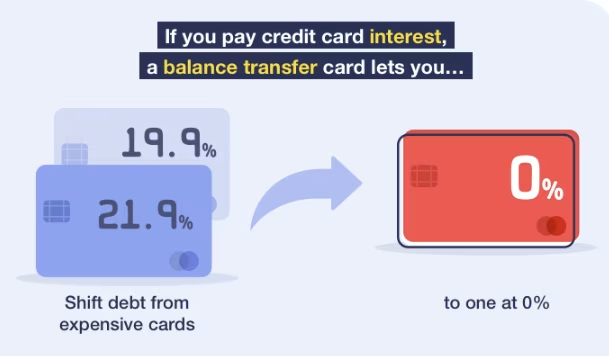
With a 0% balance transfer you get a new card to pay off debt on old credit and store cards, so you owe it instead, but at 0% interest.
A card will have a 0% period, during which you pay no interest – for example, 25 months – and in return you'll usually pay a small transfer fee. It means you become debt-free quicker, as more of your repayments reduce the debt, rather than pay off interest.
Analysis of in September 2026 showed that more than half (55%) of credit card comparisons were for balance transfer cards.
Before moving on, there are some key terms to familiarise yourself with first...
The balance transfer period. This is how long you get at 0% interest.
The balance transfer fee. This is a one-off fee calculated as a percentage of the amount of debt you transfer to your new card. Typically, the longer the period, the higher the fee. Some credit cards offer shorter periods where you pay no fee, though these are rare.
The APR. This is the rate of interest at which you will be charged after the 0% period ends, should you have debt remaining on the card. The higher the APR, the more you'll be charged on any outstanding balance.
How does a 0% balance transfer work?
See Martin's understanding 0% balance transfers video for a full explanation, but in brief...
A balance transfer allows you to transfer debt from one credit card provider to another. To do this you must open a new balance transfer credit card, which are specifically designed for this process. You can then request a balance transfer of all or some of your debt from old credit cards and it will be transferred to your new card. You usually need to request this within the first 60 to 90 days – if you delay, you could lose the promotional 0% deals.


Transcript of what Martin said on the show
From The Martin Lewis Money Show Live on Tuesday 21 January 2025, courtesy of ITV. All rights reserved. Watch the full episode on ITVX.
"Okay, so what is a 0% balance transfer? This is for cutting the cost of existing debts. It's absolutely the crucial weapon. I want to really break it down for you. Let's imagine you have £2,300 worth of debt, one on a Stalecard and one on a Rottencard, both at relatively high rates of interest.
"So what do you do? Well you apply for a new card that's got a specific balance transfer deal to shift the debt. Here we go. The new card. We'll call it the Martcard. Hey, why not? It's 31 months at 0%. You've got a £2,000 credit limit. So what do you do? Well, the first thing is you look at the most expensive debt. That's the one growing quickest.
"That's the one you want to get rid of. And you say, “Please pay the debt off that one.” And that's what the balance transfer is. There we go. The new card pays off the debt on the old card. So you now no longer owe it. It's debts gone down to £0 and you now owe £1,400 pounds, but at 0% for 31 months.
"But you've got a credit limit of £2,000. Now, in terms of balance transfers, they only let you balance transfer 90% of the credit limit. So that's £1,800 in this case. So we've got £400 left. Well you may as well do it again. There we go. Pay off the Stalecard. Now you've got £1,800 worth of debt here and only £500 worth of debt on the Stalecard.
"So if we think of it, roughly your average before was around 23 or 24% APR on £2,300 debt, about £600 a year interest you were paying, now that's all interest-free. You got only £500 debt on there. So that's what, just over £100. That's £500 of interest saved, which means far more of your money is clearing the actual debt rather than just paying the interest. And that gets you debt free quicker. That's why balance transfers are so important.
"You have something? [speaking to his co-host]. "Yeah I have. Anne’s been in touch [referring to user who has written in to the show], she wants to know on this one...
“I have a £4,500 credit card debt, and I'm thinking of a 0% balance transfer. I've been offered a 13 month interest-free credit card for £2,750. Is it worth me doing this as doesn't cover the full amount?”
"Yes yes yes yes yes. Okay. Right. You've made an application. It's gone on your credit file. Your credit file is already affected. You've already spent your creditworthiness and you spent it on a really good thing cutting the cost of your debt. People often get in touch and they say the credit limit they’ve given me is too low. What should I do?
"Well, use it even if it's for £200. £200 at 0% is better than £200 at 25%. So if we talk about that £2,750, assuming you're on a typical APR is £700, £800 a year, you're paying and you could now be paying 0%, even though the rest of your debt you're still paying interest on.
"It's quite like this scenario [referring to the Stalecard, Rottencard and Martcard from earlier]. It's still worth doing. Then once that money's been shifted across, then now get back onto an eligibility calculator, more on that in a moment, and let's see if you can get another balance transfer for the rest. It might be slightly more difficult. You might not be able to get it, but at least you're bringing your interest rate down. So if you get a low credit limit, still use it. You've spent it, back with the application, use it.
[His co-host speaking] "Okay, now I think people want to know Martin about the best deals." [Martin replies] "And that’s my job, that’s what I do." [His co-host continues] "Lorna that's been in touch here. Lorna’s asking...
“What is the best and cheapest way to get rid of credit card debt?”
[Martin continues] "Well, let me carry on to my next page. Okay. So my big message to anyone who's paying interest on credit card debt. If you cannot afford to clear your credit card debt or your store card debt, you can't afford not to try to lower the interest rate, maybe to interest free.
"So rule number one is protect your credit history. Use an eligibility calculator first. That is a tool. Better to do one where you get a comparison. It will tell you your odds of getting the top cards, and it does that before applying so you can see which [you] are most likely to get so you can home in and hopefully apply where you're going to be successful to minimise the impact on your credit file. So I'd always apply via an eligibility calculator. Some individual card firms have them, but I go for one that gives you a spread of different cards, so you can see what's most likely.
"Rule number two. When you do a balance transfer there's usually a one-off fee, the amount you're shifting. So if you're shifting £1,000 and the fee is 3%, you pay £30 to do it. So, the longer the card, the bigger the fee. If you can repay more quickly and you're sure you can repay more quickly, go for a shorter card, lower the fee because it'll cost you less. But if you're not sure, just go long. Have a longer 0%, play safe."
As an example, imagine you've had to make a few unexpected purchases on your credit card, so you owe £4,000 and are being charged 24.9% annual interest...
-
To avoid paying any interest, you open a balance transfer credit card with 20 months at 0% and a one-off fee of 3% of the amount transferred.
-
Following your transfer request, the £4,000 is transferred from your existing credit card to the new card, which including the 3% fee gives you an outstanding debt of £4,120.
-
You close the old card (as all outstanding debt has been transferred) and now have 20 months to pay off the £4,120 without being charged any interest.
-
Paying £206 per month over 20 months would accomplish this.
As you can see, these cards can offer a vital relief from interest charges, allowing you some breathing space to pay off debt as quickly as you can.
0% balance transfers: the five golden rules
Get this wrong and it can cost you large, so please read the following.
1. Always clear debt or shift again before the 0% or cheap rate ends, or costs can rocket
Cheap balance transfer deals are designed to make lenders money when the 0% period is over, as interest rates jump massively (typically to between 20% and 40%). Yet this can be avoided...
-
Aim to clear the balance before the end of the 0% transfer period. Quite simply, divide the amount you owe by the number of months at 0%, then pay at least this every month to pay it off in time.
-
If you can't clear it in time, balance-transfer again to another 0% offer. Check which cards you're eligible for using our eligibility calculator.
2. Repay AT LEAST the monthly minimum or you may lose the 0% rate
Just because you grabbed a 0% deal DOESN'T mean you can get away with paying nothing – you must pay at least the minimum monthly repayments, preferably more. Otherwise you will be hit with penalties and some card providers will withdraw the deal, leaving you on an expensive rate.
But your aim should be to repay more than the minimum – unless you've expensive debts elsewhere, in which case focus maximum repayments on them. Minimum repayments are designed to make debts last as long as possible, which you should try to avoid – see our Credit Card Minimum Repayment Calculator for tips to beat this.
3. Don't withdraw cash – it's expensive. Spending can be OK but only if you pay it off in full each month
While many balance transfer cards now allow interest free spending if you pay off IN FULL each month, caution is still required. Not all cards work like this and, even if yours does, you need to keep a close eye on what you spend – if you fail to pay off IN FULL, you'll incur unnecessary interest on the balance.
If you do want to make a balance transfer and spend on the same card, a better option is a specialist all-rounder card. These come with 0% periods on both spending and balance transfers, which can help you steer clear of avoidable interest payments. Check our 0% balance transfer & spending guide for full info, or alternatively you could try a separate 0% credit card for purchases.
Note: Withdrawing cash on a balance transfer card is still a bad idea. ATM withdrawals typically begin to build up interest even if you repay in full.
4. To get the 0% and advertised fee, you usually have to transfer within the first one to three months
For most cards, the 0% period is only reserved for balance transfers that are made within the first 60 or 90 days – though it does vary. After this time, any transfers would incur expensive interest at the card's normal rate (unless it's paid off IN FULL) and you may also pay a higher one-off fee.
There are some notable exceptions to this though, with certain cards requiring you to request the balance transfer when you apply, and others allowing transfers at any point during the 0% period. But as the 0% period usually starts on the day the account is opened, you'd have less interest-free time if you waited.
How to request a balance transfer
When you apply for the new card, it will usually include a 'Do you want to transfer debts from other cards?' section. Here, put in the details of the other card(s). If you're successful in getting the new card, it will pay the other one(s) off.
If you don't do it at the initial application, you can usually submit the request via your card's online banking, in the app or by calling the lender.
5. You can't balance-transfer between two cards from the same bank or often the same banking group
For balance transfers, one rule is clear – you can't transfer a balance between two cards issued by the same bank (for example, from one Barclaycard to another).
However, for some cards it's a bit more complicated, as certain providers extend this to prevent transfers between cards from the same banking group. Some notable groups include:
-
NatWest, RBS and Ulster Bank
-
HSBC, First Direct and M&S Bank
-
Santander and Cahoot
-
Virgin Money, Nationwide, Clydesdale Bank, Virgin Atlantic, and Yorkshire Bank.
-
Capital One, Littlewoods, Luma, Ocean, Post Office, Thinkmoney and Very
-
Newday, Amazon, Argos, Aqua, Fluid, John Lewis, Marbles, Opus. For these cards, you can't transfer a balance from a store card or American Express.
This is not an exhaustive list – it's always best to check that the new card will accept a transfer from your current card before applying if you're not sure.
Try our free Credit Club
Sign up to MSE's Credit Club to boost your credit power – access our free tools to see how the financial world views you, including:
An Eligibility Rating that combines your credit score, affordability, and market trends.
View your full credit report – your financial CV.
Get personalised acceptance odds for credit cards and loans.
Which 0% balance transfer credit card is best for me?
First up, you can't transfer a balance between cards from the same bank/group. So who your existing card debt is with will narrow down your choice. Then work out how long you'll need to clear your debt, and check which card(s) you're eligible for (as you'll need to pass a credit check as part of any application).
Our eligibility calculator will show your chances of acceptance for most of the top interest-free balance transfer cards in this guide, with no impact on your credit score. If it shows you're eligible for several cards, but you're unsure which to pick, follow this rule...
Go for a card with the lowest fee that offers a 0% period long enough for you to clear the balance IN FULL. Unsure? Play safe and go long.
Best 0% balance transfer credit cards
We've two categories of best buys – the longest 0% cards, plus shorter low-fee 0% cards (some are even NO-FEE). Which to go for depends on how long you need to clear your debt.
Some cards are 'UP TO', which means some get a WORSE 0% deal. Thankfully, for most cards, our eligibility calculator will tell you IN ADVANCE the 0% length you'll get.
It'll give you a personalised best-buy table, so you can hone in on the cards you're most likely to be accepted for. It will also show if you’re pre-approved for any cards (ie, you'll definitely be accepted), plus for some cards it'll show you what credit limit you'll get.
New
Capital One
New.
Tesco Bank
Best 0% balance transfer credit cards for bad credit
To be accepted for most of the deals above, you need a decent credit score. If that's not you, there's still hope, as a few providers offer cards for those with a patchy credit past – though the 0% transfer periods are usually much shorter. Some will accept you even with past defaults or county court judgments (CCJs). See Credit cards for bad credit for full info.
The cards below are all included in our eligibility calculator, but they're worth highlighting because of one big difference...
The interest rates after the 0% periods end are VERY expensive, so plan how much to shift. All the cards below charge up to 49.9% rep APR after the 0% periods end, so compare that against your current card's interest rate. If your current card's rate is higher, then shift as much debt as possible. If it's lower, then only shift the amount of debt you're sure you can clear within the 0% period.
Our eligibility calc will tell you the 0% deal you'll get before you apply – it could be 24 or 20mths with a 3.9% fee.
Vanquis accepts some with past CCJs or defaults, but you can't currently be bankrupt or have an active individual voluntary arrangement (IVA).
Up to 24mths 0%, 3.9% fee (33.9% rep APR after 0%)
Our eligibility calc will tell you the 0% deal you'll get before you apply – it could be anywhere up to 15 months.
It has a low annual income requirement of £5,000 and accepts some with past CCJs, IVAs or bankruptcies (provided they're over 3 years old). You'll also need a year's UK address history and a UK bank account.
Up to 15mths 0%, 3% fee (34.9% rep APR after 0%)
New.
Capital One
Try the credit card shuffle to cut interest
If you're unable to get any of the cards above (use our eligibility calculator to check), you may still be able to slash the interest and save money by asking for a low-rate or 0% deal on the card you already have.
If you've more than one credit card, you can then shift debt to the card which offers the lowest rate, though you'll need to factor in any one-off transfer fees. Here's our step-by-step:
How the credit card shuffle works
1. List all your debts. Take stock of your current situation and note down all your existing debts, including an overdraft if you have one. Our credit card shuffle worksheet below may help.
2. Check your account(s) for existing-customer offers. Lenders sometimes offer special deals (either a lower rate or 0% for a set period) for transferring new debt to your existing cards, though usually for a one-off fee. You can usually find these on your online account or by calling your card provider.
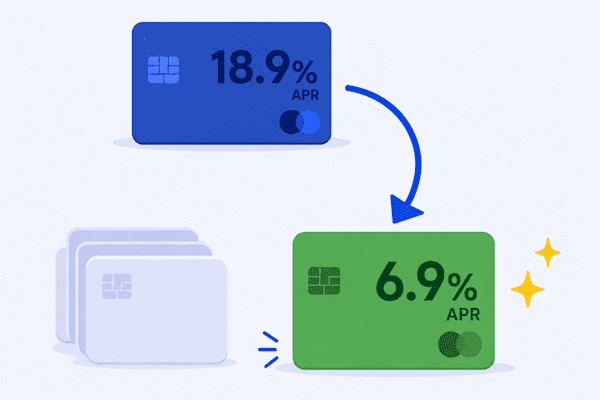
For example, if you're paying interest at 18.9% APR, and you can get a low-rate deal for 6.9% APR on another card, you could save about £120 interest in a year on a £1,000 debt.
3. Shift debts to the cheapest card. Do a balance transfer to shift your debt from the card(s) charging the most interest to the one charging the least (or the cheapest ones, if your credit limit isn't big enough to allow you to move it to just one card).
You could even consider shifting debt away from any card that will offer you a 0% deal for transferred balances. You can then transfer it back along with debt from other cards to get the 0%. Though be aware of balance transfer fees that could wipe out the gain.
4. Repay the most expensive debts first – the most crucial part. Once all your debt's as cheap as possible, relist them in the credit card shuffle worksheet. Then, focus as much cash as possible on the most expensive debt first and just pay the minimum repayments on any less expensive debts.
Once that's repaid, focus on the next highest-rate debt... continue until you're debt-free.
Which debts should I prioritise?
It's all about interest rates here. Over to Martin to explain the basics below:

The best thing to do is list all of your debts in order of the interest rate (APR) with the highest first. Then focus all spare cash on clearing that highest APR debt – as that's growing most quickly – and just pay the minimum on all others.
For many people this will be the overdraft at first, as at 40% it's close to double most credit cards. So reducing your debt on it is the priority. Once you’ve cleared the costliest debt, shift your spare cash to the next highest APR, and so on.
This way you’ll pay less interest and more of your money will be clearing the actual debt.
To give this a go, our credit card shuffle worksheet may help you visualise which balances make most sense to transfer and to where.
Try our free Credit Club
Sign up to MSE's Credit Club to boost your credit power – access our free tools to see how the financial world views you, including:
An Eligibility Rating that combines your credit score, affordability, and market trends.
View your full credit report – your financial CV.
Get personalised acceptance odds for credit cards and loans.
0% balance transfer credit card FAQs
Should I apply if my eligibility odds are low?
Don't be put off by low acceptance odds. If you're paying high interest on existing debt, it can still be worth applying for a balance transfer card even if the eligibility calculator suggests you're unlikely to be accepted.
The potential savings from a successful application may outweigh the temporary impact on your credit score if you're rejected. The exception is if you're planning to apply for other credit soon, such as a mortgage, where protecting your credit score is usually more important.
For more on this, and what you can do to improve things, see Martin's related blog: Why you shouldn't worry too much about your credit score - it's not actually a real thing.
What if my credit limit isn't big enough?
The application is now on your credit file anyway, so make use of it. Use the new card to shift as much debt as you can to cut costs.
Once that's sorted, you can use our 0% Balance Transfer Eligibility Calculator again to see your chances of acceptance for other providers' cards. Though try to spread future applications out, as too many in a short space of time can hurt.
Can a balance transfer hurt my credit score?
Shifting a balance from one card to another isn't recorded on your credit file, so you're free to balance transfer as many times as you like. However, a footprint is added to your file every time you apply for a new credit card.
Multiple applications, especially close together, and high outstanding debts, even at 0%, can affect your ability to get further credit. See our Credit scores guide for full information. The most important preventative measures are to leave a few months between applications and use our eligibility calculator to check your chances of acceptance, before applying blind.
What if the eligibility calculator says ‘no chance’ for all cards?
It happens, especially if you’ve a poor credit history or lower income (see how to improve it in MSE's Credit Club).
If your existing cards still have spare credit limit, see if you can shift debt from a high-interest card to a cheaper one — some providers even offer existing-customer balance transfer deals (eg, 12mths at 0%).
If that’s not an option, focus on repaying debts in order of highest APR first — it saves you the most in interest. See our credit credit card shuffle for step-by-step help. If none of these are a goer, the priorities are repaying in the right order.
Can I transfer my partner's debt on to my 0% card?
Be aware that the debt then becomes yours. Even if you have an informal agreement between you that they will make the payments, the credit has been provided to you, so it's your responsibility to pay it off.
Think carefully before taking on someone else's debt, as circumstances can change.
But if you're comfortable doing it, some lenders do allow balance transfers from a card in someone else's name (provided it's not with the same provider). Barclaycard allows this, while other lenders may permit it on a case-by-case basis. Check with the provider before applying.
Can I shift debt to my existing cards too?
If you have spare credit limit, this is usually allowed. Some cards will give existing cardholders special offers (eg, 12mths 0% for a 3% fee), not as good as new customer deals, but useful, especially as it won't usually go on your credit file.
Even if you don't get a special rate, try and move all your debt to where it's cheapest. For example, if one is 18% APR, another 30%, ask the 18% card if you can shift debt from the other to it, it'll help. For a full step-by-step, see the credit card shuffle for how this all works.
Will transferring a balance close my old card for me?
No. When you transfer debt from one card to another the old card stays open, and you're able to use it if you wish – although if you're trying to pay debt off, it's usually not wise to keep spending on credit.
If you want to close your old card, you will have to let your old card provider know. Just not using the card or cutting it up doesn't close the account. Read full pros and cons of closing old credit card accounts in Should I cancel old cards?
I'm worried about debt. Is a balance transfer card right for me?
Getting a credit card is not always the right thing to do, and if you have a poor credit history or too much debt already, you might be rejected for one (or more) cards anyway.
If you're struggling to pay for your outgoings or meet your debt repayments, or are building up more debt just to pay for day-to-day living, getting another credit card could just add to any debt problems in the longer term. Our full debt help guide runs through the practical steps you can take if you're struggling with debt, including specialist resources and charities you can contact for free one-on-one debt counselling and advice.
Can I transfer a balance from an American Express (Amex)?
Yes, usually – but there are quirks. Amex cards have 15-digit numbers (not 16), so some providers’ systems can’t process them online (eg, Santander, Tesco Bank, TSB). In that case, call the new card provider, or try adding a “0” to the start or end of the card number.
Some lenders won’t accept Amex transfers at all – eg, NewDay (Aqua, Fluid, Marbles). Others have restrictions: Sainsbury’s Bank asks you to check first, and Virgin Money only accepts UK-issued Amex cards.
How long does a balance transfer take?
Once approved, a balance transfer often takes one or two working days, though timings vary by provider and extra checks can delay it. If you’re applying for a new card, allow additional time for your application to be processed and the account opened.
Keep making any payments due on your old card until you’ve confirmed the transfer is complete, so you don’t risk a missed payment.
Why can you trust MoneySavingExpert?
MoneySavingExpert.com is the UK’s biggest consumer finance website, founded by Martin Lewis, offering impartial, research-based tips.
The site's dedicated to cutting your bills and fighting your corner with journalistic research, cutting-edge tools and a massive community – all focused on finding deals, saving cash and campaigning for financial justice.
⚠️ You're viewing just the top picks & key tips. Want all the detail? Switch to the full guide.
Top 0% balance transfer cards
The longest 0% deal isn’t always the right choice. Three things to know before you pick:
1. Check eligibility first. Our eligibility calculator shows your odds for each card before you apply, so you can target the cards likely to accept you and avoid rejections on your credit file. Some cards are ‘up to’, meaning some people get a shorter 0% than advertised. For most of these, the calculator tells you which length you'll get before you apply.
2. Pick the lowest fee with a 0% period long enough to clear your debt. Longer 0% periods usually mean a bigger fee. A 3% fee costs £30 per £1,000 shifted. If you can repay sooner, a short no-fee or low-fee card is cheaper. Unsure? Play safe & go long.
3. Follow the golden rules: Always pay at least the monthly minimum, clear the debt before the 0% ends (or shift again), transfer within 60-90 days, don’t withdraw cash, and avoid spending on the card.
New
Capital One
New.
Tesco Bank
Got bad credit? To be accepted for most of the deals above, you need a decent credit record. If that's not you, see our best cards for bad credit in the full guide.
Share this guide?