




Supermarket shopping tips
30+ tools & tricks to slash food bills

Supermarkets are brilliant at making us spend our hard-earned cash, yet with a few focused techniques you could save £1,000s a year. We've put together a trolley full of ways to max discounts, including how to speedily find the cheapest supermarket for your items, time trips to bag the best yellow-sticker reductions and more.

First, a quick overview of supermarket shopping tips...
We've a full rundown of all our supermarket shopping tips below, but here are the key details in brief...
Start with a budget. Use our free Budget Planner and a shopping list, so you only buy what you planned to. (And don't shop hungry!)
Do the Downshift Challenge. Drop down one brand level – typical savings are around 30%, and even swapping half your items can save £100s or £1,000s.
Look for codes, coupons and cashback. Seek out ways to drop the cost further.
Compare supermarket prices. Use the free Trolley comparison tool to check the cost of items you regularly buy and set price alerts for them.
Unlock loyalty discounts. Join free schemes such as Clubcard, Nectar and Morrisons More to access member prices, and earn up to 50% off. Plus you can get discounts as a new customer ordering groceries online.
Time yellow-sticker runs. First reductions are often mid-morning and the biggest cuts early evening, though timings vary.
Waste not, want not. Avoid throwing out food unnecessarily by knowing your best-before from your use-by date.
-
A supermarket's job is to make us spend
Supermarkets are cathedrals of consumerism. They're perfectly honed marketing environments, benefiting from millions of pounds of research into how to encourage and seduce us into buying and spending more than we should. This means as consumers, we must learn counter moves.
If you want to teach an eight-year-old about money, the best place to start is a supermarket. Ask them what they can smell. It'll usually be bread or a bakery, as the scent makes us hungry and likely to buy more food, so the supermarket profits.
Supermarkets' other tactics include the following:
-
Treats and magazines placed by the till. These are impulse buys, so putting them near the till gives stores one last attempt to grab our cash.
-
Store layouts make us walk the whole distance. Regularly bought items tend to be spread around the store, so we need to pass many other tempting goodies to complete our shopping.
-
Eye-level products are the profitable ones. The most profitable stock is placed at eye level (or children's eye level if it's targeted at them), yet profitable goods tend not to be the best deals for shoppers. The age-old adage "look high and low for something" really does apply.
-
Sales-type signage for non-sales items. Seedless grapes and other attractive treats are usually near the store entrance, often below cost price, to entice us in. Similar signs and displays are used elsewhere to promote deals, even when they're not on sale.
Bright colours and the words "discount" and "sale" make us feel good, yet the reduction may be pennies and cheaper equivalents hidden elsewhere.
-
-
Steer your own trolley

That is to say, have a plan and stick to it. For those on a strict budget, it's important to get into the right mindset. Don't ask: "What's the cheapest way to get all the goodies I want?". Instead ask: "On my £XYZ budget, what can I afford?"
Of course, a budget is part of a wider strategy and how much to prioritise food shopping depends on your other expenditure. Use our free Budget Planner tool to help.
-
Bag big discounts via first-timer grocery codes
Online supermarkets commonly put out introductory discount vouchers to 'capture' new customers, for example, £15 off £60 at Morrisons or 25% off Ocado. Our full list of first-time shoppers' supermarket offers is regularly updated with the latest codes.
We also list free codes and vouchers in our Supermarket coupons guide. All hot new offers go in our free weekly email. -
Take the Downshift Challenge – can you slash £1,000+ off your yearly grocery bill?
Don't believe the brand hypnosis. Whether it's bacon, biscuits, baked beans or bolognese sauce, if something costs more it's got to be better, right? Wrong.
The phrasing and promotional language used in shops hypnotises us into thinking most costly is best. While the packaging looks more opulent, look beneath to the actual product you're getting and sometimes you won't be able to tell the difference.
Supermarkets separate their products into different categories, using loaded language to give you the choice of how 'luxury' or 'basic' you want to be.
As you move up the brand level, costs increase, as do presentation and sometimes ingredients. Often a manufacturer's brand and own brand may well be made in the same factory by the same people (though it's tough to prove with specific products).
-
Premium. Words like 'finest' or 'extra special' imply it's a treat.
-
Branded. Products like McVitie's Jaffa Cakes or Kellogg's cereal.
-
Own brand. These tend to be presented in a similar way to manufacturers' brands, but with the supermarket's own take on it.
-
Value. With names such as 'basic' or 'savers', the presentation is deliberately stark to imply it's cut back to the bones (though Tesco has replaced its 'Everyday Value' range with 'brands' only sold at its stores, including Eastman's, Stockwell & Co and Hearty Food Co).
To fight back and save big, try the Downshift Challenge. The theory is simple:
Try dropping one brand level on everything. Then see if you can tell the difference. If not, stick with the cheaper one.
The next time you shop, swap one of everything to something just one brand level lower. So if you usually buy four cartons of Tropicana orange juice, this time buy three of those and one of Tesco's own brand. If you use branded aloe vera shower cream, drop to Asda's own brand.
The point of this system isn't to force you to drop down a brand level on everything, but to ensure you're not spending money for no reason. If you can't tell the difference between the lower brand level goods, then why pay more for it.
It's far better to taste with your mouth than your eyes, so try giving family members a blind taste test with no packaging to ensure it's fair. Of course, let's not go extreme on this. If there's a 2for1 on a higher brand (and you'd use both packs) making it cheaper than downshifting, stick with the higher brand.
Downshifting typically cuts grocery bills by 30%. Even if you only swapped half the items, that's still a 15% saving, which could be worth £100s or £1,000s.
Bear in mind that the biggest downshift savings aren't from premium brands to manufacturer brands, but for those who are already lower down the brand chain.
-
-
Watch the Downshift Challenge video
You can turn on subtitles by clicking on the closed captions icon in the bottom right of the video.

 Martin gives more info on the supermarket downshift challenge in a video from 2008
 -
Downshift cleaning products & toiletries too
Rather strangely, reports show people are more likely to stick with branded washing powders, shower gels and other cleaning products than food. Yet these products don't even need tasting and the saving is huge. So try downshifting these too.
Then again, old-style MoneySavers wouldn't forgive us if we didn't say you can clean the whole house with white vinegar and lemon juice (read more on Old Style Cleaning and full info in the charity Thrifty Ways book).
-
Hunt for disguised own brands
After the Downshift Challenge, many people will be tempted to ask, "is there actually any difference between normal brands and own-brands?" Often they're made in the same factories.
To help break through this, there's a 'Disguised own brand' Great Hunt discussion in the forum, which asks any current or past factory workers to dish the dirt on whether there's really any difference. Of course there's no guarantee it's true, but it makes fun reading.
We also used social media and our weekly email to ask factory workers and others to spill the beans on their work-related insider tips and we had loads of great responses including, "One massive block of cheese, but five wrapping stations for different brands... including Tesco Value". See the full list of insider tips.
For an ITV programme, Martin got a scientist to examine some own brands and compare them to the main brands. Surprisingly, almost none were nutritionally identical. The conclusion was small differences were deliberately added so no one can say "they're the same". Even so, they're often very similar in taste, so it doesn't matter too much.
-
Never shop when hungry
It may sound obvious, but it's true: if you're hungry, you're more likely to buy things you don't need.
Plus beware pick-up shops. If you pop into your local shop to buy a pint of milk as a catch-up midweek, don't pick up a basket. Do that, and you'll generally fill it. If you want a pint of milk, buy a pint of milk then leave.
-
Grab coupons or cashback worth £100s a year
Using coupons, or getting cashback via special apps, can save you £100s on your shopping. Check out our Supermarket coupons guide for a regularly updated list to help you slash serious money off your bill.
Got a top tip we haven't listed? Let us know in the Cut supermarket costs discussion.
-
Speedily find the cheapest supermarket for your groceries
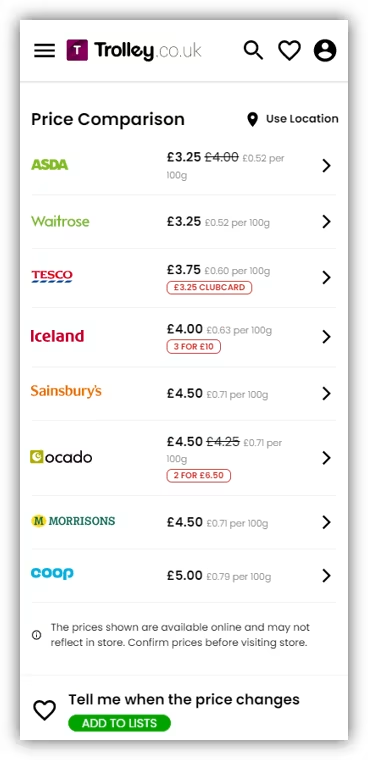
A handy free comparison tool, Trolley, lets you benchmark the cost of items at the major supermarkets. You can also set alerts for when the price of your favourite items drop.
It looks at the biggies including Tesco, Asda, Waitrose, Ocado, Morrisons, Sainsbury's, Iceland and Boots.
The prices it shows are online prices, but these are often reflected in stores, so even if you're going in person, it's worth checking to see which is cheapest for you.
Just search for a product to see the price of it at different stores. You can set price alerts – just register (it's free), go to a product page and select 'Add to lists'.
There's also an app for Android and Apple phones so you can compare the data to in-store prices as you shop. Trolley is run by a small team. While we've found prices are generally accurate, we've had feedback from some users who've found errors, so double check prices on the supermarket's own site before making a special trip. -
Use free supermarket loyalty schemes to unlock discounts of up to 50% off
If you regularly shop at a particular supermarket and it has a free loyalty scheme, then signing up is a no-brainer.
Schemes such as Tesco's Clubcard and Sainsbury's Nectar will give points when you shop that you can convert into money off your shopping or rewards with selected partners. Yet you can also use these schemes to unlock special discounts on a selection of products each week, which could save you £100s on your groceries over a year.

Tesco's 'Clubcard Prices' promotion offers up to 50% off selected items for members of its Clubcard loyalty scheme*, including big brands and Tesco's own-brand.
For example, previously we've seen £3.50 large Swizzels Sweet Shop Favourites tub (next cheapest £5), £5 Mai Thai jasmine rice 5kg (£6) and £1.60 McCain Home Chips Extra Chunky 1kg (£3.19). Products in the Clubcard promo can change from week to week, so you won't necessarily see the same offers as these current Clubcard Prices. But items in the promo are clearly marked in stores and online.
Discounts come off automatically when you buy an eligible product online for delivery or click & collect, or scan you Clubcard at a Tesco store. (Excludes some smaller Express stores.)
You have to be signed up to Clubcard, which is free to join online at Tesco* or via the Clubcard app. See our Reclaim & boost Clubcard vouchers guide for more tips.

If you're a Sainsbury's shopper, get discounts on 100s of items with a Nectar card membership. Look out for Nectar Price labels when you shop for deals on selected products.
When you scan your card or app or check out, it'll automatically trigger the discounts. If you're shopping online, you need to link your Nectar card to your Sainsbury's account.Look for 'Nectar Prices' on Sainsbury's to see what's on offer. If you don't already have a membership, you can sign up to Nectar for free. See our Boost Nectar points guide for more tips.

Morrisons lets you redeem points for £5 vouchers. Sign up to Morrisons More to earn points on your shopping, fuel and selected bonus offers.
Once you've collected 5,000 More points, you'll get a £5 voucher to spend at Morrisons in-store or online. You'll also get personalised offers, money-off coupons and 'More Card Exclusives'. It also offers More Card Prices.
If you haven't already signed up to Morrisons More, you can do so for free online or via the app, which you can download from the Apple App Store or Google Play Store. See the Morrisons Fivers are back news story for full details.
-
Consider smaller discounters over supermarkets
When shopping in store, consider Lidl and Aldi if you haven't before. If you already shop at these stores, it's worth trying Home Bargains and B&M Bargains, too. These can often prove cheaper than big supermarkets – many shoppers go once a month to buy all their staples, then use the big four for the rest of their goods.
-
Go further and grab cashback
Once you've found the cheapest groceries, you may be able to get paid cashback on top. A number of sites get paid by online stores for sending traffic then give you a cut – see full information and warnings in Top cashback sites.
For supermarket-specific cashback, see Shopmium deals.
-
Get 5kg fruit and veg for £1.50 with Lidl's food waste boxes
If you head into a Lidl store, you can pick up a 5kg 'Too Good To Waste' box of fruit and vegetables for £1.50. The boxes contain 'edible but not perfect' fruit and veg. See Lidl 'Too Good To Waste' boxes.
Sainsbury's offers similar fruit and veg boxes for £2 each. -
Know when to BOGOF

Bogof! No, not you... BOGOF stands for 'buy one, get one free'. Often there to 'exploit' our impulses, these can be a menace or an angel.
The time to grab 'em is when the BOGOF (or three-for-two or half-price deal) is on something that won't go off that you'd buy anyway. Classic examples include toothpaste, bog roll and batteries.
To locate cracking current offers, check the forum's Food and Grocery Shopping board. All top supermarket offers and loopholes also go in the free weekly email.
-
Loyalty schemes don't give something for nothing
Supermarkets use sneaky tactics to keep us in their store so we don't take advantage of competitive markets.
Don't think loyalty schemes, such as Tesco Clubcard and Nectar, give you something for nothing. Loyalty points schemes are incorporated into pricing policies. So the golden rule is: choose where to shop on price, not because you get points, but always get points when you're spending there anyway.
See our points boosting guides for Tesco Clubcard and the Nectar scheme for more info and tips to boost your stash. -
Reclaim old Clubcard vouchers
Flash your Clubcard at Tesco and you bag one point per pound spent. Then it converts the points into vouchers – 500 points equals a fiver to spend in store.
Many lose or forget to use them. But there's an easy way to claw back up to the last two years' of unused vouchers (some report successes from even further back).
Log on to Tesco's site and tucked away is a 'Your Vouchers' area showing your voucher history, including those that haven't been redeemed. See Reclaim Tesco Vouchers for more info.
Also note that a 500-point voucher is worth a fiver in Tesco, but you can trade it for up to two times that (in other words, £10) via Tesco Clubcard Reward Partners. Rewards include days out, restaurant vouchers, railcards, hotels and more. For full info on redeeming vouchers, see Tesco points boost.
-
Eat for free: Krispy Kreme, Taco Bell and more
You really can get a free lunch. Make sure you supplement these supermarket shopping tips by maxing out all the food freebies available.
The likes of Krispy Kreme and Taco Bell offer freebies to get you through the door, yet often you don't need to spend anything to get the freebie.
Plus food-sharing app Olio links you with others nearby who have surplus grub to give away, so it's not wasted – like Freecycle does for unwanted furniture and other items.We've put together a full guide that shows how to take advantage of clever tricks, coupons and apps to eat and drink for nothing. See How to get free (or cheap) food for full details.
-
Time trips right to bag huge yellow-sticker discounts
'Yellow sticker' discounts are when items have been reduced to clear, and they've been slapped with... well, the clue's in the name. If you can find what you're looking for with a yellow sticker on, fantastic – grab it and use it quickly as it's a saving on perfectly good nosh.
To try to build a picture of the best time to find these savings, we asked MoneySavers who work in supermarkets to spill the beans on stores' reduction policies, plus shoppers and supermarkets themselves.
As a rough guide, the first yellow stickers tend to appear mid-morning, and silly price reductions begin early evening, when stores cut prices by 75% and more. But let's be clear – this is an art, not a science. Reduction times vary not just by supermarket but by store (and it's particularly dependent on opening times).
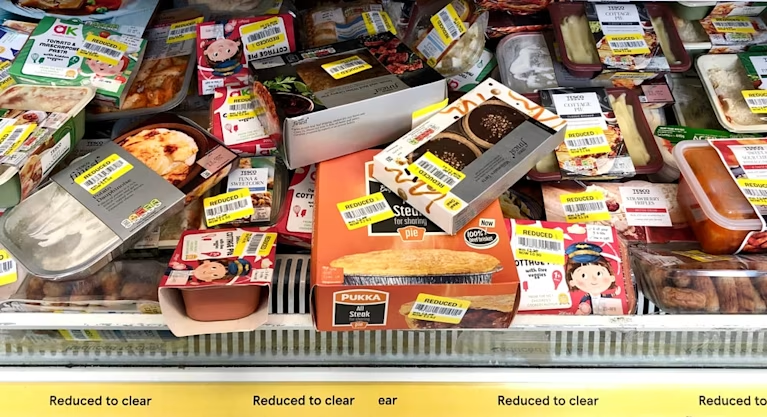
Over the last few years, we've asked MoneySavers to tell us the best times to bag these bargains, and we've pulled together that information below. For the most timely suggestions (or if you know better), see the 'Yellow sticker' discount forum thread.
-
Asda. MoneySaver Lisa bagged £60 of shopping for £2.55 via Asda's 'whoopsie' yellow-sticker discounts, so there are big savings to be had. We've been told final reductions often start around 7pm – and most bargains have been snapped up by 9pm.
-
Co-op. MoneySavers told us the timing of discounts very much vary by store. One former staff member told us items which expire that day tend to have a 50% discount, though another MoneySaver said you have to wait until 8pm for 75% discounts.
-
M&S Food. Shoppers said they've seen final reductions 30 minutes to an hour before closing.
-
Morrisons. Shoppers told us reductions tend to start late morning or lunchtime, but Morrisons said it's up to individual store managers.
-
Sainsbury's. It told us the discounts are "completely store dependent". Some MoneySavers said it's worth looking around lunchtime, but another told us big reductions at her local store kick in around 7pm.
-
Tesco. It also insisted there's no hard and fast rule on discounts. Previous reports from shop-floor staff suggested reductions start as early as 8am and big discounts materialise early evening.
-
Lidl. One MoneySaver tweeted to tell us she goes to Lidl as soon as it opens to pick up ready meals for as little as 20p.
-
Aldi. Its half-price stickers start appearing from 8pm, according to one MoneySaver.
-
Fortnum & Mason. If you're in London, it's well worth heading over to the 300-year-old upmarket grocer after 6pm. MSE Jenny bagged two posh Scotch eggs and a packet of quail eggs at 75% off.
Also remember many staff have the authority to reduce prices at their discretion, so keep your eye out for goods that are damaged/nearing their sell-by dates. The consensus from those who have helped us compile this list was: "We will reduce prices for friendly customers – but if you're rude and demand a reduction, forget it."
Remember as well, that much of the food that's reduced will be because it's close to its use-by date, so fresh items are likely to need consuming quickly.
-
-
Try shopping in a different aisle (and crouching down...)
Did you know you can often buy the same item in the same supermarket for less? Check out our Deals Hunters' blog for how you can make big savings by shopping in the world foods aisle, and how to avoid overpaying in the free-from aisle. Plus see how you can save by crouching down.
-
Consider eating less meat – it's good for the planet and your wallet
Veggie and vegan diets have become more popular in recent years. Of course, this is very much a personal choice – for some, giving up meat may not seem like a simple step. Yet many people have switched for environmental reasons – and you may well find you end up saving as a result too.
Buying decent quality meat isn't cheap, and the staples of a meat-free diet are often cheaper – though of course, it depends on what you eat. Plant proteins such as beans and lentils typically cost less than the equivalent amount of animal protein. What's more, there are now many meat-free versions of family favourites such as bangers, mince, nuggets and burgers.
As an example, Tesco's British lamb mince (500g) costs £6.50 or £13/kg. Its own-brand Plant Chef vegetarian mince (454g) is just £1.58 or £3.48/kg – and there's actually slightly more protein in the veggie version, at 17.1g per 100g (vs 16.8g in the lamb mince).For inspiration, see former MSE Rhiannon's MoneySaving vegan meals blog, for seven easy recipes which can save up to 60% vs the meat equivalents.
Not sure if you want to remove meat from your diet completely? You could try cutting back. The Meat Free Monday not-for-profit campaign suggests having a weekly break from meat.
If you do switch, it's important to make sure you have a balanced diet, so check the NHS advice on vegetarian and vegan diets. -
Don't be a waster – know the difference between a 'best-before' and 'use-by' date
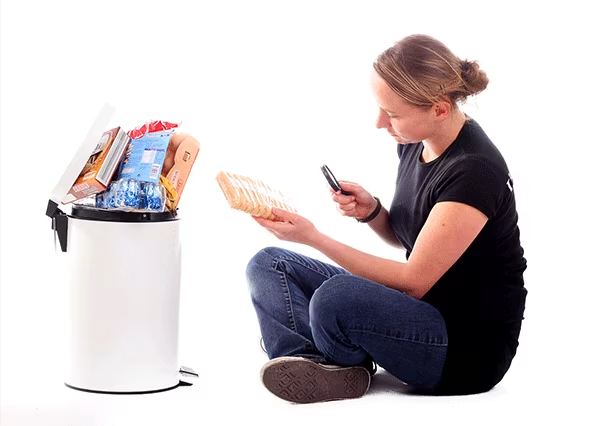
If you don't know the difference, the likelihood is you're throwing away a lot of food unnecessarily. Here are the rules of thumb for each date:
Past use-by date? Bin it! Use-by means just that. Eating nosh beyond that date is risky, even if it looks and smells fine. Typical foods to watch include dairy, milk, fish and eggs.
Past best-before date? Still edible but may lose flavour/texture. Best-before labels usually have nothing to do with safety; they're just the manufacturer's view of when they're at optimum quality. This is usually longer-lasting foods such as frozen meals, tins, sugar, pasta and cereals.
You can eat after the best before. Use smell, taste and sight to check it's OK. If so, the only downside's that the food may lose some flavour and texture.
Display-until and sell-by: Instructions for shop staff, not for you. These dates are instructions for shop staff to tell them when they should take a product off the shelves. Check the use-by and best-before dates instead.
See MSE Sarah's blog 14 ways to STOP wasting food and drink for more tips and tricks. Plus find more ideas about saving food on Love Food Hate Waste.
-
Buy beyond best-befores at big discounts
Not only is it usually safe to eat food items beyond best-befores, it's legal to sell them.
There are local specialists and even an online store, Approved Food*, which specialises in out-of-date stock. We've seen Filippo Berio Classico Olive Oil 250ml for 20p, six Mr Kipling Victoria slices 20p and Old El Paso enchilada kit 20p.
Delivery's £3.99 per box (up to 25kg), so it's really only worth it if you're bulk-buying. As there aren't any finite rules on how far beyond a best-before date it's still safe to eat products, you need to make the decision yourself. Generally though, the longer the original shelf life of the goods before the best-before date, the longer you can go beyond.
-
Grab big discounts for abandoning your virtual shopping basket
It's possible to bag big discounts from online supermarkets simply for walking out the (virtual) shop. When you don't complete an order, they often email you a discount as a way to entice you back.
To try it, pop something in your basket, without buying. You may well find a code or offer lands in your inbox a few days later. Sign into your account though or they won't know who you are.
While we've no concrete proof, forumites reckon they've nabbed £5 off at Tesco, £20 off Ocado and £22 off Waitrose this way. For more insider shopping tricks like this, see our Shopping secrets guide.
-
Use a '2D linear tracking device' (otherwise known as a list)
Supermarkets are great at targeting our impulses, so nowt's more powerful than a good old-fashioned shopping list – hopefully by giving it the fancy name of '2D linear tracking device', it'll feel more important and you won't forget it.
The reason's obvious. By planning what you need before heading out, it's easier to cut out anything that goes over budget and stick to it. Buy only what you planned, with a little flexibility for promotions.
-
Cashback every time you buy groceries

The app-based Chase debit card gives 2% cashback on supermarket spending, to a maximum of £20/mth if you meet certain criteria. You don't need to switch bank to get it and it only does an ID not a credit check, so is easy to get.
But you do have to be comfortable opening a new bank account, and operating it through an app. For help to decide if it's right for you, see our Chase account review.
-
Don't get caught out by shrinkflation
Shrinkflation is when a product gets smaller but the price stays the same or even goes up. It's harder to spot than a straightforward price rise, but means you could end up paying more for less.
Manufacturers have shrunk everything from chocolate bars and crisps to washing powder and toilet roll in recent years. That's why it's always worth checking the pack size and the supermarket's unit price (such as price per 100g or per litre). Counterintuitively, sometimes smaller packets cost less per unit than larger ones.
-
Over 60? Get 10% off at Iceland
If you're aged 60 or over, you can get a 10% discount on your shopping at all Iceland stores nationwide. Use it every Tuesday when you show valid ID and your Iceland Bonus card.
-
Money off nutritious food through the Healthy Start scheme
Pregnant or have a child under four? Check if you can get help with food costs. If you're on certain benefits, Healthy Start cards give up to £9.30/week (or Best Start in Scotland up to £44.80 every four weeks) to help buy healthy food, milk and vitamins for child(ren). See a full guide to Healthy Start cards.
-
Write a meal plan
The best way to make your shopping list super-effective is by writing a meal plan for the week/month. That way you can work out what you're going to eat every day, incorporating the ingredients you already have.
To help, there's an amazing resource where thrifty MoneySaving Old-Stylers have put together menu planners of various thrift levels to copy and download.
Get organised with the full index of free MoneySaving menu planners.
-
Check you aren't paying MORE for LESS biscuit
For a bit of fun, we looked at whether you pay extra for biscuit 'Thins'. Ex-MSE Jordon compared prices of standard-size biscuits to their ‘Thins’ alternative, and found choosing ‘Thins’ could see you being charged almost double... for half as much biscuit.
While the blog was written in 2018, the principles can still be used to check now. See full details in the Thin biscuits, thinner wallets blog. -
Nifty tools to use up larder leftovers
To stop wasting food that you don't know what to do with, use special sites that suggest recipes for the items left over in your fridge or cupboard.
Tell the SuperCook or BigOven tools what items are in your fridge or cupboard and they'll suggest a recipe for them from thousands.
Another option's using AI tools such as ChatGPT, Google's Gemini or Microsoft's Copilot. Try asking 'I have two eggs, a spoon of pesto and a tomato - give me one quick dinner idea' or 'What can I make with lentils, peas, peanut butter and couscous?'.Here's what ChatGPT came up with:
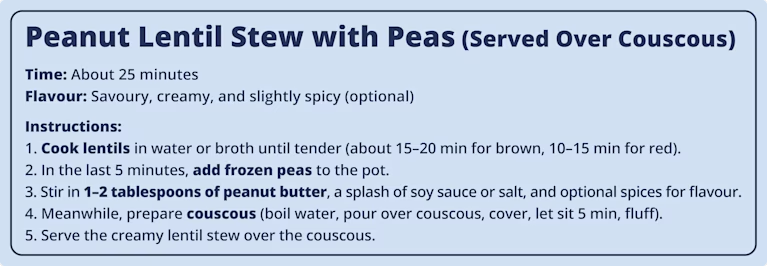
Alternatively, go to this site's Old Style Recipe Index and scroll down to the relevant ingredient.
-
Instant £12 boost to your Christmas budget
Supermarket Christmas saving schemes get you to save all year round in them, to spend in their stores at Christmas. They'll usually add a small bonus on top of what you save.
We're not a fan as savings accounts are more flexible and are better-protected. But a supermarket savings loophole means you can net a year's bonus in just one day.
Most supermarkets pay out the bonus based on how much you've saved by a specific day or month. For example, if you top up Tesco's savings card with £200 by 25 October, you'll have £212 in November.
The full Supermarket Xmas boost rundown is updated every year with the top ones - we'll add details for 2026 as soon as we have them. -
Don't forget to check out local market stalls too
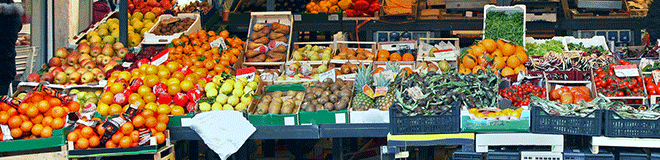
Supermarkets may be convenient, but local market stalls can kick their bums on fruit and veg prices. As prices vary across the country, you'll need to do some comparisons of your own. Keep receipts from your supermarket shop, then write down how much you spend at the local market for the same quantities.


Share this guide?