




Young driver insurance
Cut costs with tips, discounts, cashback & more

Drivers under 25 have always faced huge insurance bills due to the higher risk of being in (or causing) an accident with the youngest drivers faring worse. According to Confused.com, the average premium for a driver aged 17 to 20 is now over £1,800/yr. Yet never assume your renewal is the best deal, as many can save £100s on their young driver insurance by following our tried-and-tested MoneySaving tips.

First, a quick overview of young driver insurance...
Young drivers can combat the higher insurance premiums they typically face – here's how...
Always compare car insurance policies. Use our Compare+ tool, which is far more than just a comparison, or check the comparison sites directly. Never simply auto-renew.
Bizarrely, adding an extra, safe driver (mum, dad, aunt, gran) to your insurance may slash costs. This is because premiums are set based on risk and a more experienced driver may help lower the price. Try out different combinations, for example, add one parent, then another, then both.
Don't automatically go for third-party cover thinking it's cheaper. It's not particularly logical, but comprehensive car insurance can be better for your budget than lesser third-party cover. Some insurers see the fact you've selected third party as an indication that you're a higher risk.
Time it right. Get quotes between 21 and 26 days before you want cover to start – which often lands a cheaper policy.
Consider a black box (or telematics) policy. Having your driving monitored by a black box device can result in lower premiums.
Haggle with your existing insurer. Got a good quote? Your existing provider may match or even beat it.
Are you in the right place?
- Learner driver? Check out our Learner driver insurance guide.
- New driver? Read our New driver insurance guide.
What is young driver insurance?

Your age is one factor that insurers use when working out how much to charge you for car insurance, but it's not the only thing (see what affects your quote). There's therefore no such thing as 'young driver car insurance' or 'teenage car insurance', as most policies are open to all ages.
However, as many young drivers have little driving experience, they'll typically have to pay more for insurance, so we've written this guide with extra tips and tricks to help you combat this. These include considering black box insurance (also see our main How to get cheaper car insurance guide).
What type of insurance do young drivers need?
Like all motorists, younger drivers will usually have the choice of three main levels of cover (see more detail in types of car insurance explained):
-
Third party only. This covers damage to someone else's vehicle or their property.
-
Third party, fire and theft. As above, but also cover if your car is stolen or catches fire.
-
Comprehensive or 'fully comp'. As above, but you can also claim the costs of repairing or replacing your own car if you were at fault and caused the accident.
There are also various add-ons you can get, from breakdown to windscreen cover.
Fully comp isn't always the most expensive
Logically, third party insurance should be cheapest for young drivers as it offers a lesser amount of cover than fully comp – yet this isn't always the case.
The rationale is that insurers think people who choose third party insurance can be more of a risk. In one quote for a young driver deemed generally to be low risk, we found an annual £1,500 saving for having comprehensive cover over a third-party only policy.
This guide is for young drivers. If you're still learning, or are older but still new to driving, check out this related content:
Learner driver insurance: How to reduce learner driver insurance costs.
New driver insurance: Get the best possible deal on insurance as a new driver.
How does age affect the cost of car insurance?
Generally speaking, the younger you are, the more you'll pay for cover. So car insurance for teenagers is typically more expensive than for someone in their twenties, for example. We've more below on why car insurance for young drivers is more expensive.
That said, factors such as your location, driving history and car type also affect the cost.
Here's a table that clearly shows how car insurance premiums drop as you get older, based on data from MoneySupermarket.
Age of main driver | Average annual insurance cost |
|---|---|
17 to 19 | £1,432.66 |
20 to 29 | £966.85 |
30 to 39 | £609.65 |
40 to 49 | £495.74 |
50 to 59 | £397.25 |
60+ | £369.17 |
All prices are based on the median annual price of comprehensive car insurance sold via MoneySupermarket in March 2026
Car insurance for young drivers need-to-knows
Here are our top tips for getting cheap car insurance for young drivers.
Adding a responsible 2nd or 3rd driver can cut costs – for example, your dad or Aunt Dot
Bizarrely, adding a second named driver to your policy can cut your costs. We tried adding a 40-year-old family member as an 'occasional' user (not a main driver) to an 18-year-old's policy, and this cut the cost by around £1,000. These seven tips show how you can get cheaper car insurance...
-
Car insurance is all about risk. That's why it can work. If you're a high-risk driver and you add someone who is a much lower risk as a 2nd (or 3rd) driver, they can bring down the average risk and you may get a cheaper policy.
-
This isn't just for young drivers. While it works well for young drivers as they are automatically seen as a high risk, it can work for anyone – but of course it's especially powerful for those with costlier insurance.
-
The better the driving history and lower the second driver's risk, the more impact it should have. That said, anyone who's a lower risk can help. By law, insurers can't discriminate over gender, but age, driving experience and history can make a difference.
-
This is about trial and error, not logic. Your mum may increase the cost, your brother may cut it, or vice versa. It's just a question of trying different quotes and seeing what happens.
-
Different insurers respond in different ways. One may cut your costs by adding your uncle, another may increase it. Therefore a quick way to check is by varying quotes on comparison sites – it's easy to do, see our top comparison sites list below.
-
The second driver should be someone who would reasonably drive your car. So don't add Lewis Hamilton, unless you happen to be his brother (and even then racing drivers are likely a very high risk so I wouldn't bother) – but your mum, son, best mate or gran should be OK – as long as they would drive the car.
-
Never add someone as main driver if they're not. This is known in the industry as 'fronting' and is fraud. If you do it and are caught, you can face a criminal conviction and your insurance will likely be invalid.
Getting cover 25 days ahead can save £100s (though it's still cheap a few days either side)
We first looked at this back in 2018, when we revealed 21 days ahead of your renewal date was the cheapest time to get car insurance quotes.
Our latest findings, from looking at 100,000s of MoneySupermarket quotes between February 2026 and April 2026, found that the cheapest time to buy is 22 to 26 days before renewal, with 25 days ahead the overall cheapest time. The average policy costs £708 a year on renewal day, but buy it 25 days earlier and this drops to £374 a year – a huge £334 saving. You might not see savings as big as those, but the principle still stands.
In general, the closer to your renewal date you get quotes, the more of a risk you're deemed to be (we've heard that it can show insurers you're a bit disorganised). Yet, getting quotes too early, for example, 28+ days out, can also push the average price up – likely as fewer insurers will provide quotes that far out.
So, if you're already within the 22 to 26-day period, get quotes now as the price tends to steadily increase closer to the start date of the policy. If you're closer to your renewal date, every day helps, so get quotes ASAP.
We've full info on how to bag the cheapest car insurance policy in this guide – see our comparison sites order below.
Make yourself attractive to insurers
There are many factors that can affect the cost of your car insurance. One of the biggest is your 'risk level', so it's key that you try to show insurers that you're willing to take steps to reduce your level of risk.
Ways you can do this include limiting the amount you drive, doing an advanced driving course, to really polish your skills, and being aware that the type of car you drive also has an impact – we've full info on how your vehicle can affect your premium in our Car insurance groups guide.
And for more on the factors that influence how much you'll pay, see our full What affects your insurance quote guide.
Quick questions
Should I try to reduce my mileage?
The less you drive, the cheaper your insurance can be, so where possible you should try to reduce your mileage.
When you get quotes, insurers will want to know the number of miles you expect to do in a year. And while this can be hard to work out when you're new to driving, it's worth doing the sums, so you can give a more accurate estimate and keep your costs down, rather than just going for an average figure of 10,000 to 12,000 miles a year.
Work out how far you may drive in a week, such as your journeys to work and/or to college or uni, and how far you may drive for pleasure at the weekends. Google Maps or any other mapping software can help here.
Multiply that number by 52 to give an annual figure. But then also think about other leisure activities that you might use your car for across the year, such as going on trips with friends or to music festivals, and also factor in any long journeys you know you'll make on a regular basis. Total these journeys up and add them to your original number, then add a 10% buffer and round the figure up to the nearest 1,000. This will give you a much clearer idea of your annual mileage than just blindly picking a figure based on averages.
Once you've been driving for longer than a year you'll more easily be able to see the mileage you're doing, and this will also be recorded on your vehicle's annual MOT check.
If you drive your vehicle on business, always declare this rather than just including the business miles as personal, or the policy may be void.
Can extra driving courses help?
Learning to be a better driver can make you safer on the roads and potentially cut your car insurance costs too.
Some insurers reduce the price of your policy if you can prove that you've done an advanced driving course. For example, the charity IAM RoadSmart offers a variety of courses (at a cost), including one specifically for younger drivers.
Another example is the Driving Standards Agency course Pass Plus, which aims to help motorists become more confident on the road. Modules include driving in built-up areas, on motorways, and at night.
The course costs about £150 to £250 depending on where you live and the instructor or driving school you choose. Some councils in England and Scotland offer discounts of up to 40%, which are usually for under-25s, while in Wales it only costs £20. You can do Pass Plus in Northern Ireland, but it's not discounted. See the Gov.uk website for more details.
Once you have the Pass Plus certificate some – although not many – insurers discount the price of your cover. Unfortunately it's become less and less recognised in the last few years, so the discounts aren't generally that high.
See whether legitimately tweaking your job title could save £100s
Another quick win is tweaking your job description (legitimately of course). An illustrator is often cheaper than an artist, an editor than a journalist or a PA than a secretary.
Have a play with our Car Insurance Job Picker tool and see whether small changes to your job description could save you cash. Remember, NEVER lie as this would be considered fraudulent. A good way to look at it is "would a reasonable person consider this a reasonable description of what I do for a living?" If not, best to err on the side of caution.
If it worked for you, share your success stories with our forum users.
Thank you @MartinSLewis, after rewording my job occupation on car insurance I have managed to save £400.
- @JenStaCreations
I did this too thanks to @MartinSLewis from creative director to marketing manager = saved £300+. Crazy world isn't it?
- @fabsternation
Quick question
What should I put if I'm unemployed?
If you don't have a job, you face a potential fivefold jump in insurance costs by declaring you're unemployed. The same hikes don't apply to homemakers (house wives/house husbands). If that's you, say so to avoid a hike in costs.
However, only enter homemaker if you're genuinely not seeking work or receiving benefits which require you to seek work. Otherwise, it's fraud.
Tell 'em the truth, the whole truth and nothing but the truth
If you haven't got 'normal' circumstances, for example, you've made a claim in the past few years, have a modified car or expect to drive 100,000s of miles a year, tell your insurer. If you don't and then try to claim, even for an unrelated issue, your policy may be invalid.
You also need to tell your insurer about any changes as this reduces potential problems in the event of a claim, even if it's just your address. Trying to get insurance after you've had a policy cancelled is very difficult, very expensive and will follow you for the rest of your life.
A change in circumstances includes moving jobs, as insurers believe this can affect your risk. Scandalously, the unemployed often (though not always) pay higher rates for their cover – so tell your provider if you're out of work.
If you have a new car, you'll need to tell the insurer right away. See our changing car insurance guide for what you need to know about transferring your insurance.
With insurance, remember – the golden rule is:
Tell them the truth, the whole truth and nothing but the truth.
If you've read these tips and thought, "it's easy to lie about this", then of course, you're right. Yet lying to your policy provider is fraud. It can lead to your insurance being invalidated and, in the worst case, a criminal prosecution for driving without insurance.
Never auto-renew. Loyalty is expensive
Nothing better illustrates car insurers preying on loyal customers than Sarah Cooper's tweet. "My car insurance renewal is £1,200. New policy with same company is £690. How do they justify this?" They don't. They just do it.
Insurers charge increasing amounts each year, knowing inertia will stop policyholders switching. If your renewal is coming up, jot it on your calendar or in your diary to remember it. Compare comparison sites and then call your insurer to see whether it can match, or even beat, the best price you found. If it can, you're quids in.
Multicar cover can save you £100s if you live with your parents or have more than one car
If you have more than one car in your immediate family or household, this could be for you. For some, discounts for adding multiple cars could save £100s, or even £1,000s in some cases, but for others it could actually be more expensive.
To help, our dedicated Multicar insurance guide explains how multicar policies work, plus when to get and how to get one – even if you have different policy start dates for each car.
Make sure you're on the electoral roll before getting quotes – it can affect costs
Being on the electoral roll is not just about being registered to vote – it can also make a difference to your insurance premium.
Insurers like to use the electoral roll as part of the ID-checking process to combat fraud. The process from the insurers is that they try to match your name (and address) with what appears on the electoral roll. If it matches, you should then the best price online.
By not being on the electoral roll, or having incorrect information registered, makes it more difficult for insurers to identify you, so they'll probably give you a higher quote or simply not offer cover.
If you're not already on the electoral roll, it's straightforward to do. See our electoral roll guide for more information, including the all-important how to get on it.
Set the excess at a level you can afford
It's worth thinking about going for a policy with a higher excess – which is the amount you have to pay towards any claim you might make. A higher excess will result in lower premiums, but make sure you can afford it in the event you need to claim.
Try different amounts of voluntary excess when getting quotes, to see how it affects what you'll pay. Bear in mind too that policies do usually come with a compulsory excess (in addition to the voluntary excess), and you have to pay both when claiming.
Of course, the downside of a higher excess is that you may have to shell out more, if you claim, so take this into account.
If the thought of a high excess worries you, an excess protection policy is available, as an add-on on top of your normal car insurance policy. This allows you to claim the excess sum back. But make sure the insurer's discount is bigger than the cost of this excess policy to make it worthwhile.
It's also worth noting that with this policy, you're not covered within the first 14 days of taking it out. And you'll still need to pay the excess, then wait for reimbursement – no matter who is at fault.
How do I get the cheapest young driver insurance quote?
Once you know the basics from our top tips for cutting costs, it's time to follow the steps below to get the best quote.
Warning: No matter how tempted you are to say someone else is the main driver, or to pretend you have no points, or to deliberately underestimate your mileage to get a cheaper policy – don't. You must be completely honest or it could invalidate your insurance, and even lead to prosecution.
Step 1: Compare cheap car insurance for young drivers
As no single comparison site captures the entire market and prices vary, combining several of them is the best way to make a saving.
There are a couple of ways you can do this – either by using our Compare+ Car Insurance tool, and getting our top tips as you go, or by doing it yourself. Both ways have their own benefits. For instance, you get personalised tips based on your own info as you use Compare+, but our manual comparison site list includes details on extra perks, such as vouchers for signing up.
Do note that comparison sites use a soft search of your credit file to return quotes, though this has no impact on your ability to get credit in future.
Option A: Use our Compare+ Car Insurance tool for personalised tips
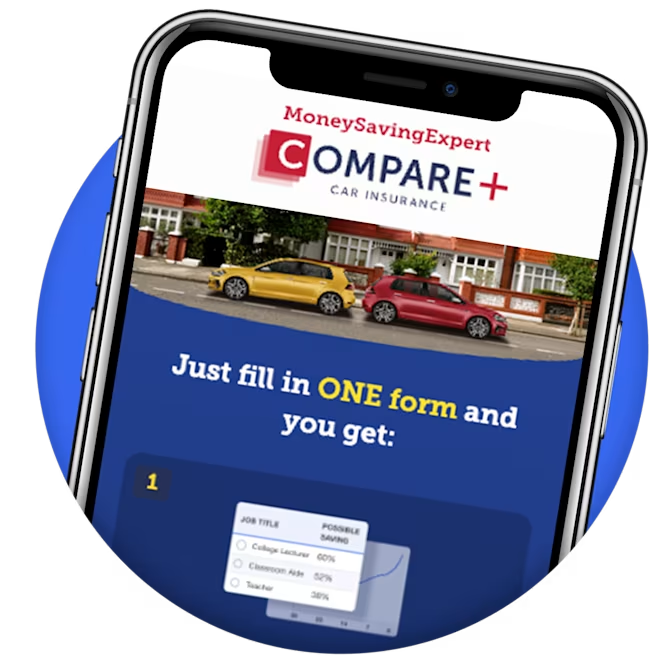
MSE's Compare+ Car Insurance tool is designed to take the hard work out of finding the cheapest quote. It'll also give you personalised tips as you go, including:
Whether delaying your quote a few days can lower the cost
Legit job description tweaks you can use to cut costs
Whether you should add an additional driver and check multicar policies
You just need to fill in one questionnaire to get your results – we've borrowed MoneySupermarket's (as we're part of the same group), so if you've used it before, your answers can be auto-filled.
You'll be able to see your cheapest insurers as a benchmark, as well as our latest alternative comparison site order to try yourselves, as MoneySupermarket may not be your cheapest. Plus, if you've time, we suggest looking at Direct Line, as it's not on most comparisons.
As Emma emailed: "Thank you for this tool. My daughter (20) just passed her driving test. We liked how easy it was to tweak things (start date, job description, adding second driver) and see the cost impact. She now has a year's insurance at under £60 a month, which is amazing, as well as a new life skill and the confidence that she'll be able to sort out her insurance next year with the tool."
Option B: Manually compare cheap car insurance for young drivers
We've ranked the order of the comparison sites that most often return the cheapest quotes so you can find the best deal yourself. We've also outlined any perks offered by the comparison site, from vouchers to 2for1 offers.
How do we pick the order?
We analyse the prices of a large range of insurance quotes given by Compare The Market, Confused.com and MoneySupermarket. We then take the following steps:
-
Check how many times each comparison site returned the cheapest or within £5 of the cheapest quote.
-
The comparison site giving the greatest number of cheapest quotes, or within £5 of the cheapest, is ranked first.
-
We then analyse the comparison site ranked first with each of the two remaining comparison sites. The combination of the two that returns the greatest number of cheapest quotes will be ranked as first and second to try, to increase your chances of a cheap quote at speed.
Here are the latest scores
This month's results show that Confused.com gives the cheapest quote 70% of the time – the most out of the three comparison sites. Get a quote from Confused.com and Compare The Market and you'll increase your chances of getting a cheaper quote to 93%.
To boost your chances of getting a cheap quote even further, get a quote from Confused.com, Compare The Market and MoneySupermarket.
Follow this order if you're under 25. However, if you're aged 25+, don't have more than three penalty points on your licence, are claim/accident-free, and it's not a company car, see our Cheap car insurance guide.
Site | Official perk info & MSE's analysis |
|---|---|
Try as many as you can, in this order... | |
| Official perk info: A Greggs hot drink per month and the choice of a £20 gift card to use on over 100 brands, including M&S, John Lewis, Tesco, Sainsbury's, Argos, and more. |
| Official perk info: Meerkat Movies and Meals, including Caffè Nero. A year's 2for1 on cinema tickets (Tue and Wed nights), plus discounts on meals out, pizza deliveries and at Caffè Nero. See our full . |
| Official perk info: SuperSaveClub and price promise. |
Then, to boost chances of finding a cheap quote further, try... | |
Another comparison site, and you get access to Rewards+. It includes discounted tickets at selected Cineworld and Odeon cinemas. | |
This big comparison site currently gives £250 'free' excess cover with every purchase. | |



Struggling to find (affordable) cover?
If you've had a string of claims or accidents, you have a medical condition that affects your driving, or you've four or more points on your licence, you may find it hard to get a cheap insurance quote for young drivers from a comparison site. Some may find it hard to get cover at all.
If no or few insurers are quoting on the sites above, or quotes are coming back too high, consider enlisting the help of a broker. Search the British Insurance Brokers' Association website to find someone who can help.
-
Always double-check the price. Click through to the insurance firm's own website to double-check the quote, as to speed up searches some comparison sites make a few assumptions .
-
Examine the policy's coverage. Check whether it's suitable. If you want a free hire car while yours is being fixed, is that included? Plus while you're there, it's worth playing with the policy details to see whether you can trim the price down. Look at the excess, and whether adding drivers cuts the cost.
Keep on top of your car insurance
Want to know when the cheapest time to get car insurance is? The MSE App has a new tool called Bill Buster – give us a few details about your insurance policy and we'll track it, alert you when it's ending and when you should start gathering quotes to save.


Step 2: Try a black box insurance policy
Black box insurance – also called 'telematics' insurance – is a type of car insurance where your driving habits are monitored. Your provider will do this by using a black box installed in your car, or other means, to assess your speed, braking and acceleration, and when you drive, alongside other factors.
If your insurer considers you a safe driver, it may then offer you a lower premium at renewal.
This makes these policies particularly valuable for young drivers, considering the higher premiums they face. To find out more about this type of cover and how to get quotes, see our full Black box insurance guide.
Step 3: See whether you can get cashback on top of the cheapest quote

If you get your car insurance via a cashback site, it will get a 'lead fee' for sending you on to the insurer, and then will pay you some of this as cashback.
This can beat going to the comparison sites above, so is worth checking if you've time. It's also best to think of the cashback as a bonus, rather than 100% guaranteed, as sometimes the deal isn't tracked or the cash paid out. These are the two routes to try...
Route a) Use cashback sites' own comparisons. There's a version of Confused.com's comparison when you use cashback site Topcashback*, or go via Quidco* and it will be a MoneySupermarket version. Should you buy a policy through either of these cashback sites, you'll get £45 cashback, though you don't get the standard Confused or MoneySupermarket perks, as these are rebranded versions of their comparisons.
Do keep an eye on the quotes you get, as you may not get exactly the same prices as you would from Confused's and MoneySupermarket's comparisons. Check the quotes you get direct from these, then take off £45 from Quidco's and Topcashback's cheapest, and compare which one is cheapest. And also try...
Route b) Go to your cheapest insurer via a cashback site. Once you've found your cheapest insurer by following the steps earlier in this guide, check what cashback you'll get going to it direct via Quidco* and Topcashback*.
But be careful not to let the cashback tail wag the dog. Choose the right insurer first, then look for cashback, not vice versa.
Again, check the price you're getting through this route is the same as the prices you found from the comparisons you've already done. If it's more expensive, see whether the cashback offsets the rise. If not, go with the quotes you got above.
Our Top cashback sites guide has full information on how these sites work.
Step 4: Once you've found the cheapest quote, try to haggle a bigger discount with your existing insurer
Haggling is not a must – especially if you want to try a new provider – but if you're looking to renew with your current insurer it's well worth contacting it to negotiate.
Once you've followed the steps above and got the overall cheapest price, give your insurer a call or use its online chat to see whether it will beat or match the quote. Usually it's as simple as asking, but if you're not getting any luck, see our Car and home insurance haggling guide for top tips.
Been with my insurer two years – I've just turned 22. Last year's price £690, price at renewal £575... while Tesco quoted £425.
Rang my insurer up, explained how I wanted to stay as I love their service. They quoted me a new price of £423, saving £152 and no changes. So happy that I rang. Thanks for the best tips ever!
- Ava, by email
Have you used this guide's techniques to save on your car insurance? If so, please feed back on the price you found in the Young drivers' insurance savings forum discussion.
What extras can I get with my car insurance?
Many policies will have optional extras, or add-ons, which you can choose to include. Common extra car insurance options include:
-
Courtesy car. Check what sort of car you might get, in which scenarios, and how long you could have it for. There may then be an optional upgrade to extend this cover if it's unlikely to suit.
-
Breakdown policy. Check the cover carefully as these are often basic policies, so breakdowns at home or onward travel to your destination may not be covered. Upgrades are often possible, but if you're paying more for the insurance because it has breakdown cover, always compare it against a cheap standalone car breakdown policy.
-
Protected no-claims discount. If you have a policy for a full year and don't make a claim, you'll earn a discount on the following year. And this can build up over time, to over 10 years' worth of discounts. Because of its value you can choose to protect it, meaning you can make a number of claims before losing it. See What is no-claims bonus protection? for full help.
You don't have to have a policy that has any of these extras, but if they're important to you (for example, you would need a courtesy car to get to work if you couldn't drive your own), make sure any policy you buy has this cover.
How to complain about your insurance provider
The insurance industry doesn't have the best customer-service reputation and while a provider may be good for some, it can be hell for others.
Common problems include claims either not being paid out on time, or at all, or even undervaluing your car if you ever had to claim for a replacement. Other reasons to complain can also be unfair charges for changing your details and exclusions being hidden in small print. Also, it's always worth trying to call your provider first, but, if not, then…
You can use free complaints tool Resolver. The tool helps you manage your complaint, and if the company doesn't play ball, it also helps you escalate your complaint to the free Financial Ombudsman Service.
This guide is for those who need young person car insurance. If you need other help, see the following specific content...
Cheap van insurance | Caravan insurance | Motorbike insurance | Multicar insurance | Learner drivers' insurance | Gap insurance | New driver car insurance | Car warranties
Young driver insurance FAQs
Why is it so expensive to insure young drivers?
Unfortunately there are several reasons for this. Young drivers are less experienced than older road users, bringing them into a higher risk category with insurers. Less-experienced drivers are more likely to have more accidents, and therefore put in more claims to their insurers – so insurance companies make their policies more expensive to compensate.
Yet by driving carefully you can help offset this and lower the price – see our young driver insurance need-to-knows above for more.
Should I take a monthly payment plan?
Beware 'pay monthly' options – usually the insurer just loans you the annual cost and then charges interest on top at hideous rates. As the average cost for a driver under 25 is over £1,400, paying by instalments can easily add in excess of another £200 to your premium.
So either pay in full, or if you can't afford it, try to borrow the money elsewhere more cheaply (ideally on a 0% interest-free credit card, ensuring your repayments are big enough to clear it within a year).
If paying by credit card, check whether the provider charges a fee for doing so – though the fee is usually less than you'd be charged extra to pay monthly.
I'm not driving my car for a bit, does it need to be insured?
Yes – cars must be insured unless declared off-road. The Continuous Insurance Enforcement scheme means all cars must be insured – even if no one drives them. The aim's to crack down on two million uninsured drivers by matching up the database of cars and insured drivers.
The only way out is to apply for a Sorn (Statutory Off Road Notification) declaring your car will not be driven during the time that the Sorn is applied.
Would it be cheaper for me just to get a motorbike instead?
Generally, insurance is a lot cheaper for a moped or motorbike than for a car. Plus, some insurers may put any no-claims bonus from bike insurance on your car insurance too if you later get your car insured with them. Yet do take safety into account as a new motorist – if you're in an accident, you're better-protected if you're in a car. See our Cheap motorbike insurance guide for more.
Are there any ways to get a no-claims bonus faster?
Some schemes do offer an accelerated no-claims bonus. MSE Forumites have suggested if you've previously been insured as an additional driver on, for example, your parents' policy, call your insurer and ask if it'd be willing to take this into account for a no-claims bonus. Some insurers do this, including Direct Line.
See the Young drivers' insurance savings forum discussion for more tips and tricks.
Do I have to inform my insurer if I have an accident but don't claim?
If you have an accident, and damage someone else's car or property, but decide to cover the costs yourself, then strictly speaking, you should still tell your insurer about it.
Many don't, thinking it will lead to higher premiums, yet a problem may arise if you have a second accident and it is found to be related to work undertaken for the first. If this happens it would most likely result in the claim not being paid, rather than the insurance being cancelled or you being reported for fraud. But it could still end up costing you £1,000s.
What happens if my insurer goes bust?
Insurance firms regulated in the UK are covered by the same government-backed Financial Services Compensation Scheme (FSCS) as banks, so if they go into default, you're protected.
However, some insurers are based in Gibraltar. In this case, a special Financial Conduct Authority (FCA) rule says that these policies have the same protection as those from UK-based insurers. Specifically: "The UK requires all EEA [European] insurers... to participate in the FSCS in the same way as all insurers that are directly authorised by the FCA."
In the unlikely event a regulated insurer goes bust, the FSCS will try to find another provider to take over or issue a substitute policy. However, if you have an ongoing claim, or need to claim before a new insurer is found, the FSCS should ensure you're covered.
At what age are you no longer a young driver?
Generally speaking, those aged 25 and older are no longer deemed to be a young driver.
That said, age is not the only consideration here – driving experience also affects car insurance costs. For instance, if somebody was over 25 but only recently learned how to drive, they may be considered inexperienced and face higher insurance costs. For help on lowering car insurance costs as a new driver, see our dedicated guide.
Share this guide?