



First Homes scheme: Can you get a 30-50% discount off a new-build home?
How it works and who can apply

Some first-time buyers in England can get up to a 50% discount off the price of a new-build home through what's called the First Homes scheme – though finding a property that's part of the scheme can be challenging. Here we explain how the scheme works, how to find a First Homes property and how much it would cost.
Important. If you're a key worker, on a low income, live locally or are associated with the armed forces, you may get priority to First Homes properties.
What is the First Homes scheme?
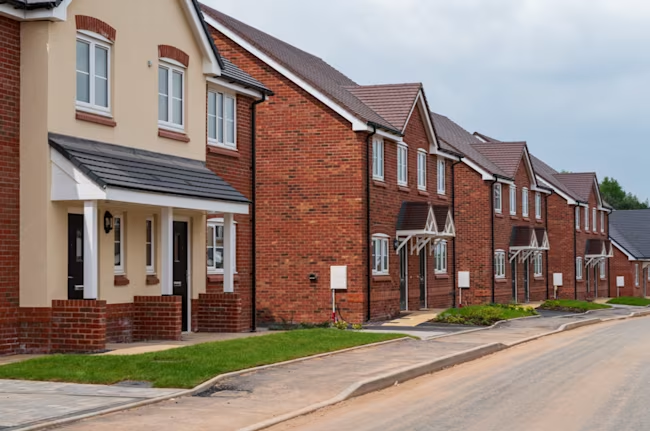
The government's First Homes scheme is designed to provide a route to affordable housing for first-time buyers. Launched in 2021, it's a relatively new scheme.
Participating developers offer to sell certain homes at between 30% and 50% below market value. It means the most you'll pay for a property through First Homes is:
- £250,000 if the property is outside London.
- £420,000 if the property is inside London.
In some areas, the cap could be even lower than this, as councils have the power to set it.
You'll need to be happy to buy a new-build home, or a home originally bought through First Homes. And as the scheme is getting up and running, the pool of properties available is limited – meaning competition is tight and finding a First Homes property can be tough.
But unless you're brave enough to buy a repossessed, distressed or doer-upper home through a property auction (which is a risky venture), then First Homes is arguably one of the best ways of bagging a home that's significantly below market value.
Yet be mindful First Homes isn't the only option if you're struggling to get onto the housing ladder. Later on, we explore how First Homes compares to other home-buying schemes.
Considering buying a new-build home?
It can be a complex process. See our top tips and what to look out for in the Buying a new-build home guide.
Who qualifies for the First Homes scheme?
First Homes is for first-time buyers only (no surprises there). This means you can't use the scheme if you already own a home or have done in the past. If you're buying with another person, both of you will need need to be first-time buyers to qualify.
Here are the other main qualifying criteria for First Homes:
-
The property must be your only or main residence. In other words, you'll live there.
-
You earn less than £80,000 a year (£90,000 if you're buying in London). Where you're buying with someone else, your joint income can't exceed these caps.
-
All names need to be on the application form. So if you're buying with someone else, you'll need to apply for the scheme together (and both be named on the mortgage).
-
You'll need to get a mortgage worth at least half the property's value. So if the discounted price of the property is £200,000, you'll need to be confident of getting a mortgage worth at least £100,000 (the actual amount will depend on the size of your deposit). See our How much can I borrow? guide to get an idea of what's realistic.
Key worker, live locally or on a low income? You may get priority
Councils are able to prioritise certain people for First Homes, such as:
- Key workers.
- People who live locally.
- Those on a low income.
While this might mean you struggle to qualify for First Homes if you don't already live in the area, this won't necessarily be the case. Check with the council what its rules are.
If you're a member of the armed forces (or were within the last five years), a former spouse of someone in the armed forces, or a widow/widower of someone in the armed forces, you may be prioritised too (even if you're not a key worker and don't live locally).
First Homes and getting a mortgage

Only buyers who need a mortgage can apply for First Homes (in other words, cash buyers – those who don't need a mortgage – can't use the First Homes scheme).
Getting a mortgage can be tricky, as only a limited number of lenders offer mortgages on First Homes, so your range of deals will be smaller and you may not be able to get the best interest rates (though the property discount should compensate for a poorer rate).
Some lenders also cap the maximum loan-to-value – for example, at 90% LTV (how much you're borrowing compared to the value of the property). This means your choice of deal may be even narrower if you've only got a small deposit, though there are some lenders that offer 90% and 95% mortgages available through First Homes.
Yet, the discounted property price can mean the size of your deposit increases in relative terms. Here's an example of this in practice:
A £50,000 deposit on a £250,000 property is equivalent to 20%, making your LTV 80%.
Yet if First Homes means the property is discounted to £200,000, your £50,000 deposit will then be equivalent to 25%, meaning your LTV decreases to 75%.
At 75% LTV, you'll get a better interest rate on the mortgage than at 80% LTV.
Not only does a smaller LTV mean better interest rates, it can also increase your chances of mortgage acceptance, as you'll be seen as less of a risk by mortgage lenders. For more details on the importance of LTV, see our How much can I borrow? guide.
And before applying, make sure to read our Boost your mortgage chances guide.
Which lenders are taking part in the First Homes scheme?
There are just over a dozen lenders taking part in the First Homes scheme, including:
- Nationwide
- Halifax
- Leeds Building Society
- Newcastle Building Society
- Darlington Building Society
- Chorley Building Society
- Mansfield Building Society
Some lenders, like Halifax, offer specific First Homes mortgage deals, which may not be as cheap as its standard range of mortgages. Yet not all lenders do this. So depending on which lender you apply to, you might be able to choose from a wider range of deals.
Either way, it's best to speak with a mortgage broker. That's because a broker can:
-
Tell you which mortgage lenders offer First Homes mortgages.
-
Advise you about interest rates.
-
Place you with the mortgage lender where acceptance is most likely.
With First Homes, mortgage lenders tend to offer a range of two-year fixes, five-year fixes, and two-year trackers – though there aren't any deals longer this, so if you want a longer deal (such as a seven or 10-year fix), First Homes might not be for you.
Remember, before applying for a mortgage, make sure you have a read of our Boost your mortgage chances and Improve your credit report guides.
How to find and apply for a First Homes property

There is nowhere central, such as a website or portal, advertising First Homes for sale, which can mean that it's not always straightforward finding where they're available.
Instead, new First Homes properties are advertised directly by developers and house-builders. So in order to find a new First Homes property for sale you'll need to:
Look out for mention of First Homes in your area or online.
Contact developers/builders and ask if and where they have First Homes.
Contact the local council and ask whether it knows of First Homes for sale in the area.
Sales of previously-lived-in First Homes properties are advertised by estate agents, so you'll need to contact the agent and ask about availability or search online property portals.
If you find a property you like, contact the developer or estate agent. They'll check you meet the First Homes eligibility criteria and help with the application form, which will be submitted to the relevant council. You'll need to include the name of your conveyancer/solicitor on your application (our Buying a home timeline guide has tips on how to find one of these).
If your application is successful, you'll then need to arrange a mortgage.
For more information on the First Homes scheme application process, see Gov.uk.
Buying a home directly from the developer/builder?
You're likely to pay a reservation fee up front, which can cost £100s. This fee will be deducted from the remainder of the purchase on completion. The fee should be refundable if your application for First Homes is unsuccessful, but it may not be if you back out – make sure you read the terms and conditions.
Warning. Selling a First Homes property can be tricky
If you sell your First Homes property, this will need to be to someone else buying through the scheme, which can making shifting your home tricky as the pool of buyers is smaller.
Your buyer will be entitled to the same level of discount as you when you bought your home. So if your discount was 30% discount and your home is now valued at £280,000, the maximum you could sell it for would be £196,000 (30% of 280,000 is 84,000). This means if your home increases in value after you buy it, you won't benefit from this in its entirety.
There are some circumstances where you may be able to sell your home on the open market at its full market value – for instance, if you're really struggling to sell your home through First Homes. But there's no guarantee as your council will need to agree to this.
Either way, to sell your home you'll need to notify your local council, use an estate agent and also get a valuation from a chartered surveyor.
Selling a home is rarely straightforward. There are added complexities that come with First Homes.
For more on how selling a First Homes property works, see Gov.uk.
How does First Homes compare to other schemes?

First Homes isn't the only option if you're an aspiring first-time buyer who feels priced out of the market or like you're struggling to get a deposit together.
Yet with different options available, it can be hard to work which is best or even if you'd qualify in the first place...
Our How Much Can I Borrow? guide has a full list of options for those with a small deposit, but below we quickly compare First Homes to some of them.
Shared ownership – own part of a property
There are far more shared ownership properties available than First Homes, as this scheme has been around for much longer.
With shared ownership, you can buy as little as a 10 or 25% share of a property, meaning you don't have to put down as big a deposit and your monthly mortgage repayments will be smaller than they might otherwise be. Remember though, you won't own all of the property – you'll only own a share. Furthermore, you'll pay rent on the share of the property you don't own (to a housing association), so your overall monthly repayments (mortgage, rent, service charge) can still add up.
If you decide to buy an additional share of your home later on (known as 'staircasing'), the share may cost you more than now if property prices have increased.
Similar to First Homes, selling a shared ownership property can be complicated as there are normally restrictions involved.
For more, see our guide on Shared ownership.
Right to Buy – get a discount on your council home
Launched in 1980, you might be able to take advantage of the Right to Buy scheme if you live in a council home (house or flat).
If you're eligible to take part, you'll be able to get a discount off the price of your council home if you want to buy it, though exactly how much depends on how long you've lived there for. The discount is worth up to £102,400 across England or £136,400 in London – likely a bigger discount than what you could get using First Homes..
While you can sell a Right to Buy home on the open market, you'll have to repay part or all of the discount you got if you sell within five years.
For more, see our guide on Right to Buy.
Lifetime ISAs – get a free bonus for your deposit
A Lifetime ISA (LISA) is a way of boosting your deposit for free. You can use it to save up to £4,000 a year, towards either a first home (costing up to £450,000) or for retirement, and the state adds a bonus of up to £1,000 on top each year. Anybody aged between 18 and 39 can open a LISA.
You can use a LISA even if you're thinking of applying for First Homes, shared ownership or Right to Buy – so if you're considering buying a home it's worth opening a LISA as soon as possible.
For more, see our guide on Lifetime ISAs.
First Homes scheme FAQs
Can I let a First Homes property?
Yes, you can let your First Homes property, but there is a cap on how long you can let the property for in total. There are no restrictions though on how long you can rent a room in your home (ie, have a lodger).
See full details on Gov.uk.
Can I decorate a First Homes property?
Yes, you can decorate and improve (such as extend) your First Homes property, so long as it's within the planning, building and leasehold regulations.
Are First Homes available in Wales, Scotland or Northern Ireland?
No, the First Homes scheme only runs in England.
Share this guide?