
Will your energy fix be reduced by the Budget's FULL '£150 a year off bills' from 1 April 2026?


Energy bills in England, Scotland and Wales are set to be cut by '£150 a year' on average from Wednesday 1 April, in line with changes announced in last year's Autumn Budget. Most suppliers have since confirmed that this will apply to both variable tariffs AND fixes – though some customers of the smallest firms may not get the full benefit. To check what your supplier is planning to do, see our updated firm-by-firm table below.
Watch. Martin Lewis: 'Already on an energy fix? It'll get cheaper on 1 April'
In the video below, filmed on Friday 27 February, MoneySavingExpert.com founder Martin Lewis explains how the '£150 off bills' will work for those on fixed energy tariffs:


Full transcript of what Martin said in his video
"If you're already on a fixed energy tariff, it will get cheaper on 1 April. There's a lot of confusion about this, and lots of people saying to me: 'Should I get a new fix?' Well, I just want to talk you through it.
"So, in a nutshell, on 1 April, all bills are getting cheaper. So, if you're on a fix, whether you got that the day before 1 April, the month before or six months before, the rate you pay for energy will drop on 1 April.
"Now typically, the amount it will drop – it's the unit rate of electricity that will fall by about 3.5p per kilowatt hour, which is typically about 13% of what you pay on the unit rate right now. And the unit rate of gas will drop by 0.33p per kilowatt hour, which is about 6% roughly on average. That's for most firms.
"But if you're with a smaller firm, you'll get a reduction, but it won't be as big. And the reason for that is what's happening to policy costs:
-
"The first one and the big one is a thing called the Renewable Obligation. 75% of the cost of that is being taken off energy bills and instead being paid for by the state. And this applies to all energy bills.
"I'm going to say 'the state', of course that means through general taxation or through debts. You can get into the politics of that yourself, I'm just talking about energy bills. So that's the main reason for the reduction. -
"And then there's another thing, which is the ECO scheme. That ends permanently in March. And that was paid for through bigger firms' energy bills, which is why bigger firms will see a bigger reduction, because that's ended. Smaller firms weren't paying for it anyway, so they'll only get the reduction from the Renewables Obligation.
"Now, I think probably the reason there's been so much confusion about this is this fall happens at the same time that the Price Cap falls. Now the timing is deliberate, but the two things are separate.
"Lots of factors make up the Energy Price Cap. The biggest reason it's falling in April is because of this reduction in policy costs. And it's the same reason we're seeing this unprecedented change in other bills is happening at the same time. But even though the same reason is driving them, they are actually two different things.
"The Price Cap doesn't affect fixed rates. It's a policy cost that affects fixed rates. So lots of people are saying to me, with prices coming down, including fixes, should I be fixing right now? Well, this isn't a reason for you to get a new fix. I mean, if you get a new fix or your existing fix, they're both going to come down (as long as it's a bigger firm) by the same amount on 1 April.
"So of course, you can go and do a comparison now. And if you go and do a comparison and you find a new fix that is cheaper than your existing fix – and do factor in any early exit penalties – then yes, you might want to move to it just because it's cheaper, because if it's cheaper now than when they both drop on 1 April, it'll still be cheaper.
"But if it's more expensive now, when they both drop on 1 April, it will still be more expensive. So, this isn't a driver for getting a new fix. This is just for you to know if you're on a fix and frankly, all bills – those on time-of-use tariffs, and those on EV tariffs – they should all be dropping on 1 April. Though with the time of use tariffs and the EV tariffs, exactly how much they'll drop is more complex because they don't work in the same way with the simple unit rate.
"I know it's confusing. It is an unprecedented move. I hope this clears it up. Loads more information in my podcast on this, where I go into it in even more detail. So that's The Martin Lewis Podcast, or I did it on my telly show last Tuesday. So, if you want to get into the nitty-gritty of that, then do have a listen or look at those too. I hope it helps."
The full bill cut should be £150 a year – but it may be less for smaller firms
The average '£150 a year' saving announced in the Budget is rounded down from £154 (£147 before VAT) and comes from either moving or reducing the cost of two elements:
-
Reducing the 'Renewables Obligation' (RO), which costs typically £90 a year on all bills. The Government will reduce the amount households pay towards this scheme by 75%. This was a policy cost applied to all bills across all suppliers, and makes up approximately £92 of the potential yearly saving (or £88 before VAT). The cost will instead be met out of central Government funds.
-
Cutting the 'ECO' scheme, which costs typically £60 a year but is only paid by customers of bigger firms. The Energy Company Obligation (ECO) scheme will close in March 2026. This is a scheme that all suppliers with over 150,000 customers had to administer, while recouping the costs through customer bills. It accounts for about £62 of the saving (or £59 before VAT).
Therefore, if you are a customer of a smaller firm – such as 100Green, Ecotricity, Fuse Energy, Good Energy, Home Energy or Tulo Energy – and on a fixed tariff (or any tariff that isn't Price Capped), it is possible your saving will be smaller as the firms weren't charging you for this anyway. See Will smaller firms pass on the ECO cut?
If you're with a smaller firm on a Price Capped tariff, you should still see the full saving in most cases, as it will be factored into the Cap that all firms have to follow.
However, there are some exceptions, such as Home Energy. Its standard variable tariff has been undercutting the Price Cap for some time. And because it's charging less than the maximum allowed under the Cap, this means the firm can – and sadly is – increasing rates on Wednesday 1 April (though they'll still be below the new Price Cap).
The vast majority of households should see their energy supplier pass on savings from both elements.
How much of the Budget savings will your supplier pass on?
The energy savings will be applied through the Price Cap to all customers on variable tariffs. Most suppliers have now confirmed that they WILL pass on the savings to those on fixes as well, as shown in the table below.
If you're currently on a Price Capped tariff, you're likely overpaying and may be able to save £100s by switching to a cheap fix – do a full Cheap Energy Club comparison to find your best deal (it'll depend on your usage and region), then check the table to make sure your chosen supplier has confirmed it'll pass on the Budget savings in April.
Provider | Will the reduction apply to ALL tariffs, including existing fixes? | Will the reduction apply from 1 April 2026 on all tariffs? | Does this firm currently pay the approx. £62/yr ECO scheme costs? |
|---|---|---|---|
100 Green | Yes | Yes | No |
British Gas | Yes | Yes | Yes |
Co-op Energy | Yes | Yes | Yes |
E Energy | Yes - but only has variable tariffs | Yes | Yes |
E.on Next | Yes | Yes | Yes |
Ecotricity | Yes | Yes | No |
EDF | Yes | Yes | Yes |
Fuse | Yes | Yes | No |
Good Energy | Yes | Yes | No |
Home Energy | Yes - but only has variable tariffs | Yes | No |
Octopus Energy | Yes | Yes | Yes |
Outfox Energy | Yes | Yes | Yes |
Ovo | Yes | Yes | Yes |
Sainsbury's Energy | Yes | Yes | Yes |
Scottish Power | Yes | Yes | Yes |
So Energy | Yes | Yes | Yes |
Tulo Energy | Awaiting response | Awaiting response | No |
Utilita | Yes - but only has variable tariffs | Yes | Yes |
Utility Warehouse | Yes | Yes | Yes |
Correct as of Monday 30 March 2026.
Martin Lewis: 'A straight cut on all bills on 1 April is the cleanest & best route'
Here's MoneySavingExpert.com founder Martin Lewis explaining how this works on Tuesday 16 December 2025 (it's an expanded version of his posts on social media):

This is all about the changes announced in the Budget that the Government says will "cut £150/yr off average bills from 1 April" across England, Scotland and Wales.
Yet that statement from the Government was blunt. It did it in reference to the default Price Caps (for Direct Debit, prepayment and pay on receipt of bills), which two-thirds of homes are on, but what about the rest – the people who've done what they should and ditched the Price Cap for cheaper fixes and special tariffs?
I called the secretary of state for energy, Ed Miliband, within an hour of the end of the Budget, to push him on this, and he promised me he'd try and get firms to pass it on to all customers. The next day, I asked him on camera on my ITV Budget show (it's at 10 mins 24secs in). Now, finally, that pushing seems to be paying off, let me take you through it...
1. This £150 year off average bills from the Budget, is mostly from shifting 75% of the cost of the Renewables Obligation policy off energy bills on 1 April 2026 and onto general taxation, and also from cutting the ECO scheme at the end of March 2026.
2. The cut to the Price Cap will be via reducing unit rates, ie, the cost of each unit of energy you use. It is projected to be:
- Electricity: a 3.5p/kWh inc VAT (c.13% off Jan Price Cap) reduction.
- Gas: a 0.35p/kWh inc VAT (c.6% off Jan Price Cap ) reduction.
... if everything else remains equal.
3. Yet, everything else is unlikely to remain equal, as the April Price Cap was expected to rise without this Budget announcement, so the actual pound-in-your-pocket cuts will be a little less than the above, yet still significant. Currently, factoring everything in, around a 6% reduction in April's Price Cap over January's is predicted.
4. What I've been pushing for, is for all energy companies to do this by simply reducing the unit rate on all their tariffs on 1 April by the amounts above. That way we can clearly see the discount has been applied and by the whole amount. The table above shows whether firms have agreed to that or the more loose 'we'll pass on all the cut' (or nothing at all).
5. The Government has told me it is pushing all firms to follow suit, as it should. The key for me, though, is how it will be implemented and making sure it is transparent and consistent across firms.
One method some firms have discussed is that when they launch a new fix before 1 April, they say they will incorporate the Budget cut in the fix's price from day one of the fix (or incorporate the ECO cut element from day one) by calculating the pro-rated savings they'd make after 31 March.
This worries me. It isn't transparent – we can't see any change. How do we know they've done it and not just priced higher knowing this? It also makes comparisons difficult if some firms reduce prices on 1 April and some won't. That's why I'm pushing the 'do it on 1 April' route.
6. A final area we're still in the dark on (ironically) is time-of-use tariffs. It's simply too early to know how they’ll factor the discount in on those (firms haven't got that far yet). However, the MSE team and I will be monitoring this nearer the date to check if it's fair and loudly state if we think it isn't.
7. Of course, many would've preferred this discount to be off Standing Charges; that way it's a flat saving for everyone. It's something I pushed for pre-Budget. That hasn't happened, but there is also a consultation on cutting c.£39 off Standing Charges by shifting the cost of the Warm Home Discount onto the unit rate on 1 April too.
If that happens, it will lower Standing Charges and increase the unit rate (though that increase would be less than the saving due to this, so the unit rate would still drop in total) – but overall, average costs will remain the same.
Those with the smallest suppliers may see less of a saving
If you're with a small supplier – including 100Green, Ecotricity, Fuse Energy, Good Energy, Home Energy or Tulo Energy – you may only see a saving from the first element (roughly £90 a year). That's because, as noted above, smaller firms never had to pay ECO scheme costs in the first place. So the end of that scheme doesn't directly reduce their costs in the same way that it does for bigger suppliers.
Energy Secretary Ed Miliband has said he expects "every penny" of the Budget intervention to be passed onto consumers. Yet, for smaller suppliers that aren't part of the ECO scheme, this intervention only amounts to about £90 of the £150 total – so, in practice, this is likely to be the maximum that these firms can pass on as a bill cut to their customers. When we asked the Government to clarify, it simply repeated: "We expect all domestic suppliers to pass on cost savings".
Industry regulator Ofgem told us it's possible that small suppliers could reduce their margins in other areas to match the savings offered by bigger suppliers. So the position could still change, but it's far from guaranteed, and so far none of the smaller firms have committed to this.
The ECO scheme also doesn't apply to households in Northern Ireland, so it won't apply here. There is a similar scheme to the RO running in Northern Ireland, but it'll be down to the Executive to decide whether to follow the UK Government in partially funding this scheme and therefore passing on the costs to consumers.
Some suppliers have already started passing on the Budget savings
Most firms will adjust the rates of their existing fixed tariffs on Wednesday 1 April, but two suppliers have started doing this already:
-
So Energy: If you joined between 27 November 2025 and 14 January 2026 on a So Hawthorne, So Kings, So Kielder or So Larch tariff, some of the saving relating to the ECO scheme ending is already included in your rates. But you'll still see a reduction from Wednesday 1 April due to the Renewables Obligation element, plus the remaining bit of the ECO scheme saving.
-
Utility Warehouse: If the name of your tariff includes 'Fixed' and a number 70 or higher (launched from 4 December 2025), the saving relating to the ECO scheme ending is already included in your rates. But you'll see a reduction in your electricity rates from Wednesday 1 April to reflect the Renewables Obligation element being removed.
Government expects all suppliers to pass on savings from 1 April 2026
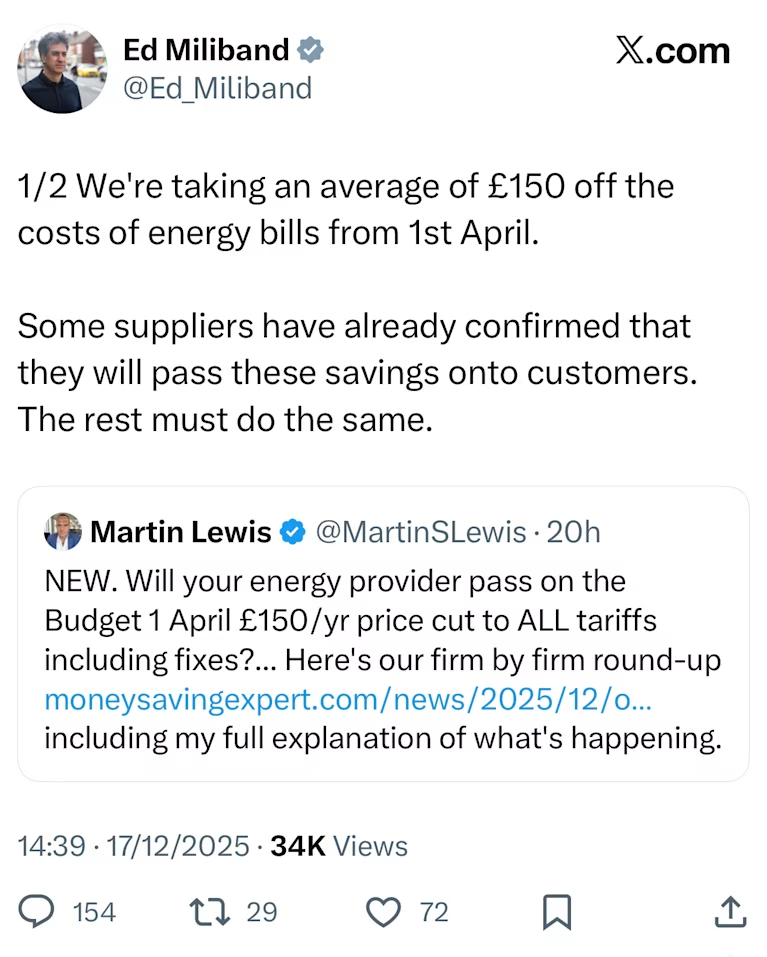
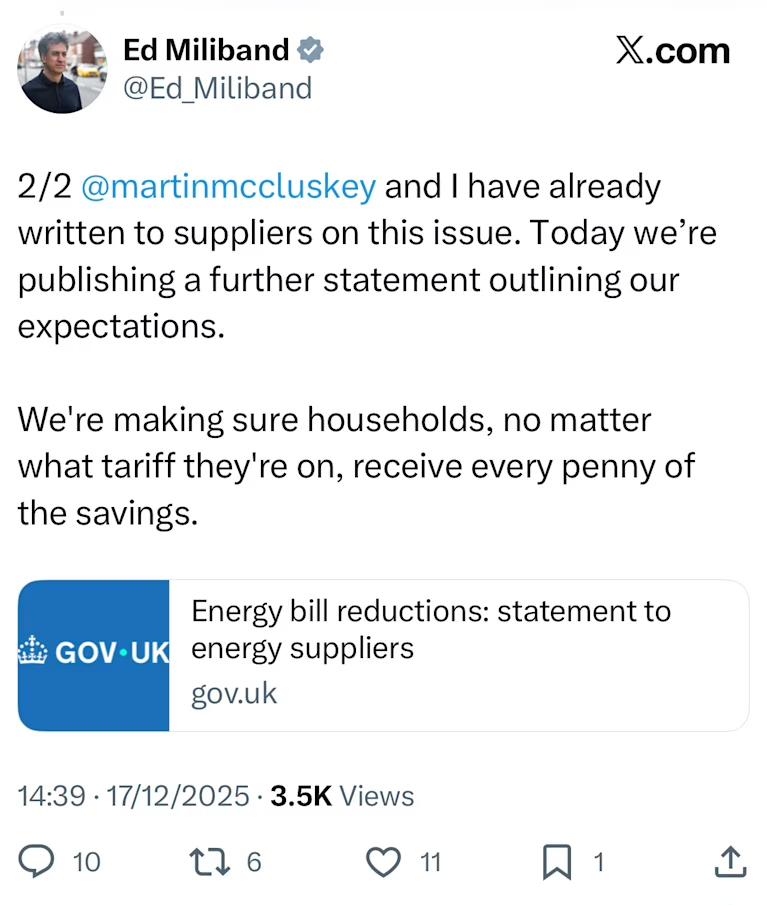
Following Martin's calls, the Department for Energy Security and Net Zero (DESNZ) released a statement (on Wednesday 17 December 2025) stating that the "Government expects the savings to be passed on in full to all customers from 1 April 2026 onwards, including those on existing fixed tariffs entered into ahead of 1 April 2026".
Energy secretary, Ed Miliband, wrote:

Share this guide?


 Latest weekly email












Clever ways to calculate your finances


