
Travel disrupted due to conflict in the Middle East? Your rights explained


If you've had your travel plans disrupted by the ongoing conflict in the Middle East, or been stranded abroad, here's what you need to know about your rights – including flight delays and cancellations, compensation and more.
Update: Tuesday 28 April 2026: Conflict in the Middle East is stretching on, which has made things more uncertain when it comes to booking and going on holiday. The closure of the Strait of Hormuz – a key trade route for oil, fuel and gas – has a global impact, which hits travel too. The executive director of the International Energy Agency warned that Europe has "maybe six weeks or so of jet fuel left".
So we've rounded up full help on cancellations, fuel surcharges, package holidays and more in our new Middle East conflict travel rights news story.
At the end of February, the United States and Israel launched an attack on Iran, sparking a wide-scale conflict across the Middle East – and a UK military base in Cyprus was also targeted. Worldwide, thousands of flights have been cancelled and in the UK, travel to the Middle East has been heavily disrupted – with British Airways cancelling all flights to Amman, Bahrain, Dubai and Tel Aviv until June 2026.
In light of the conflict, MoneySavingExpert.com founder Martin Lewis put a callout on social media, asking MoneySavers whether they've been impacted, and what questions they have. We've tried to answer as many of those questions here, and we're updating this story regularly.
In this guide
The latest travel guidance for the area:
-
Current operating guidance from major Middle Eastern airlines
-
My MOT has run out and I'm still stuck abroad – how can I avoid a fine?
Your cancellation and refund rights:
-
Current rebooking and cancellation guidance from major airlines
-
Rail tickets for travel to or from a British airport may still be valid
-
Flight going ahead but the FCDO advises against travel? This is a tricky one
Additional avenues to try and get your money back:
The UK has issued advice for travel to and from affected countries
The UK's Foreign, Commonwealth and Development Office (FCDO) has issued travel advice for various countries affected by the conflict – see the table below.
This is important for two main reasons:
-
If you travel against FCDO advice, you risk invalidating your travel insurance. Your policy generally won't cover you for most types of claims if there's advice against ALL travel to your destination (though it's still worth checking directly with your insurer).
-
If you booked a package holiday, you may be able to get a refund. According to travel industry body ABTA, if the FCDO issues a warning against travel to your destination after you've booked, your provider should offer you a suitable alternative. If it can't, or if the alternative would amount to a "significant" change to your holiday, you should get a full refund – even if the original trip's not been cancelled.
This isn't the case with DIY trips where you've booked hotels and flights separately. In that situation you can still try asking the companies concerned for a refund, but you don't have the same rights.
FCDO advice | Countries included |
|---|---|
🔴 Advising against ALL travel to country (or parts of it) | Afghanistan, Armenia, Azerbaijan, Egypt, Iran, Iraq, Israel, Jordan, Lebanon, Pakistan, Palestine, Saudi Arabia, Syria, Turkey, Yemen |
🟠 Advising against all but essential travel to country (or parts of it) | |
🟣 Other advice – check detailed guidance using links |
This information is correct as of 2.40pm (BST) on Friday 10 April.
Current operating guidance from major Middle Eastern airlines
We've gathered information from three of the best-known Middle Eastern airlines below – but if you've imminent travel coming up, it's best to contact the airline directly as the situation can change quickly. The following is correct as of 2.30pm (BST) on Friday 10 April. This info is for those who booked with the airline directly; if you booked through a travel agent, contact it directly for help.
-
Emirates is now operating a reduced schedule, with some routes open for bookings. If your Emirates flight was cancelled, you can rebook it for free until 15 June 2026 or request a refund. If you're unable to make changes to your travel online, contact Emirates directly.
-
Etihad is now operating a flight schedule between Abu Dhabi and "around 80 destinations". Tickets are available for sale online. If you've been affected by cancellations and you were due to travel on or before Wednesday 15 April, you can rebook your flight for free for travel up until Friday 15 May or request a refund. If you're due to travel on or after Thursday 16 April, you can rebook your flight for free for travel up until 15 June 2026 or request a refund.
-
Qatar Airways is continuing to operate a reduced schedule. You can check the latest, including the current list of available flights, on its website. If you're affected by any cancellations, you can rebook your flight for free for travel up to 31 October 2026 or ask for a refund.
What to do if you're currently stuck abroad
There are a few things you should do NOW if you're stuck abroad:
-
Register your presence in an affected region with the UK's FCDO. If you're currently in Bahrain, Israel, Kuwait, Lebanon, Palestine, Qatar, or the United Arab Emirates, the FCDO has requested that you let it know. This is so the FCDO can update you directly on the latest travel restrictions and guidance.
-
Check if your tourist visa is about to, or has already expired, and contact your nearest British consulate or the FCDO directly. India, Indonesia and Saudi Arabia, for example, all require Brits to hold a valid tourist visa. The FCDO told us it is working with authorities abroad to encourage flexibility. It says Indonesia and Thailand are loosening visa rules in this scenario, while the British embassy in Vietnam can provide letters to those affected to help them avoid financial penalties.
-
Check for updates from your airline. Many airlines are publishing up-to-date information on their websites as the situation develops. Be sure to check in frequently if your flight is coming up, as circumstances may change quickly.
-
Contact your travel insurer. It's a good idea to let your provider know the situation and ask about your cover. If you only had a single-trip policy, it may have been extended automatically for the extra time you're away – though it's always best to check directly.
See below for your flight delay and cancellation rights, including the help your airline must offer during the disruption.
Abu Dhabi's Department of Culture and Tourism told us that it WILL be covering hotel and accommodation costs accrued by visitors who are unable to fly out of Abu Dhabi due to flight cancellations. It has communicated directly with hotels, telling them to extend check-out dates for current guests automatically – if you're currently stuck in Abu Dhabi, you should with your hotel or accommodation provider directly for more detail.
My MOT has run out and I'm still stuck abroad – how can I avoid a fine?
We asked the Driver and Vehicle Standards Agency (DVSA) about what to do if you find yourself in this situation – here's what it said about next steps:
-
If possible, arrange for your vehicle to be moved to a driveway or other private land while you're away. If your car is parked on a public road and its MOT has expired, it could be subject to a fine.
- If you manage to do this and you don't expect to be home for some time, you could register your vehicle as 'off the road'. You can do this by filing a 'Statutory Off Road Notice' (SORN) for free with the Driver and Vehicle Licensing Agency (DVLA). If you file a SORN, you'll get a refund for any full months of vehicle tax you have left, but you cannot use your vehicle on the road again until you pass an MOT test. You should also file a SORN if your vehicle isn't insured, even if this is only for a brief period. -
If you can't move your vehicle to private land, reschedule your MOT test for just after you expect to be home. You may still be hit with a fine, but you can typically change the date of your test as many times as needed, so long as you give advance notice. When you return, you can only drive your vehicle directly to a PRE-BOOKED MOT test or to a garage for repairs – otherwise, you risk being hit with a fine.
-
If your vehicle tax has also elapsed, contact the DVLA directly. You won't be able to have an MOT test if you haven't paid this tax, so it's best to explain your situation to the DVLA directly in this case.
If you're concerned about being clamped, towed or fined, the DVSA said you can try contacting your local police force's non-emergency line directly. This is because their enforcement approach may vary. Unsure if your vehicle's due for an MOT test? Use the Gov.uk MOT check tool – all you need to is your registration number.
BEWARE social media scams
We've already heard reports that scammers are taking advantage of the travel chaos to target people by setting up fake profiles impersonating airlines (including British Airways, Emirates and Qatar) on social media.
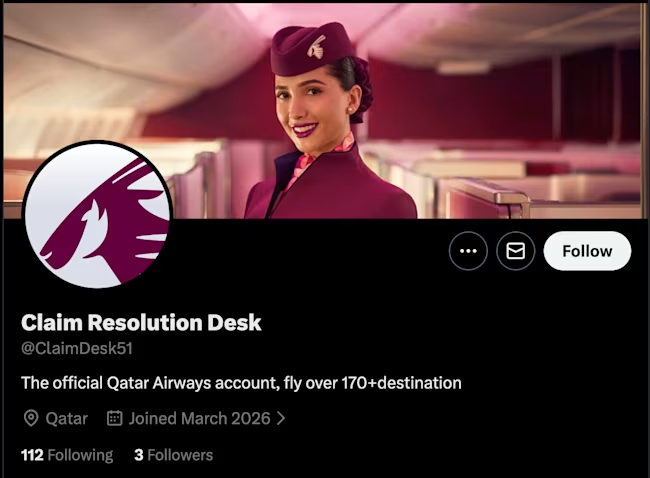
Santander told MSE that it's seen fake accounts reach out to people who are stranded or due to travel via direct message, or by replying to posts they've made about their disrupted travel. The accounts ask for personal details, then reach out later offering to process a refund.
According to Santander, people are then being sent links to money transfer apps, through which fraudsters may be able to take cash from people's accounts.
We've seen what appears to be one of these fake accounts mimicking Qatar Airways on X (see the image included). For reference, Qatar Airways told us its only legitimate X handles are @qrsupport and @qatarairways.
Here are a few key points to remember:
-
ONLY contact airlines and travel companies using details you've verified independently. Visit the firm's website directly to find its legitimate contact details – and be extremely wary of unsolicited contact on social media.
-
Beware any urgent deadlines. This is a stressful and fast-moving situation, so it's understandable if you want to act fast – but this is a tactic scammers often use to cash in. Take your time and double-check the details before engaging.
-
Be extra careful with links in texts or emails. Scammers may pretend to be airline representatives via these routes. If in doubt, DON'T CLICK – find the firm's contact details on its website and contact it that way.
If you're worried you might've been scammed, end all further communication straight away and see our What to do if you've been scammed guide for more help.
Current rebooking guidance from major airlines
British Airways | - If you're travelling to or from Abu Dhabi, Amman, Bahrain, Doha, Dubai, Tel Aviv or Riyadh up to and including 31 October 2026 (and your ticket was issued on or before Wednesday 1 April), you can request a full refund online. - If you're planning to travel to or from any of the above destinations on or after Tuesday 2 June, you can also opt to change your route or travel date without any fees – but you will need to pay any fare difference on the new route in this case. |
Emirates | If your flight was scheduled to depart up to and including Sunday 31 May, you can either: |
Etihad Airways | - If your ticket was issued on or before Saturday 28 February, and your travel is planned for any date up to Wednesday 15 April, you can request a refund or rebook for free on any Etihad-operated flights on dates up to 15 June 2026. If you opt to rebook for a date after 15 June, you may face a rebooking fee. |
Jet2 | - A Jet2 spokesperson told us that its flights and holidays are currently "operating as normal, and are subject to the usual terms and conditions", adding that the firm would "continue to monitor the situation closely." |
Qantas | If you booked to fly to, from or through Bahrain, Israel, Jordan, Oman, Qatar or the UAE on a Qantas partner airline (Qantas doesn't directly operate any flights in the region) on or before Sunday 31 May, and you plan to travel up to and including Sunday 31 May, you can request either a: - Full, fee-free refund. - Fee-free flight credit, though you may need to pay the difference in fare prices when you book. - Fee-free date change to travel on or before 15 June 2026 – though this is subject to availability. |
Qatar Airways | If your flight was scheduled to depart between 28 February and 15 June 2026, you can either: |
Ryanair | TBC |
TUI | - If you're due to travel to or through Qatar or the UAE on or before Tuesday 14 April, TUI says it will contact you to let you know what your options are. - If you'd prefer not to wait for TUI to contact you, you can call 0203 451 2688 – but be aware the lines are likely to be very busy. |
Virgin Atlantic | - Virgin says you should contact it directly to "discuss the flexible booking options which may be available to you". |
Virgin Australia | - If you're flying on Virgin Australia's Doha services up to and including 15 June 2026, you can claim a full refund, travel credit, or a free booking change to the same destination up to 31 October 2026. |
Wizz Air | - Standard policies apply, so you may be charged fees to change or cancel. |
This information is up to date as of 2.30pm (BST) on Friday 10 April.
Flight delayed or cancelled? Your rights at a glance
Your options depend in large part on whether your flight is covered by UK or EU rules (which are the same rules in effect). The table below gives a quick summary of your rights – follow the links for much more info.
Covered by UK/EU regs | |
Flights TO the UK | - If cancelled by airline, entitled to refund OR alternative flight |
Flights TO the UK | - If cancelled by airline, entitled to refund OR alternative flight |
Flights FROM the UK | - If cancelled by airline, entitled to refund OR alternative flight |
NOT covered by UK/EU regs | |
Flights TO the UK | - Rights vary based on airline's policy and its home country's laws |
Flights entirely outside the UK & EU | - Rights vary based on airline's policy and its home country's laws |
UK- or EU-regulated flight cancelled? You're entitled to an alternative (or refund)
If your flight's been cancelled by the airline, however long before it was due to take off, you have a legal right to choose between EITHER a refund for the flight that was cancelled OR an alternative flight (airlines call this re-routing) to your destination.
If you choose to be re-routed, you should be offered an alternative flight at the earliest opportunity and it DOESN'T have to be with the same airline. Some have agreements with other airlines and may try to book you on one of these initially – though if this alternative is not suitable, stick to your guns and ask for a more convenient flight – see our Flight cancellations guide for more information.
Of course, given the scale of the disruption, it may be difficult to get through to the airline to arrange a replacement flight. Keep trying, or check to see if you can sort it online through the airline's 'Manage my booking' portal.
DON'T just book a new flight yourself. Your airline has a responsibility to help. Booking yourself should be a last resort, if you've exhausted all possible avenues through the original airline. If you do have to do this, make sure you keep all evidence to help your eventual refund claim.
UK- or EU-regulated flight? Your airline must help during the disruption
If your flight is delayed, or it's been cancelled and you've opted to be re-routed, or you're stuck at the airport abroad, your airline is responsible for providing a so-called 'duty of care'. This includes:
-
Regular updates on what's going on. You may not always be able to ask for updates at a check-in desk, as this situation is fast-moving and unpredictable, but your airline should be issuing updates via its website, app and social media accounts. You should also check the email you used when booking in case you've been sent an update.
-
Food and drink. Your airline should provide food and drink (or vouchers to buy them) if you're delayed for more than two hours on a short-haul flight, three hours on medium haul (for example, Manchester to Malaga) or four hours for long haul. If it's unable to, you can buy your own and claim it back, but make sure you keep receipts. Check if your airline's website has any guidance on what it'll cover.
-
Accommodation (if needed). If the flight is delayed overnight you're entitled to a hotel, and the airline must also provide transport to and from it. Ideally it will arrange the hotel for you, so always check before you book somewhere.
-
A 'means of communication'. In this day and age, this just means the airline's likely to reimburse you for the cost of any relevant calls you make.
Had to buy your own own food, drink, accommodation, or extra travel? Keep your receipts
As we've mentioned above, if your flight has been delayed or cancelled, your airline should be proactive in providing you with food and drink (and a place to stay overnight, if necessary). If it doesn't, you should be able to claim back any reasonable expenses when you get back.
When you contact your airline, you'll need to include:
-
Receipts. To show how much you spent on food and/or a place to stay or alternative travel arrangements. Remember only reasonable expenses are covered – so it's unlikely you'd be able to claim for alcohol, for example. Check if your airline's website has any guidance on what it'll cover. If it does, you can include this information in your claim alongside your receipts.
-
Proof you didn't just go for the most expensive option. If you had to book a place to stay overnight, it can be useful to include the rates of nearby hotels to demonstrate that you didn't just pick the most expensive option. It's unlikely an airline will cover the cost of a luxury hotel if there's a cheaper alternative you could've used nearby.
-
Proof of delay. It can be useful to include how long your flight was delayed by – as what you get is based on how long you had to wait. Include any updates you received by text or email, or screenshots of updates posted on the airline's website or social media.
Flight not covered by UK/EU rules? Contact your airline
If your flight to the UK departs outside the EU on a non-UK and non-EU airline, or your flight is entirely outside both the UK and the EU, then it's not covered by the UK and EU regulations.
This means your rights depend on the policies of the airline you're flying with and the rules set by its home country. The Civil Aviation Authority (CAA), the UK's aviation regulator, suggests contacting the airline directly for further information. You can also see what major Middle Eastern airlines are doing below.
Extra flight delay/cancellation compensation is unlikely
For flights covered by UK or EU rules (see how to check), you can sometimes claim additional compensation of between £210 and £520 if your flight was delayed or cancelled and your airline was at fault.
Crucially, however, you CAN'T claim this extra compensation if the delay or cancellation is out of the airline's hands due to an 'extraordinary circumstance' – which would include the ongoing conflict ongoing in the Middle East. So extra compensation is unlikely to be due here.
I have a connecting flight through the Middle East – what are my rights?
With connecting flights, your options depend on whether your flight is covered by UK/EU rules or not – check our table above to see whether you're covered – and whether you booked your connection as one fare. If your flights are...
-
UK-/EU-regulated AND you booked the connection in one fare: if you can't get to your intermediate stop because your first flight was cancelled, then the airline must refund the whole ticket price, or offer an alternative way to get there. The same usually applies if the disruption is to the second leg only
-
UK-/EU-regulated BUT you didn't book the connections under one fare: your refund rights depend on the status of each individual flight.
-
NOT UK-EU-regulated: you should contact the airline directly for more information on your options.
- Emirates said: if it cancels one leg of your trip booked up to and including 31 March, you'll be able to claim for a refund without fees ONLY for the unused part of your trip.
- Etihad said: if BOTH of your flights are being operated by Etihad, you can get in touch with it to manage any changes or you can request a refund if it cancels one or both of your flights, as outlined above.
If your first flight with Etihad has been delayed and you'll now miss your connecting flight with another airline, you'll need to contact that airline for help.
If you're unhappy with how the airline has handled the situation, you can raise a formal complaint. Alternatively, if you paid using a debit or credit card, you could try getting your money back through your card provider.
What if I booked through a third-party site?
If you booked your flight, hotel or travel extras (such as car rental) through a third-party travel site, in most cases you'll need to contact that booking site directly for help.
We asked some of the most popular sites what they're doing to support travellers – here's what they've told us so far:
-
Loveholidays said it will "cancel and refund all holidays to the UAE, Qatar, Kuwait, Jordan and Bahrain up to and including Sunday 17 May". It has also cancelled some of these holidays beyond that date to align with partner airlines' individual policies. It added that for those currently on a trip, its support team is "available 24/7".
-
On the Beach said it's cancelling all holidays to the UAE and transiting through the UAE up to and including Thursday 30 April and issuing full refunds. It added that it is prioritising supporting customers who have "immediate or urgent travel needs".
-
Tripadvisor said most of its 'Experiences' allow for free cancellation up to 24 hours in advance of the booking by default – though check your terms directly, as these rules do vary depending on the third-party supplier.
-
Trip.com said it would offer refunds in the following circumstances:
- If you booked a hotel in Bahrain, Egypt, Iran, Iraq, Israel, Jordan, Kuwait, Lebanon, Oman, Qatar, Saudi Arabia, Syria, United Arab Emirates, or Yemen before 9am (GMT) on Saturday 28 February, and your check-in date was between Saturday 28 February and Friday 20 March.
- If you booked an airport transfer, car rental, cruise, attraction or tour in one of the above countries that was due to take place by Friday 20 March, but you couldn't travel due to flight cancellations or disruptions.
If you're not happy with how the booking firm has handled the situation, you can try raising a formal complaint. Alternatively, if you paid using a debit or credit card, you could try getting your money back through your card provider.
What about hotel-only bookings?
Here, your refund rights usually depend on the terms and conditions you agreed to when you booked. Of course, these may still let you cancel for free or move your trip. Even if they don't, it's worth checking what your options are just in case – depending on how you booked, you'll need to contact the hotel, third-party booking site or your travel agent.
Booked a package holiday? You've extra rights
According to travel trade association ABTA, if a travel company cancels your holiday due to "unavoidable and extraordinary circumstances", including global conflict, it should offer you:
-
An alternative holiday (when available), OR
-
A refund.
If your holiday is still scheduled to go ahead, but you no longer want to go, you should contact your provider to see what your options are.
According to ABTA, if the FCDO issues a warning against travel to your destination after you've booked, your provider should offer you a suitable alternative. If it can't, or if the alternative would amount to a "significant" change to your holiday, you should get a full refund – even if the original trip's not been cancelled.
What about cruise bookings?
Some cruise lines have cancelled trips or altered their itineraries to avoid stopping at ports in affected areas. Here's a quick rundown of your rights:
-
If you booked your cruise as part of a package holiday, you'll be covered by the above rules. This means you should be eligible for a refund if a) the travel company you booked with has cancelled your holiday due to "unavoidable and extraordinary circumstances" including global conflict, or b) it's made a "significant" change to your holiday but does not offer you a suitable alternative.
-
If you booked your cruise directly and it's since been cancelled, you should generally receive a full refund too – though you should check your cruise line's policy.
-
If you no longer want to travel or can't travel anymore because you're stuck abroad, your cruise line may let you cancel and get a refund or credit to spend on another cruise – again, you'll need to check directly to find out your options.
Travel association ABTA says it expects all of its members (you can check if your company's a member here) to provide full refunds when travel has been cancelled by the company OR when there's a relevant FCDO warning in place and your travel is "imminent".
Important: If the cruise line you booked with is a member of ABTA (Cunard, Marella Cruises, MSC Cruises, Oceania Cruises, P&O Cruises, Royal Caribbean, Seven Seas Cruises, and Virgin Voyages all are, for example), and you don't believe it's handling the situation correctly, you can make a complaint via the travel association's complaints process. If the company you booked with is not a member, ABTA suggests contacting Citizens Advice.
Rail tickets for travel to or from a British airport may still be valid
If you already have a rail ticket to or from a British airport (or airport-serving rail station) and you either landed at a different date, time or location than expected due to the conflict, you may still be able to use your existing ticket.
You'll need to show National Rail proof of travel to or from Bahrain, Iran, Iraq, Israel, Jordan, Kuwait, Lebanon, Oman, Qatar, Saudi Arabia, Syria or the United Arab Emirates to qualify. That proof can be in the form of your flight ticket, a rebooking confirmation, or confirmation from the airline that there's been a delay. If you meet this criteria and you're...
-
Arriving at a British airport or airport-serving rail station: you can use your existing ticket on the day you land, even if you've landed at a different airport than planned. If your flight lands too late for you to travel on the same day, it will also be valid for the next day. You'll need to carry your proof of travel with you on your rail journey and show it alongside your rail ticket if asked by a ticket inspector or station staff.
-
Planning to leave from a British airport or airport-serving rail station and your flight's been cancelled or moved: you will be able to claim a full refund (without any admin fees) for the unused ticket. To claim, reach out to the company you booked with directly and be prepared to show proof of travel during this process.
These rules DO NOT apply to tickets valid on the London Underground or DLR – those tickets will only be valid on the date shown on your ticket.
Flight going ahead but the FCDO advises against travel? This is a tricky one
Here, you need to make a difficult choice between travelling against the FCDO's advice and therefore risking invalidating your insurance, or cancelling your flight yourself, which may waive your right to a refund, and could potentially mean you remain stranded. We've more guidance on your self-cancellation rights below.
When it comes to insurance, if you MUST travel due to an emergency (a family bereavement, for example), the Association of British Insurers (ABI) told us you should contact your insurer directly and explain your situation. Your insurer may be able to arrange specialist cover.
No longer want to travel? Don't rush to cancel
If your trip is imminent (within the next few weeks), you may be able to rebook for free or request a refund from your airline – we've rounded up the latest info from major airlines above, though it's always best to check directly as the situation is changing rapidly.
If your trip is further away, it may not be covered by the special policies outlined above, in which case your rights will depend on the original terms and conditions of your booking. But you may want to wait and see what happens, as there's a chance your airline could extend its flexibility (we've already seen this happen a few times during the conflict).
IMPORTANT: If you're not certain to get a refund, and your trip has NOT been cancelled by the firm you booked with, don't make a rash decision to cancel the trip yourself. That's because if the airline later cancels it (that may yet happen) you would be due a refund, so it's a bit of cat and mouse.
It's also important to note that you may lose out on future refunds for add-ons or upgrades you've purchased (such as seat upgrades or extra luggage) if you do decide to cancel yourself. Virgin Atlantic and Wizz Air, for example, told us that if they cancel your flight, they will refund the cost of add-ons along with the cost of the flight. If you cancel yourself, according to their normal policies, you will NOT be refunded for any add-ons.
How to push your complaint with your airline
We've seen reports that people who should be due a refund from some of the major Middle Eastern airlines, in particular, are struggling to claim them in full. We've put this to Etihad and Qatar Airways and we'll update this story if we get a response.
In the meantime, if you're unhappy with how the airline has handled the situation, you can try raising a formal complaint directly. If you've tried this to no avail, you may be able to take your case either to a relevant regulator, or to one of several alternative dispute resolution (ADR) schemes many airlines have signed up with.
Alternatively, if you paid using a debit or credit card, you could try getting your money back through your card provider.
What travel insurance will – and won't – cover
Many travel insurance policies have wide exclusions relating to war, conflict or insurrection, according to the British Insurance Brokers' Association (BIBA) – meaning claims relating to delays and cancellations are unlikely to succeed.
Similarly, additional costs incurred while you're stuck abroad (such as food or accommodation) are unlikely to be covered by standard travel insurance policies, according to BIBA. The same is also true if you've decided not to travel.
However, you may still be covered for medical emergencies unrelated to the conflict, such as falling ill or having an accident, for example. Five major insurers – ABTA Travel Insurance, Admiral, AllClear, Allianz Partners and Staysure – told us they would extend single-trip policies to cover these scenarios for those stranded abroad.
However, the best thing to do is contact your travel insurer directly to see how it can help, as industry body the Association of British Insurers (ABI) told us "approaches can vary".
Here's what insurers told us when we asked what they would cover:
-
ABTA Travel Insurance said it may consider claims relating to pre‑booked excursions, accommodation, or other non-refundable costs if the airline doesn't cover them, depending on the Ts&Cs of your policy.
It added that it may also cover you for cancellations if the FCDO advises against "all but essential" travel to your destination. If there's a warning in place but your travel is essential, it may also cover emergency medical expenses abroad. -
Admiral said that, if you're stuck abroad and your airline won't cover your additional costs, it will accept claims relating to extra travel needed to continue your trip, and extra accommodation (though it may ask you to move to a cheaper option). It will also offer £30 per person per day for food during any period of time you're stranded abroad.
In addition, if FCDO advice changed after you purchased your policy, Admiral says you can claim for the costs of cancelling your trip or cutting it short. -
AllClear said claims not related to the conflict – such as medical emergencies or accidents, for example – will be covered by your policy as usual.
If you're due to travel in the "next few days" but your trip's been disrupted, you can contact AllClear to move your policy's travel dates by up to seven days, free of charge. -
Aviva said it would support those stranded abroad or whose future trips have been affected "on a case-by-case basis", provided you haven't been able to recover the costs elsewhere. It also said that if you're unable to get a refund or reschedule, you may be able to make a claim for cancellation-related costs – though this won't apply if you've gone against the FCDO's travel advice.
-
Staysure said all of its customers, regardless of policy type, "remain covered for medical emergencies and repatriation [getting you back to the UK for treatment]".
-
Virgin Money said policy holders will still be able to access emergency medical assistance if they're in the affected region.
If you've been in touch with your insurer and you don't believe it's handled your case properly, you can submit an official complaint – for more on this, see our Travel insurance guide.
Struggling to get a refund? You can try your debit or credit card provider
If your flight was cancelled by the airline but you're having real difficulties getting the refund you're owed, you may be able to claim from your card firm – though note this won't always work:
-
If you paid on a credit card: Under Section 75 of the Consumer Credit Act, if you pay for something costing more than £100 but less than £30,000 on a credit card, the card firm's equally liable if something goes wrong. See our Section 75 guide for more details. If your purchase was for £100 or less, you may still be able to get your money back via Chargeback.
-
If you paid with a debit card: Under chargeback – which isn't a legal requirement, just a customer service promise – your bank will try to get your money back from the bank of the firm you purchased from. Though be aware that even if you're paid, the firm itself can sometimes dispute it with the bank and the money may later be clawed back. You typically have 120 days from purchase to submit a claim. See our Chargeback guide for full info.
Additional reporting by the Press Association.




Share this guide?


 Latest weekly email











Clever ways to calculate your finances


