|
Free £20 Argos voucher with top 0% card
New best-buy 'all rounder' card (0% on spending and shifted debt) gives an easy £20 freebie
New Barclaycard* Platinum customers (min income £20k) get 14 mths 0% on debt shifted from other cards (for a 2.9% fee) AND new spending. Plus, spend £100+ within 60 days to get a £20 Argos voucher. As it's 0% for both, it minimises card applications, protecting credit scores. Repay before the 0% ends or it jumps to 18.9% representative APR. All cards require a credit check.
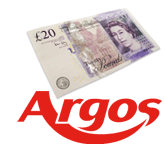 Only want the Argos voucher? Get the Barclaycard*, use it for your normal daily spending until you hit the £100 trigger, then ensure you repay in full each month so there's no cost. For the impact on your credit file of this, see Credit Card Freebies. Only want the Argos voucher? Get the Barclaycard*, use it for your normal daily spending until you hit the £100 trigger, then ensure you repay in full each month so there's no cost. For the impact on your credit file of this, see Credit Card Freebies.- Want the £20 but just for new borrowing? Credit cards should never be used just to fill an income gap, it's a nightmare to catch up. Yet for big one-offs, 0% cards, done right, are free. Borrow the minimum needed, budget and plan repayments to clear before the 0% ends. For slightly longer deals, Tesco* and M&S* last 15 months, then they jump to 16.9% and 15.9% representative APR. See Top 0% Cards guide for full info.
- Want the £20, new borrowing and to shift existing debts? The Barclaycard* is the outright longest all-rounder anyway, so provided you clear debts before the 18.9% representative APR hits, it's a good route. If you already have a Barclaycard, next best is Virgin* giving 13 mths 0% on spending and balance transfers (2.89% fee), then 18.9% representative APR on purchases and 20.9% on transfers.
- Only looking to shift existing debts? Forget the £20, you'll save far more focusing on the right deal. See the Best Balance Transfers guide for best-buys including up to 22 months 0% with 2.9% fee and £40 rebate.
For full info, see the 0% Balance Transfer & Spending guide (and Official APR Examples)
|
|
Boiler cover - save £100s
No need to stick with your energy supplier | Winter's coming, protect your heating for less
Many energy providers use our fear of losing the heating or hot water to charge hefty insurance costs to cover repairs. To help, we've researched and rewritten our Cheap Boiler Cover guide with policies from £7/month, saving £100s annually. Here's a taster...
-
 Do you need cover? If you rent, the boiler's your landlord's responsibility, though check it has a gas safety certificate. Owners with reliable new boilers should consider the likelihood of breakdown vs cover costs. Some may be better to 'self-insure' during your boiler's most reliable early years, where you stick cash in a top savings account to pay for repairs yourself. Do you need cover? If you rent, the boiler's your landlord's responsibility, though check it has a gas safety certificate. Owners with reliable new boilers should consider the likelihood of breakdown vs cover costs. Some may be better to 'self-insure' during your boiler's most reliable early years, where you stick cash in a top savings account to pay for repairs yourself.
-
Step 1: Work out what cover you want. It falls into three rough types: i) Boiler only: Just boiler and controls. ii) Boiler and central heating: Includes radiators etc. iii) Home emergency: Often boiler, central heating plus plumber, drains and lost keys cover. Yet this usually has lower cover limits (eg, just £500 max to cover repairs & labour).
- Step 2: Compare to find cheapest policies. Comparison uSwitch* performs the widest-ranging search, though Energyhelpline* and Boiler Choices* are also worth a few extra minutes to check for wider cover.
- Step 3: Check the ones they miss. Once done, check the biggies not on comparison sites including Npower's* Hometeam 50, which gives dual fuel customers a 50% rebate if you don't use call-outs, and Eon. Then, home emergency policies from Direct Line, Aviva and Swinton.
- Step 4: Before signing up, check cover limits and safety. Comparison sites list some of the exclusions, but check policies in full before buying. Plus, note whether it's an insurance policy, which means it's FSA protected, or service cover, which means you're reliant on company solvency (more info in the guide).
These are just the basics. For full info, see the Cheap Boiler Cover guide. Related: Switch Energy Now
|
Please HELP. 14,000 sigs needed for financial education
It's a national disgrace: we educate our youth into debt when they go to uni, but never about debt
Our Financial ed in schools petition has over 86,000 signatures, but we're desperate to get to the 100,000 needed to push MPs to debate it (as Justin Tomlinson MP has agreed to sponsor it, hopefully all we need do is hit the number). |
Sign the petition here - it only takes 20 seconds
Facebook share, Tweet it, Auto email friends |
 It's about getting it on the curriculum. We're a financially illiterate nation, with millions caught by mis-selling, over-borrowing and being ripped off. Is our debt-imbued financial crisis any surprise? Education would help kids thrive and survive in one of the world's most complex consumer economies. While some schools do it, most don't, as headteachers must prioritise curriculum subjects. It's about getting it on the curriculum. We're a financially illiterate nation, with millions caught by mis-selling, over-borrowing and being ripped off. Is our debt-imbued financial crisis any surprise? Education would help kids thrive and survive in one of the world's most complex consumer economies. While some schools do it, most don't, as headteachers must prioritise curriculum subjects. - It can be done with minimal disruption for schools. We know teachers are already stretched. The aim isn't to make it another main subject, but smoothly fit it in existing lessons, minimising extra work and time. MSE's been helping support and finance an inquiry by a group of MPs on how to do this. They're listening to schools and teachers.
- Uni applications down 9% - a tragedy of misinformation? To show how important financial education is, take the new £9,000/year fees for 2012 starters and the wild, inaccurate coverage of them. While we're no fans of the changes, many are scared off for the wrong reasons. To understand the real cost, not the headline figures, please see Student Loan 2012 myth-busting, 2012 Video and Student Fees 2012 cost calc.
Financial Ed now for your kids: Free Teen Cash Class, Other Financial Education Resources
|
|

















 Latest weekly email