|
While headlines shriek "mortgage rates at record lows" and we've seen the longest-ever 0% credit cards, these days unless you're super-creditworthy you won't get 'em. What's more, the new 'representative APRs' on loans & cards mean only 51% of accepted customers must get the advertised rate, so a poor score can mean you pay more. Here are the 'need to knows':
| 1. |
You DON'T have a credit rating and there's no blacklist. Ignore credit agencies' attempts to flog you your specific 'score'. It means little as each lender scores you differently (for each product). As well as your credit file, they also look at application info & any past dealings they've had with you (see the Credit Rating guide). So a rejection from one isn't a rejection from all. So, the aim's to don some credit-rouge to make yourself credit-pretty.
|
| |
|
| |
|
| 2. |
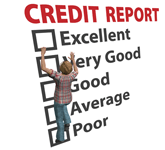 What they really know about you...What's on your credit file? Addresses, CCJs/bankruptcies, 6 years' credit history, credit applications, some utility history. What's not on it? Criminal records, parking or speeding fines, your race/religion, whether you've checked your file (you see it, lenders don't), savings, salary, CSA info, student loans, credit rejections, PPI or bank charge reclaims. What they really know about you...What's on your credit file? Addresses, CCJs/bankruptcies, 6 years' credit history, credit applications, some utility history. What's not on it? Criminal records, parking or speeding fines, your race/religion, whether you've checked your file (you see it, lenders don't), savings, salary, CSA info, student loans, credit rejections, PPI or bank charge reclaims.
|
| |
|
| |
|
| 3. |
Space out applications. Lots in a short time make you look desperate for credit and thus a worrying risk. So spread 'em out and prioritise. Always check files after a rejection before applying elsewhere. If there's an error, even if it's fixed later, lots of apps in the meantime could hurt. |
| |
|
| |
|
| 4. |
Check you're on the electoral roll NOW. Not being on it is the single biggest credit kibosh (Join the electoral roll). If you're a non-EU citizen, you can send your notice of permanent residency to the credit agencies. |
| |
|
| |
|
| 5. |
Check your file for free (or get paid £5 to do it). Ensure you check your file for errors every year and before any major applications. The credit agencies try to charge you for it, yet there's a way to Check Your Credit File Free and even get PAID cashback. |
| |
|
| |
|
| 6. |
Use same job description & mobile number. Consistency and stability are crucial when filling in applications. While it won't hurt your credit score, it can trigger hidden fraud warnings. So if nothing's changed, use the same language on all applications. |
| |
|
| |
|
| 7. |
How to (re)build your credit score. Credit scoring works by using your past behaviour to predict how you'll act. So those with no or poor histories often get rejected. Perversely, the best trick to gradually rebuild a score is get a 'bad credit' card, spend a little on it each month (repaying IN FULL so the hideous APR's are irrelevant) to show you're responsible.
Currently, poor scorers (eg, some CCJs/defaults, not bankrupts) may get the Capital One Classic* which (via this link) is 0% interest until Jan 2012, though a horrid 34.9% representative APR afterwards. So at the very least ensure any debts clear by then. Full options, help & warnings see the Best 'Bad Credit' Card guide and Official APR Examples. |
| |
|
| |
|
| 8. |
Forget marriage or holding hands, only joint finances count. Marriage or living together is irrelevant, the only way someone else's history can affect yours is if you've joint mortgage or bank accounts (joint credit cards don't exist). So if one partner's history's poor, keep finances separate. Plus, if you split and are now financially independent, ask credit agencies to de-link you. |
| |
|
| |
|
| 9. |
Old addresses & unused cards are a danger. Even something as innocuous as an unused, but not closed, contract mobile phone account (which counts as credit) with the wrong address on it can kill applications, so check 'em all. Plus cancel unused cards, as it can look like you have access to more credit, making you less appealing (see the Cancel Old Credit Cards guide). |
| |
|
| |
|
| 10. |
Fight incorrect info. If your file info's wrong 1) Check at the other agencies to see if it's there too; 2) Write to the company the problem's with & ask it to correct the inaccuracy; 3) If it won't, write to each agency to add a 'notice of correction' explaining your side; 4) If necessary, complain to the free Financial Ombudsman, which can order companies to correct errors. |
This is just the beginning ... To seriously boost your score & understand what banks know about you, see the full Credit Rating guide and Credit Checker Tool.
|

















 Latest weekly email