





How to get cheap black box insurance
Learn what it is, whether you should get it and how to cut costs

Looking to lower your car insurance premium? Getting a black box insurance policy can help you do so by basing the cost on your actual driving, and NOT assumptions about factors such as your age. Here we look at what exactly black box insurance is, whether it's worth it and how to find a cheap policy.
Just want to compare black box policies?
If you already know all about black box insurance, and don't need to read our full guide, you can jump straight to comparing black box insurance policies with our Compare+ tool.
What is black box insurance?
Black box insurance is a type of car insurance where the insurer monitors your driving habits. It does this to assess how well you drive – and if it considers you a safe driver, it may offer you a lower premium at renewal.
It's called black box insurance because the tracking is usually carried out by a black box – although not necessarily. These boxes typically use telematics technology, which is why it's sometimes also called telematics car insurance. The device then sends this driving data to the insurer.
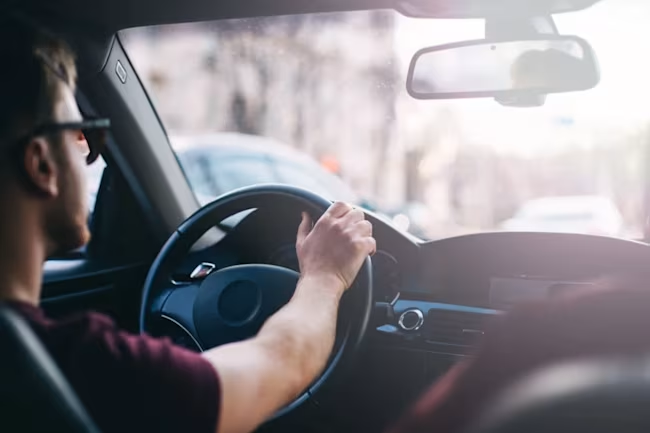
Black box car insurance is especially valuable for drivers considered higher risk by insurance companies – for example, young drivers and new drivers.
These motorists tend to face higher insurance costs, making black box insurance potentially a useful way of reducing premiums. Of course, the flipside is that high-risk driving behaviour can increase your policy costs – or even lead to cancellation. However, if you're a good driver, you should pay less.
What is a black box?
Also called a telematics box or telematics device, a black box is usually a small device installed behind your car's dashboard. It will be sealed and hidden so others can't see it.
Black boxes typically use GPS, wireless communication and onboard diagnostics to record how and where a car is being driven.
The insurer will usually arrange for the device to be installed at a garage – some providers want this done by the policy start date, others within 14 or 30 days. Check the provider's terms to be sure.
You won't own the black box yourself, making you liable to the insurer if anything goes wrong. That said, the provider should replace it free of charge if the damage is accidental or the device is faulty – more info below.
Not all black box insurance policies use black boxes
Although this type of cover is often referred to as 'black box insurance', black boxes aren't always used to monitor driving behaviour.
Rather than a telematics box, you might get a smaller tracker that you plug into your car's 12-volt socket, or a tag to stick to your windscreen. Some insurers even just have apps that use your phone's GPS to track your driving.
These policies work in the same way as standard black box insurance – they simply use a different method to check on your driving.
Quick questions
What do black boxes monitor?
A telematics box typically monitors behaviours including:
-
Speed
-
Acceleration and braking
-
Cornering
-
Types of roads used
-
Vehicle idle time
-
Seatbelt usage
-
Time of day the vehicle is driven
-
Journey duration and distance
-
GPS location and routes taken
-
Frequency of trips
What is telematics?
Vehicle telematics is the technology used to monitor how and when you use your car, and its location, but mainly your driving behaviour.
A telematics system uses a combination of GPS, wireless communication and your vehicle's onboard diagnostics – including its sensors and 'electronic control unit' – to track all of this.
How does black box insurance work?
Black box insurance is similar to a standard car insurance policy in that it offers you financial protection in the event of an accident.
You'll be covered if you damage someone else's vehicle or property, and, depending on the level of cover you go for, black box insurance can also cover your own car if it is stolen, broken into, or if you're involved in an accident. You can read more about the different types of car insurance in our dedicated guide.
Black box insurance vs car insurance without a black box
The main difference is that, with black box insurance, the provider monitors your driving.
This assessment is done over a specific time frame – usually over the course of a year's policy. Insurers will generate a driver score based on your driving style – how, when and where you drive – which is usually out of 100. They may divide your score into these categories, giving you separate scores for:
How you drive. From how smoothly you brake and accelerate, to your speed.
When you drive. Such as how often you drive and at what times of day. For example, driving at night is considered riskier.
Where you drive. Including the kinds of roads you usually drive on and where you park your car. Different areas and road types may be deemed to be more dangerous.
You should be able to track your score via your insurer's app or website. It will usually update after a set period – such as once a week, once a day or after each journey.
When it's time to renew your black box insurance policy, your insurer will analyse your driving and offer you a new quote based on your score. The better you've performed, the less you can expect to pay.
Compare policies before auto-renewing
You might be tempted to let your black box insurance policy auto-renew after your first year of cover and stay with the same provider. After all, you might be looking forward to a hard-earned discount for your good driving, and be put off by the prospect of having to have one box removed and the next one installed.
Despite this, you should always compare costs when it comes to renewal time – ideally around 26 days before your next policy is due to start.
This is the best way to ensure you're finding the cheapest policy for your needs. So, take your current provider's renewal quote, and compare it with others elsewhere. It may even be that a non-black box insurance policy works out cheaper for you in future – in which case you'd be swerving the additional admin involved anyway.
Quick questions
What happens to your black box data?
A car's telematics box data is typically stored for a minimum of 30 days, but this does depend on the system and provider. Insurers may keep this data for your policy's duration to:
-
Adjust premiums mid-policy or at renewal
-
Provide feedback on driving habits
-
Investigate claims or disputes
A common concern around black box insurance is that the insurer will pass on or sell your data to other insurance companies. However, strict data protection laws prevent car insurance providers from doing this.
Your insurance provider also won't give your data to the police unless they're required to do so by law – for example, if you've been involved in a serious crime or traffic accident and a police investigation is launched.
What add-ons can you get?
Like with any kind of car insurance policy, you can typically buy add-ons to strengthen your policy. Common extras include:
ADD-ON | WHAT IT DOES |
|---|---|
Courtesy car | This gives you a car temporarily if you're unable to use your own. Do check what kind of car you might get, how long you could have it for and if you'd get a courtesy car if your car's stolen or written off. |
Breakdown cover | Many insurers throw this in to get you to buy a policy. However, do check the details carefully as it'll probably be basic breakdown cover. You may be able to upgrade, but do see whether the upgrade price is cheaper than buying car breakdown cover separately. |
Protected no-claims discount | This typically means you can make a claim and not lose your no-claims discount when you renew (if you stay with your existing insurer). That said, do bear in mind that maintaining your no-claims discount does NOT guarantee your premium won't go up. |
Legal costs cover | This helps recover costs or losses incurred because of a claim where you weren't to blame. For instance, for claiming for a loss of earnings or personal injury after an accident where the other driver was at fault. |
Key cover | The clue is in the name – this covers the cost of new keys if, say, yours have been lost or stolen. If you have a breakdown policy, do check whether that already covers you for this before committing. |
What are the pros and cons of black box insurance?
The main advantages and disadvantages of black box insurance are as follows...
✅ The advantages of black box insurance
-
Lower premiums for safer drivers. Having good driving habits monitored can prove that you're a safe driver and lead to lower car insurance costs.
-
Accessibility for higher-risk drivers. Unlike some car insurances policies that penalise past infractions, black box insurance focuses on current behaviour, arguably offering a fairer route to affordable cover. This can make car insurance cheaper for drivers insurers consider higher risk, such as young and old drivers, new drivers, those with a criminal record and drivers who have recently claimed on a policy.
-
Driving improvements. Policyholders can access their performance data, helping them identify areas for improvement. This can be especially useful for young or new drivers.
-
Extra claim support. GPS tracking helps locate stolen vehicles and can support insurance claims by providing data on speed, braking, and impact force. That said, most new cars now have in-built tracking capabilities.
❌ Disadvantages of black box insurance
-
Higher premiums for risky driving. Having your driving habits monitored can have the opposite effect though, as poor behaviours can lead to increased costs or even policy cancellation.
-
Costs can rise mid-policy. The annual price you've been quoted, and are paying, can increase during the policy year if your driving behaviour is not regarded as safe or sensible, making budgeting difficult.
-
Restrictions on driving times and locations. Some policies penalise driving during high-risk hours, which can be limiting for shift workers or students, for example.
-
Potential extra fees. Although most providers will pay for a black box replacement for accidental damage, this isn't always the case.
-
Privacy concerns. Continuous tracking may feel intrusive to some drivers, though strict privacy laws do prevent insurance companies from sharing any data collected.
How much money can you save with black box car insurance?
Getting black box cover can help you to save on your car insurance costs, as the price will be based on your driving habits and not assumptions about factors such as your age.

According to MoneySupermarket data, new drivers save an average of £379.50 a year with a telematics policy.
Based on the median annual price of comprehensive policies sold through MoneySupermarket in April 2025, new drivers paid the following for black box and non-black box car insurance policies:
New driver insurance (average): £1,501.24
Telematics insurance (average): £1,121.74
It's important to note that these are just average figures, however, and savings aren't guaranteed.
What affects the cost of a telematics insurance policy?
Aside from the level of cover you choose, the cost of black box insurance depends on factors such as:
FACTOR | WHY IT AFFECTS COSTS |
|---|---|
Your age and experience | Typically, black box insurance for young drivers is more expensive than for older drivers, as they're considered riskier due to their inexperience. |
Your driving | Safe driving is rewarded with lower premiums, while poor driving habits can lead to increased costs. |
Your driving frequency and patterns | Infrequent drivers and those who avoid peak driving times can benefit from cheaper coverage. |
Your vehicle | The type of car you drive can also affect your premium – for instance, those with larger engines are statistically more likely to be involved in accidents, leading to higher insurance costs. |
Your location | Some areas are considered higher risk than others, leading to more expensive black box insurance premiums. |
Your provider | Different insurers offer varying prices and policies, so it's important to compare black box insurance quotes. |
Your claims history | If you haven't built up a no-claims discount, for example, then expect to pay more for black box insurance. |
Your excess | Going for a higher excess can reduce your black box insurance costs, but you'll then have to pay more towards a claim. |
How you pay | You'll typically save more by paying for your policy annually rather than monthly. |
Like with all kinds of insurance, you should compare policies to find the cheapest one for you.
Does it cost to get a black box fitted?
Once you've signed up for a black box insurance policy, you'll need to arrange a date for it to be fitted (unless it's a self-fitting device or a smartphone app-based policy).
You don't typically have to pay for the box upfront, with the price included within the overall insurance cost. Some insurers will charge a fee if you miss an installation appointment, need to move the box to another car, or want it removed.
And if you tamper with it and the black box breaks, expect a hefty bill for a replacement.
Get black box insurance quotes
No matter if you're looking for black box cover or standard car insurance, comparing quotes to get cheaper cover is the same process. Here's what you need to know about finding cheap black box car insurance quotes.
Combine comparison sites
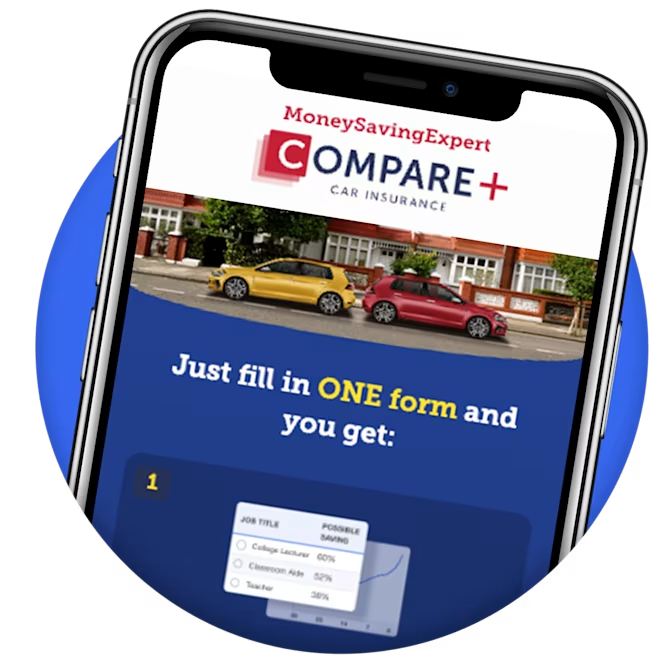
The first rule is to use multiple comparison sites, so you can quickly and easily compare hundreds of insurers. The policies and prices can vary between the sites, so while they may look similar on the face of it, the results you get can be different.
To help, our Compare+ tool gives you top MoneySaving tips as you complete the form, and will then show you results from MoneySupermarket (we're part of the same group). Just make sure to tick the "Telematics (black box)" box on the left hand side.
It'll then recommend getting quotes from other comparison sites such as Compare The Market* and Confused.com*. You can also try sites such as Gocompare and Quotezone* for even more quotes.
Keep on top of your car insurance
Want to know when the cheapest time to get car insurance is? The MSE App has a new tool called Bill Buster – give us a few details about your insurance policy and we'll track it, alert you when it's ending and when you should start gathering quotes to save.


Always check your policy carefully before buying
Don't get carried away by a cheap black box insurance price in isolation – always make sure the policy is right for your needs, including the add-ons. Always be 100% honest too – for example, letting the insurer know if you have any penalty points.
Comparison sites usually make assumptions to help speed up searches, so always look at any quotes carefully on the insurer's own website too.
It's also worth making sure that the insurance company is registered with the Financial Conduct Authority (FCA). This means it has to meet certain standards and have the FCA's permission to sell insurance, which is a regulated activity. The provider will usually say whether it's registered, but always check on the FCA register. All providers within our Compare+ tool are FCA-registered.
We hope you never need to, but here's the process to follow if you need to make a claim.
Want to learn more about car and motor insurance? Check out our other guides on the topic:
Young driver insurance | New driver insurance | Learner driver insurance | How to get cheaper car insurance | Cheap van insurance | Cheap motorbike insurance | Caravan insurance | Gap insurance | Multicar insurance
Black box insurance FAQs
Is black box insurance the same as pay-as-you-go car insurance?
While the terms 'black box insurance' and 'pay-as-you-go insurance' – also called 'pay-as-you-drive insurance' – are sometimes used interchangeably, they're not quite the same.
Black box car insurance | Pay-as-you-go car insurance |
|---|---|
The black box tracks factors such as speed, braking, acceleration, cornering, and the time of day you drive. | Instead of focusing on how you drive, the black box tracks how much you drive. |
Your premium is adjusted based on how safely you drive. | You pay a base rate plus a per-mile or per-minute charge. |
It's often aimed at young or new drivers looking to reduce high premiums. | Pay-as-you-go insurance is ideal for people who drive infrequently or only short distances. |
Some insurers combine both models, offering hybrid policies that reward both safe and low-mileage driving. Read our Temporary car insurance guide for more info.
How strict are black boxes?
How strict a black box is depends on your particular insurer and policy.
Some only use the data to offer a discount on your next policy when it's time to renew, while others may increase your premium or even cancel it for risky driving. In addition, some providers impose unofficial curfews, where driving at night can negatively affect your driving score. Check the policy for exact details before purchasing.
However, it's important to note that you're usually not penalised for occasional mistakes – it's consistent risky behaviour that will have an impact.
What are some common black box insurance rules?
Black box rules vary between insurers, so always check your own policy carefully. That said, some common black box insurance rules include:
-
No night-time driving. Some black box insurance providers may penalise you for driving at certain times – namely at night.
-
Set policy duration. The black box must remain in place and active for the entire policy period.
-
No tampering. You can't tamper with the telematics box.
What happens if you speed with a black box?
A black box will record any speeding and alert your insurer. However, your insurance provider generally won't pass this info on to the police unless you're involved in an accident. Regardless, not only is breaking the speed limit dangerous and against the law, but consistently doing so could lead to increased premiums or even cancellation of your insurance.
Most modern cars are also already fitted with their own 'black box', an event data recorder, which records crash data.
Can you remove a black box?
This depends on the type of telematics device being used. Whichever type it is, removing or turning off a black box before the end of your policy will invalidate it and could result in it being cancelled and you being charged a penalty fee.
That said, it's possible to remove a self-installed telematics device at the end of your policy (but always check with your provider before doing this). You'll typically be able to do so simply by unplugging it – your insurer will likely just ask you to return it by post.
You're unable to remove a hardwired, professionally installed black box without arranging for a dedicated engineer to do so on your behalf. Tampering with it yourself can lead to penalties or replacement costs. Your insurer should cover the black box removal costs at the end of your policy.
While you shouldn't remove or turn off a telematics device before your policy is over, you can cancel your insurance at any time if you no longer want the black box. Do note that this will also likely lead to you having to pay a cancellation and/or admin fee. See our full guide on how to cancel your car insurance.
Can I take my telematics data with me when switching provider?
No, you generally can't transfer your black box or its data to another insurance provider.
However, you should be able to transfer the telematics device if you've bought a new car, for example, and want to retain the same policy.
Can I add a named driver to my black box policy?
Most black box insurance policies allow you to have a named driver. However, the telematics device won’t know who is actually driving, so their driving behaviour will be reflected in your score. This isn't ideal if they drive poorly.
Although some black box apps do let you assign journeys to specific named drivers after they've been on them, you're unable to say that a particular driver will be driving in advance. It's also crucial that you're honest about who is driving when, or you could invalidate your policy.
Should learner drivers get black box insurance?
This can be a good idea. Just like qualified drivers, all learner drivers must have car insurance when behind the wheel. They must also be supervised by a qualified driver, and can either add themselves to this driver's existing policy or get their own.
A black box insurance policy can make sense if you decide to buy your own.
With this type of policy, your provider monitors your driving using a device installed in your car and prices your premium accordingly.
This means they enable learner drivers to demonstrate good driving behaviours right away, which can help them both to reduce future insurance costs and start to build a no-claims discount. This is especially valuable for learner drivers due to the high insurance costs they usually face.
Learn more about learner driver insurance in our guide.
Share this guide?