
Martin Lewis tells MPs: 'Have a single water social tariff, sort energy Standing Charges and stop confusion ruling'


MoneySavingExpert.com founder Martin Lewis delivered wide-ranging and important evidence – which was just the start – to the Commons Public Accounts Committee in a session on regulating key utilities. You can read and watch Martin's evidence to the cross-party MPs below.
Martin gave his evidence on Monday 29 June, along with Anne Pardoe of charity Citizens Advice and Ali Bell of consumer organisation the Consumer Council for Water. You can watch the full session on Parliamentlive.tv.
Watch: Martin Lewis to MPs: 'There's a huge amount of confusion'
Martin told the committee that across the energy, telecoms and water industries, "there's still a huge amount of confusion", for both vulnerable and non-vulnerable consumers. For example, he explained, different water companies set different eligibility criteria for financial help – some based on income, and others based on benefits. This makes giving people guidance on whether they could be eligible needlessly tricky, he told MPs.
Here's a clip of what Martin said:
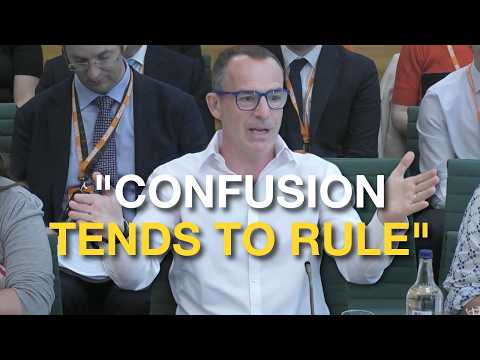

Transcript of what Martin said on sector-wide confusion
Labour MP Catherine McKinnell: "Where do you think the biggest challenges are for customers within the water, energy and broadband sectors at the moment, in your opinion?"
Martin Lewis: "I think there's still a huge amount of confusion, both for vulnerable people and non-vulnerable people across all of the different sectors. Some of that is caused by regulation. Some of that is caused by external circumstances. Some of that is caused by the way that companies operate.
"I have to say, I do think the situation is better than it was when I've done these things 15 years ago – I think there's been some improvement in behaviour and improvement in trust. An example of that would be 15 years ago I would never have told people to contact their company when they're in trouble – in the energy sector specifically – because I thought that they would behave as bad actors, and often did. And there was data on that.
"I think on that area it has changed, and I think that vulnerable customer activity has improved. I'll just do a brief bit on each.
"We have the energy market, where we have what was meant to be a backstop tariff for vulnerable customers that now [has] 60% of the population on it, the Energy Price Cap. That Energy Price Cap is operating on a time lag, so the fact that the Middle East conflict started in March and we saw worldwide wholesale rates rise in March is only going to hit people's bills on the 1 July. It will continue to hit people's bills in October and possibly next January.
"At the same time, fixes are getting cheaper, so you have a duality of market – one that's based on a five-month time lag, and one that's based on instantaneous wholesale prices. Vulnerable people can't and don't take advantage of the potential to fix right now. People who are on prepayment meters – there is no competition.
"So Ofgem rightly has made pre-payment cheaper for those who are Price Capped. It is now the cheapest way to pay. I think that was a good move. And so I get questions from the public: 'I'm on prepayment. Is it cheaper? Should I move?'. So I will give you my answer that I give to consumers:
"If you're going to stay on the Price Cap, you are better to stay on prepayment. If you can move off the Price Cap and you're able to engage in the market, there is a whole wealth of competition on Direct Debit that does not exist on prepayment.
"So those on Direct Debit who are willing to switch will pay materially, currently 17%, less [MSE: Martin mistakenly said 'more' when he meant 'less'] than those who are on prepayment meters, even though the prepayment meter is cheaper on the Price Cap. And the length of time it has taken me to explain that to you is an example of the complexity.
"If we look at mobile and broadband, which I hope you've got the report we've put out today. We have the Ofcom regulation to bring in transparency two years ago on the back of the above-inflation price hikes. Our examination of 47,000 tariffs shows 75% of people are paying more because of what Ofcom has done than they would have done otherwise.
"99% of people are paying more than if we'd done – and if you'll forgive the phrase - the bleedin' obvious and simply said, 'you cannot raise prices mid-contract, above inflation'. The obvious solution. Why we don't do the obvious is not obvious, because it's pretty obvious that's what we should have done.
"If we go for water, I mean water is a really interesting industry. Which has competition? No. Privatisation? Yes. And the worry is that we have the worst of both worlds when we come to that particular market. And if we take the social tariff, I do not understand why the Government did not universalise the social tariff.
"I mean, I take my job – I always look at, and I use this as an example, my job is mass communication. How do you communicate. How do I, on my television show, explain the social tariff? I have to say, 'If you're on a lower income, you may be eligible for a social tariff' – but I'm afraid I can't tell you what a lower income is because it's different with every water company.
"In some, it's defined by benefits, in some it's defined by income, in some it's defined by an income assessment. So basically my really rough rule of thumb – and I mean, why am I giving a rough rule of thumb? – is if you earn under about £26,000, check out if you can get a social tariff.
"But that's not good enough, because you know what happens? Someone goes and checks it out and they're on £23,000. They're told they're not eligible, and they say to everyone, 'it's crap. I wasn't eligible and he told me wrong because he said go and check'. And all I can do is say 'this is the level at which you can check.'
"So hopefully that gives you a broad spread of the different things going on in different industries, where confusion tends to rule, certainly amongst vulnerable customers and many not-so-vulnerable.
"And a big question for you is, how far do you spread the help up the net? Do we only look at the very lowest people on means-tested benefits? What about those on low and middle incomes who are struggling with these systems, too? I'll stop there."
Lower Standing Charges – 'by far and away the thing that drives people mad the most'
Standing Charges – which you pay just for the facility of having gas and electricity, even if you don't use any – currently make up around £315 of the average annual energy bill. Martin and MSE have long called for these charges to be lowered, as they penalise lower-use households and those looking to cut their usage.
Martin reiterated this ask to the committee, explaining that Standing Charges are "by far and away the thing that drives people mad the most". He added that two-thirds of complaints he gets on energy are related to these charges. Watch what Martin told the committee:

Transcript of what Martin said on Standing Charges
Martin: "Two-thirds of my mailbag on energy complaints is very simply about the Standing Charge.
"The moral hazard that you have to pay £315 a year just to have the facility of having gas and electricity, that we have older people who don't use gas for two-thirds of the year and are having to pay a daily charge for it. And the people who are lower users, who, if they reduce their usage, it doesn't make any difference because they're still paying the Standing Charge. That is by far and away the thing that drives people mad the most.
"And I always use the analogy, if I go to buy a book from a bookshop, they don't say, 'sorry, you have to be a member of the club and pay us each month in order to buy a book, because we have fixed costs'. My fixed costs are factored into the price of the book. Why do we have to have fixed costs factored into a daily charge and variable costs factored into a unit rate?
"The shift could be done, and I was very hopeful with Ofgem. We had long conversations that it was going to bring a dual price cap: low Standing Charge, high unit rate and the normal Standing Charge and lower unit rate. Which in my view, people who are on the Price Cap should be automatically shifted to whichever one is beneficial for them based on their prior years' usage with an opt-out basis if they chose not to.
"That was stopped, and then it was moved to the system of, 'we're going to allow switchers tariffs and mandate switchers tariffs, which have a lower Standing Charge'. Now, my big problem with that is that doesn't help anyone who's vulnerable because they're the people who don't switch, that the Price Cap was set up to protect in the first place. So switchers tariffs don't help.
"And then, we're going to trial switchers tariffs, and they'll be coming in spring. [Whistles.] Haven't seen any yet."
In September 2025, energy regulator Ofgem confirmed that all major energy suppliers should offer at least one low Standing Charge tariff to households – and that these wouldn't fall under the Price Cap. In February 2026, Ofgem's then-chief executive then revealed plans for a 'low or no Standing Charges' trial – but it doesn't appear progress has been made.
'We need a centralised 'Share Once' system for utilities'
Earlier this year, Martin and the charity he founded and chairs – the Money and Mental Health Policy Institute (MMHPI) – published new research showing that the majority of people struggling with their mental health are missing out on extra help from their utility companies.
Many firms – such as banks, energy suppliers and telecoms companies – offer extra support for people with mental health problems. But only 14% surveyed by MMHPI had told their financial services provider about their condition, largely due to how daunting the process can be.
Martin reiterated to the committee his and the MMHPI's calls for the Government to introduce a 'Share Once' system for those living with mental health problems to disclose their conditions to all the providers they use at once, in a safe, secure way (if they've consented to the service). Martin told the committee:

More support needed to promote telecoms and water social tariffs
The committee also discussed recent data from the National Audit Office (NAO), which show millions across the UK are missing out on social tariffs – typically offered to those on low income and/or benefits to help manage utility costs.
Martin told MPs he doesn't understand "why the Government did not universalise the social tariff," calling for improved signposting and accessibility, so vulnerable people are able to access social tariffs when they need them.
Ms Pardoe, policy head at Citizens Advice, also proposed an idea for increasing uptake of these tariffs during the session. She said: "What we're suggesting now that is in broadband – instead of a specific tariff, you could have a voucher for low-income consumers, for them to use to offset the cost of a package which actually works for them. At the moment, it's really difficult for people."
This would enable consumers to select broadband speeds and terms that work for them, rather than being tied into what's available at the time they qualify for a social tariff, which is often limited.
In a subsequent committee session held on the same day, chief executives from the telecoms, energy and water regulators – Ofcom, Ofgem and Ofwat, respectively – gave evidence on the same themes, saying they'd work with the Government and utilities companies to make their social tariffs more accessible.
'Do the bleedin' obvious' – ban mid-contract, above-inflation price hikes
During the committee session, Martin also raised exclusive research from MSE, published the same day, which found that millions of broadband and mobile customers have been clobbered by higher bills thanks to the telecoms regulator's mid-contract price hike solution.
Martin told the committee that he'd called on the Government and Ofcom to do "the bleedin' obvious" and ban mid-contract, above-inflation price rises altogether. "It's pretty obvious that's what we should have done," he said.




Share this guide?


 Latest weekly email











Clever ways to calculate your finances


